

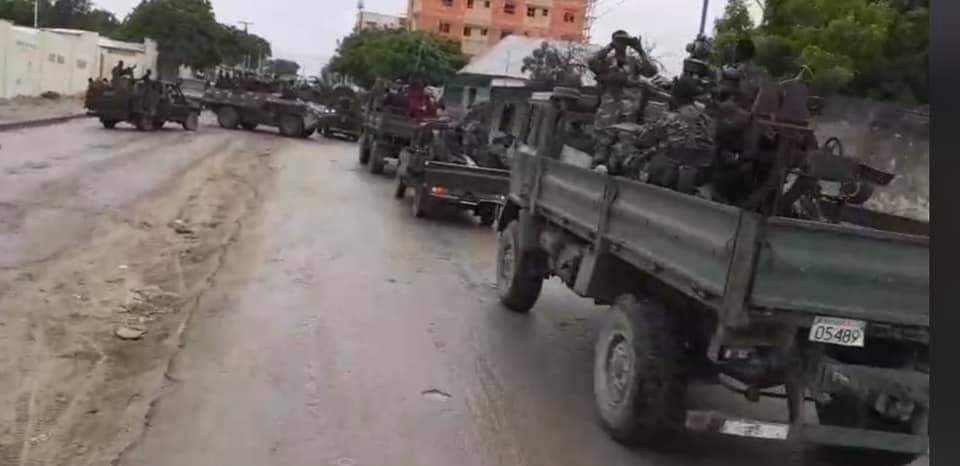

The political standoff in Mogadishu has once again heightened concerns regarding capital security, weapons proliferation among armed factions, and the overall feasibility of implementing a comprehensive disarmament framework in Somalia at a time when the Federal Government and political opposition remain locked in acute disputes over elections, constitutional revisions, and the scope of executive authority.
State security forces were recently deployed adjacent to the residences of prominent opposition leaders, including former President Sheikh Sharif Sheikh Ahmed and former Prime Minister Hassan Ali Khaire.
The National Intelligence and Security Agency (NISA) accused certain opposition figures of involvement in recent security incidents, while opposition leadership warned that troop movements risk provoking armed conflict.
The claims made by both sides have not been independently verified.
The primary strategic question is whether a politically and operationally viable disarmament framework can be executed at this time, given that Al-Shabaab maintains an active presence across parts of Somalia and numerous armed formations and security details remain aligned with various political factions.
Disarmament represents a formal security process aimed at reducing or collecting weapons held by civilians, informal militias, and non-state actors operating outside legal security structures.
It frequently serves as a component of broader Disarmament, Demobilization, and Reintegration (DDR) initiatives designed to register weapons, disband irregular militias, integrate eligible fighters into formal state armed forces, or provide viable economic alternatives.
However, in the Somali operational context, disarmament extends beyond the technical recovery of arms from specific groups.
It is intrinsically tied to state capacity, public trust, central-regional federal dynamics, and mechanisms for political dispute resolution.
If a disarmament campaign is perceived as an impartial rule-of-law measure applied uniformly across all illegal weapons holders, it can strengthen state consolidation.
Conversely, if opposition factions perceive disarmament as a selective effort targeting them exclusively while leaving other armed entities intact, building trust and cross-factional cooperation becomes exceptionally difficult.
This dynamic is particularly critical in Mogadishu, where political-military friction directly impacts civilian security, commercial transportation, trade, and daily life.
A primary structural obstacle hindering a nation-wide disarmament campaign is the ongoing counter-insurgency effort against Al-Shabaab.
A report published by the European Union Agency for Asylum (EUAA) in May 2026—evaluating security conditions between April 2025 and March 2026—noted that Al-Shabaab continues to control or exert significant operational influence across wide swathes of southern and central Somalia, retaining the capability to execute asymmetric attacks beyond its core areas of control.
This situation illustrates that the Somali government faces a dual operational challenge. On one front lies the ongoing war against Al-Shabaab, while on the other are internal security and political disputes among Somali factions. If state security resources and capabilities become consumed by internal political confrontations, serious concerns arise regarding the ability to secure territories liberated from Al-Shabaab and maintain security along critical transit corridors and major urban centers.
Conversely, the persistence of Al-Shabaab does not inherently mean that incremental disarmament measures are impossible.
The government can pursue lawful measures to regulate illegal arms within the capital while simultaneously sustaining counter-insurgency operations against the militant group.
The vital imperative is ensuring that such enforcement measures do not trigger fresh armed conflict that diverts security forces from primary operational mandates.
The June 2026 events in Mogadishu offer a clear example of the complexity surrounding this issue.
A report published by Reuters on June 5 indicated that clashes between state forces and armed groups aligned with the opposition caused gridlock and widespread disruption across parts of the capital.
The government subsequently stated that it had restored public order and disarmed the opposition-aligned groups involved.
The fundamental lesson derived from those events is that a ceasefire and a disarmament program are not synonymous.
Halting active hostilities can mitigate immediate casualties; however, unless underlying political disputes are resolved, standardized security protocols established, and a clear consensus reached on arms management, underlying tensions inevitably resurface.
Furthermore, disarming a specific faction outside the framework of a broad agreement trusted by all stakeholders raises serious concerns regarding impartiality and operational intent.
Such perceived selectivity heightens opposition resistance and severely complicates efforts to conduct peaceful arms collection.
The state bears the primary responsibility for protecting public safety, enforcing the law, and preventing illicit arms proliferation from disrupting national peace.
Where weapons are stockpiled outside legal authorization or an armed group poses an active threat to civilians, state security agencies possess a lawful mandate to intervene.
However, a strict distinction must be drawn between illicit weapons, standard arms held by state armed forces, and weapons deployed for the personal protection details of political figures.
Each category possesses a distinct legal status. The arms assigned to political protection details cannot be addressed without evaluating statutory provisions, threat levels, licensing frameworks, and the security rights of protected persons.
Consequently, disarmament measures executed against political opposition groups must not stem solely from political alignment or disagreement with the administration.
Any such program requires a transparent, codified legal framework applied impartially and subject to institutional oversight by competent regulatory bodies.
Should the government characterize an initiative as a public safety operation, it remains essential to provide public clarity regarding its legal foundation, scope, weapons registration procedures, and safeguards preventing the operation from degenerating into political intimidation.
Conversely, opposition leadership must clearly articulate protocols governing their security details and ensure those arms present no threat to the civilian population.
The foundational requirement is for the administration and opposition factions to convene a dedicated security dialogue isolated from broader electoral disputes.
This dialogue must explicitly define authorized weapon types, personnel entitled to carry firearms, permissible storage parameters, and the specific agency empowered to seize illicit arms.
The second step entails establishing a comprehensive arms registration system that categorizes official state military inventory, licensed VIP protection details, and weapons held by non-state entities.
Such a framework mitigates operational misunderstandings and prevents indiscriminate weapon seizures.
The third step mandates rigorous oversight and institutional accountability.
Disarmament operations must adhere strictly to statutory law, human rights standards, and civilian protection protocols.
Allegations involving operational abuse, property destruction, or unlawful detention require transparent, independent investigation.
Furthermore, national security strategy must not remain confined strictly to Mogadishu.
Given that Al-Shabaab maintains operational capabilities across broad swathes of the country, the government requires an integrated strategy linking urban center stabilization, transit route security, force augmentation, and administrative consolidation in newly liberated territories.
Without securing these areas, military gains cannot be translated into enduring national stability.
This imperative is reinforced by ongoing United Nations operations in Somalia addressing disarmament, demobilization, and community reintegration.
UNTMIS notes that it continues to support the Federal Government in formulating and executing an inclusive, human rights-compliant framework—specifically regarding the management of defectors from non-state armed groups, as well as Small Arms and Light Weapons and ammunition control.
If a disarmament operation is initiated during a period characterized by a mutual deficit of trust between the government and the opposition, several major risks emerge.
The respective sides may accuse one another of breaching agreements or weaponizing state security institutions to exert political pressure.
Should armed confrontations erupt, civilians bear the primary burden of casualties, particularly if engagements occur within densely populated urban quarters.
Another critical risk is the spillover of political friction into state security institutions.
National armed forces are required to operate strictly in accordance with statutory law, rather than fracturing along partisan lines to support competing political figures.
Should public and institutional confidence in their political neutrality erode, mounting a unified response to the nation’s primary security threats becomes severely compromised.
Conversely, if the government refrains entirely from enforcing measures to curb illicit arms, risks surrounding factional clashes and unregulated weapons employment will persist.
Therefore, the strategic imperative is neither to abandon arms control altogether nor to resort to force, but rather to establish a codified legal mechanism that reinforces security without provoking political instability.
Within the Somali context, localized or phased disarmament measures remain achievable in select sectors; however, comprehensive nationwide disarmament encompassing all armed entities presents an exceptionally complex challenge.
The persistent threat posed by Al-Shabaab, the proliferation of armed formations, ongoing friction between the administration and opposition factions, and the paramount necessity of protecting civilian populations collectively dictate that disarmament must be approached as a structured, long-term strategic endeavor.