

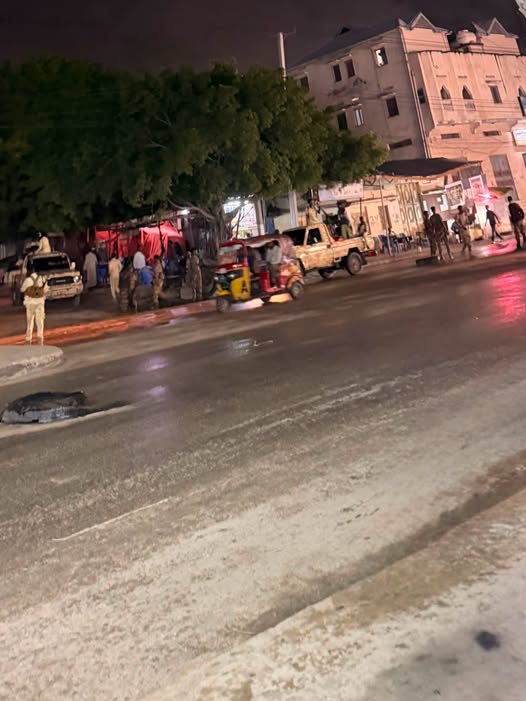

Security concerns are mounting in Somalia’s capital, Mogadishu, amid escalating political tensions between the federal government and opposition figures, particularly former President Sheikh Sharif Sheikh Ahmed and former Prime Minister Hassan Ali Khaire.
Reports of troop movements, road restrictions and an alleged plan targeting Sharif’s residence have heightened fears of a possible confrontation, although key claims remain unverified.
According to circulating reports, an officer identified as Ahmed Beeryare, reportedly serving in the Somali National Army’s reconnaissance and intelligence command, has been accused of agreeing to lead an operation allegedly targeting Sharif’s home.
The reports describe Beeryare as having close links to Mahad Salaad and claim he accepted the assignment after other officers declined.
These allegations have not been independently confirmed, and no publicly verified evidence has established that such an operation was formally planned.
The claims have emerged amid a dispute over statements by the National Intelligence and Security Agency (NISA) concerning an alleged attack on its personnel by members of Sharif’s security detail.
The agency accused armed men allegedly acting under Sharif’s orders of attempting to provoke a confrontation with its forces in Mogadishu’s Wadajir district.
Sharif’s office rejected the accusations, alleging instead that government forces had targeted his staff and restricted access to his residence.
Retired military officer General Mohamed Mohamud Koronto, a former commander of the Somali National Army’s 27th Division, criticised NISA’s account of the incidents.
In a sarcastic remark questioning the agency’s explanation, he said it would have been better for NISA to claim that Sharif had shot at himself inside his own home and that an investigation was underway, drawing a comparison with an earlier case involving General Mahad “Shub.”
His comments reflect the deep divisions over the credibility of security agencies’ statements and the handling of allegations involving opposition figures.
Koronto has also been associated with the Badbaado Qaran forces, which opposed the administration of former President Mohamed Abdullahi Farmaajo during the political and security crisis surrounding Somalia’s previous electoral dispute.
Meanwhile, reports from Mogadishu indicate that armed personnel have been deployed along several important roads, with restrictions on the movement of vehicles and pedestrians in some areas.
Residents have reportedly expressed concern over the military presence and alleged blockages affecting certain roads and side streets.
However, the number of troops involved, the reasons for their deployment and their precise locations have not been independently established.
Sharif’s residence and the home of former Prime Minister Hassan Ali Khaire have also featured in reports concerning opposition leaders’ security concerns.
The reported deployments have fuelled speculation that the political dispute could take on a more serious security dimension, but there is insufficient verified information to establish whether the movements are connected to a coordinated operation against opposition figures.
Banadir Regional Governor Abdifatah Omar Halane, widely known as Mungaab, was also quoted as issuing a warning directed at those he described as political opponents resisting progress.
“Those who are backward and sit at home—if they make even a small move against Mogadishu’s security, they will be met with a much stronger response,” he reportedly said.
The remarks have been interpreted by some as a warning to opposition politicians, although their precise context and intended targets remain unclear.
The developments come as Somalia faces renewed political friction over governance, security and the country’s electoral process.
With government officials and opposition figures exchanging accusations, observers face the challenge of separating verified incidents from claims circulating amid the political standoff.
A peaceful resolution will depend on restraint from all sides, transparent investigations into reported security incidents and the use of lawful political dialogue rather than force or intimidation.
Protecting civilians and preventing political disagreements from triggering armed clashes remain critical to maintaining stability in the capital.