

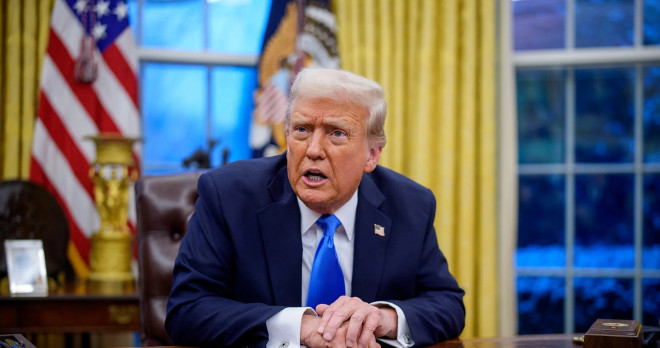

U.S. President Donald Trump delivered a speech sharply critical of immigrants originally from Somalia and Haiti during a political rally in Youngstown, Ohio, focusing his address on immigration enforcement and Republican Party platform policies.
Trump specifically targeted the Somali community residing in the state of Minnesota and Haitian residents living in the city of Springfield, Ohio.
He accused both diaspora communities of causing disruptions in the United States, utilizing his remarks to build support for strict administration policies aimed at curbing immigration and tightening residency enforcement.
The U.S. President stated that unless action is taken against conditions he characterized as problems in Minnesota, similar issues could emerge in Ohio.
“If you want to save Ohio from the looting, robbery, and destruction happening in Minnesota, we are going to stop it,” Trump declared at the rally, reinforcing his sharp criticism of immigrant communities.
Trump’s statements form part of the broader national political debate in the U.S. concerning immigration, public safety, and civil rights.
However, generalized allegations leveled against an entire diaspora community do not establish that all members of that group are involved in the alleged activities.
Trump also reiterated previous controversial claims concerning Haitian residents in Springfield, alleging that they were consuming domestic pets.
These allegations spread widely during the 2024 U.S. presidential debate, sparking intense discussion at the time regarding their accuracy.
Reports and statements issued by local officials confirmed that no evidence was found to substantiate claims alleging that Haitian immigrants were consuming domestic pets.
In his speech, Trump declared that the residents of Springfield are getting their town back, praising measures enacted by his administration to restrict immigration and tighten the legal status of Haitians residing in the United States.
These remarks have reignited debate surrounding the rhetoric utilized by American politicians regarding immigrants and the broader impact such statements exert on targeted communities.
Minnesota’s Somali community targeted in Trump’s remarks. Trump dedicated a significant portion of his address to criticizing the Somali community in Minnesota, home to a large population of Somali immigrants in the United States.
The President used derogatory language to attack Somalis, describing them as low-IQ individuals and employing language aimed at disparaging their appearance and living conditions.
In recent times, Trump has consistently criticized the Somali community in Minnesota, weaving these attacks into national political debates concerning immigration, government assistance programs, and the role of immigrant populations in American politics.
Conversely, Somalis in Minnesota represent an integral part of the state’s social fabric, contributing actively to commerce, education, public services, and politics.
Consequently, generalized rhetoric targeting an entire community provokes critical debates regarding discrimination, political representation, and the protection of civil rights for citizens and residents alike.
Trump’s remarks came on the same day that—according to reported details—U.S. homeland security officials executed a search at the residence of Ilhan Omar, a Democratic congresswoman originally from Somalia who represents a district in the state of Minnesota.
Ilhan Omar has long been among the most prominent politicians in the United States, particularly regarding debates surrounding immigration, refugee rights, and domestic policy. She is also among the public figures whom Trump has repeatedly and sharply criticized.
However, further details regarding the underlying authorization for the search at Omar’s residence, the specific agency executing the warrant, and any potential relationship to Trump’s public statements were not substantiated in the provided source material.
Consequently, it is unwarranted to treat the two events as directly linked without confirming factual evidence.
Trump’s address formed part of his broader political campaign efforts supporting Republican Party candidates ahead of the U.S. midterm elections.
The President utilized the rally platform to address his supporter base on immigration enforcement, public safety, and platform policies intended to consolidate voter support for his party.
According to reported rally details, Trump specifically campaigned in support of Senator Jon Husted, who faces a competitive electoral challenge from Democratic politician Sherrod Brown.
Immigration policy remains among the primary ideological dividing lines between the two major American political parties.
Republicans generally prioritize border security enforcement and curbing undocumented immigration, whereas Democrats hold varied perspectives on immigration management frameworks, even as individual politicians across both parties endorse stringent enforcement measures.
Trump leveraged his address to criticize immigrants in order to reinforce his core political messaging, citing conditions in Minnesota and Springfield as illustrative examples to support his perspective on immigration policy.
It is evident that immigration will remain a primary battleground issue in American politics, with the public rhetoric of political leaders continuing to exert significant influence over public perception of immigrant communities and the broader debate surrounding the future direction of national policy.