

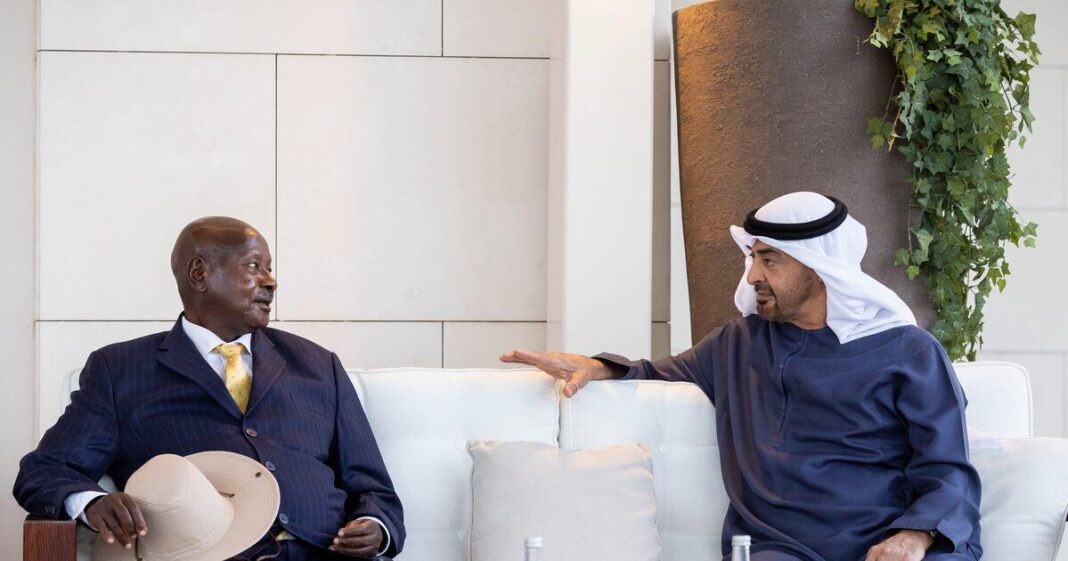

A report published by the Baraza Brief platform presented serious allegations suggesting that the United Arab Emirates pledged nearly 500 million dollars in funding to Uganda to withdraw its troops from Somalia.
This development has sparked questions regarding the geopolitical and economic influence struggles waged by foreign nations in Somalia, particularly the competition surrounding major infrastructure projects pursued by Turkey in the country.
The report stated that Abu Dhabi offered financial backing and investment to Uganda, linking this step to Emirati regional interests and Somalia’s deepening relationship with Turkey.
However, the allegations concerning this funding have not received independent verification. No official statement exists confirming that the UAE provided or promised the alleged sum to Uganda, nor that Uganda’s troop withdrawal decision stemmed from such an agreement.
Uganda Announces Troop Withdrawal Plan
Uganda deployed troops to Somalia in March 2007, becoming the first nation to contribute to the African Union mission, AMISOM. For nearly twenty years, Ugandan forces have remained an integral component of the war against Al-Shabaab and the defense of the Somali government.
Nevertheless, on November 2, 2026, Reuters reported that Uganda had initiated the repatriation of its military personnel from Somalia, with a phased plan targeting the complete withdrawal of all Ugandan troops by the end of 2027.
Ugandan military spokesperson Colonel Chris Magezi stated that troops stationed under bilateral agreements concluded with the Federal Government of Somalia would be repatriated first, while forces operating under the AUSSOM mission would draw down gradually.
Reuters noted that Uganda maintains approximately 4,500 personnel in Somalia under AUSSOM, though the exact troop strength under direct bilateral pacts was not explicitly specified.
This indicates that Uganda’s departure will not occur abruptly as a single event, but rather unfold through distinct, staged phases.
What is the Basis of Allegations that the UAE is Financing Uganda’s Withdrawal?
A November 3 report by Baraza Brief stated that local sources indicated the UAE offered Uganda funding approaching half a billion dollars, coupled with investment pledges and project commitments.
The report advanced the perspective that the UAE seeks to curtail the African Union’s military footprint in Somalia, linking this objective to Turkish interests and active projects within the country.
The analysis also suggested that the UAE aims to exert influence over Somalia’s security trajectory by leveraging relationships with regional actors and Somali political factions.
However, it remains vital to clarify that claims regarding the $500 million transaction rely on unnamed sources. Baraza Brief presented no documentary agreements, transaction records, or official governmental communiques from Uganda or the UAE substantiating these assertions.
Consequently, it cannot be definitively asserted that the UAE disbursed these funds or directly precipitated Uganda’s decision.
Turkey and UAE: Visible Influence Rivalry in Somalia
In recent years, Somalia has evolved into a theater where overlapping political, economic, and security interests of diverse external powers converge.
Turkey maintains close relations with the Federal Government of Somalia, driving bilateral cooperation across defense, military training, energy infrastructure, technology, and strategic developmental projects.
Conversely, the UAE maintains commercial and economic interests spanning various regions of Somalia, including ports and select federal member state administrations.
A Chatham House international affairs institute report issued in October 2026 observed that Turkey and the UAE remain two of the most influential external actors shaping Somalia’s political landscape.
The report highlighted that Turkey aligns closely with the Federal Government, whereas the UAE engages administrations and political factions contesting select policies originating from Mogadishu.
This dynamic illustrates that internal Somali disputes are rarely confined to domestic political actors, but frequently intersect with the competitive ambitions of regional and international powers.
Somali Offshore Petroleum Exploration Attracting Global Scrutiny
Among major Turkish-backed initiatives in Somalia is offshore seismic exploration and petroleum drilling.
This project holds paramount importance for Somalia’s economic future, as verifiable commercial hydrocarbon extraction could establish an entirely new revenue stream for the state.
Simultaneously, Somali maritime petroleum possesses immense strategic significance, attracting corporations and states vying for access to the nation’s natural resource wealth.
Baraza Brief linked this initiative to its asserted Turkey-UAE geopolitical rivalry. However, no independent evidence indicates that Uganda’s withdrawal plan was specifically engineered to disrupt Somali petroleum exploration or drilling operations.
Warsheekh Space Launch Center Emerges as Another Strategic Project
A secondary initiative cited in the Baraza Brief report is Turkey’s planned aerospace launch facility near Warsheekh in the Middle Shabelle region.
This project relates to aerospace technological cooperation between Somalia and Turkey, reportedly forming part of Ankara’s broader roadmap to develop indigenous satellite-launch capabilities.
While this project offers Somalia opportunities for technological acquisition and expertise, it simultaneously elevates the strategic prominence of the nation’s coastline.
Lower Shabelle Confronts Acute Security Apprehensions
The primary anxiety confronting the Somali populace regarding the withdrawal of Ugandan forces centers on regional security implications, particularly concerning the Lower Shabelle region.
Ugandan troops have long constituted a foundational pillar of anti-Al-Shabaab operations, with their forward bases and deployment posture serving as a critical shield safeguarding the capital and securing southern transit arteries.
Reuters reported that an internal AUSSOM communication directed to the United Nations Support Office in Somalia (UNSOS) on October 31 expressed apprehension that the Ugandan retrograde could leave sectors of Lower Shabelle acutely vulnerable to insurgent infiltration.
Somali State Minister for Foreign Affairs Ali Omar informed Reuters that while the prevailing security situation was not immediately catastrophic, an unmanaged, abrupt withdrawal risked generating severe instability.
An Associated Press dispatch noted that AUSSOM is planning to assume control of four forward operating bases near Mogadishu to prevent Al-Shabaab from exploiting positions vacated by Ugandan forces. That report also underscored that ultimate administrative responsibility for remaining vacated installations has not yet been fully delineated.
This reality demonstrates that the drawdown blueprint transcends diplomatic maneuvering, directly impacting indigenous Somali force capacity and the overarching future of the counter-insurgency campaign.
AUSSOM Funding Deficits as a Paramount Official Driver
While the Baraza Brief report highlighted allegations concerning the UAE, documented financial deficits represent a clearly verifiable structural impediment.
The AUSSOM mission requires sustained, predictable financing to cover personnel remuneration, fuel logistics, rations, water supply, transport infrastructure, medical services, and operational sustainment.
Reuters emphasized that Uganda faced mounting challenges regarding mission funding as international donor support receded. This financial reality constitutes a core rationale explaining the necessity of sustainable funding architectures to maintain operational continuity.
Accordingly, two distinct dimensions must be evaluated separately: official structural drivers tied to mission financing deficits and Ugandan drawdown schedules versus the Baraza Brief allegations regarding external financial incentives. These factors must not be conflated.
Imperatives Confronting the Federal Government of Somalia
The departure of Ugandan forces imposes a profound national security responsibility upon the Federal Government of Somalia regarding indigenous force preparation.
It remains imperative to institute a clear operational plan identifying vacated bases, designating relieving units, procuring necessary logistical and materiel support, and establishing protective frameworks for local civilian populations.
Furthermore, the Federal Government and federal member states must harmonize security strategies, recognizing that the campaign against Al-Shabaab cannot succeed through fragmented regional approaches.
Persistent political friction between the central government and federal member states threatens to undermine security coordination at a historic juncture defined by major international troop realignments.
The Chatham House assessment similarly cautioned that external power rivalries combined with internal political discord risk exacerbating instability across Somalia.