

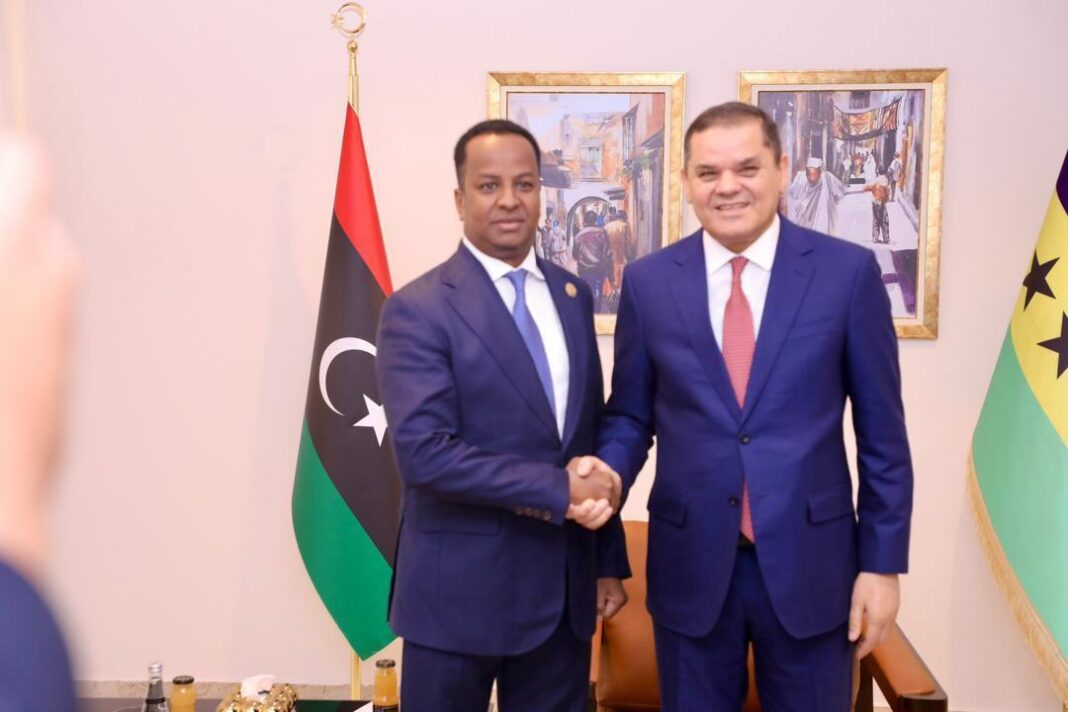

The Government of Libya has announced discussions held with Somalia regarding a plan to open a branch of the Sahel-Saharan Bank for Investment and Trade (BSIC) in Mogadishu.
If realized, this step could transform the financial relations between the two countries, while opening new opportunities for Somali merchants and financial institutions.
This news emerged following a meeting in Tripoli on November 8, 2026, between the Minister of Finance of the Government of National Unity of Libya, Rashid Abu Ghuffa, and Somalia’s Minister of Foreign Affairs and International Cooperation, Abdisalam Abdi Ali.
According to the Libyan News Agency, the two sides discussed strengthening economic and financial cooperation, particularly the legal conditions and procedures for opening the bank branch in Mogadishu.
Interestingly, details regarding the bank branch opening plan first emanated clearly from the Libyan side, with their official media broadcasting the meeting and the topics discussed.
The Somali Foreign Minister also met in Tripoli with the Chairman and General Manager of the BSIC bank, Dr. Ahmed Omar Al-Hadi, to discuss direct cooperation between the bank and Somali banks.
That meeting focused on establishing partnerships between BSIC and Somali financial institutions, expanding investment opportunities, and exploring how Somalia can benefit from developmental projects funded by the bank in various African nations.
This indicates that the discussions are not limited merely to opening a branch in Mogadishu, but are part of a broader strategy to strengthen banking ties and investment cooperation between Somalia and regional financial institutions.
What is the Sahel-Saharan Bank?
The BSIC bank is a regional financial institution established on April 14, 1999, following an agreement among member states of the Community of Sahel-Saharan States (CEN-SAD), signed in Tripoli, Libya.
The bank engages in banking services, domestic and international trade financing, loan provisions, and support for economic development projects.
According to the bank’s data, its priority sectors include agriculture and agro-processing, infrastructure, telecommunications, transportation, tourism, and international trade.
Consequently, the plan for a Mogadishu branch is not just about a new bank opening an office in Somalia, but could serve as a conduit for Somali merchants and corporations to access financial services and investment opportunities outside domestic markets.
What Can Somalia Gain?
If this plan is successfully implemented, Somalia could reap several potential benefits:
* **Trade Financing:** Somali merchants could secure opportunities to expand their commerce, particularly ventures linked to African and North African markets.
* **Support for Domestic Banks:** Cooperation between BSIC and Somali banks could contribute to enhancing financial services, inter-banking connectivity, and new commercial prospects.
* **Financing Large-Scale Projects:** The bank possesses recognized expertise in financing infrastructure, agriculture, transportation, and commerce. If Somalia leverages these services, attracting capital to support economic projects becomes feasible.
* **Job Creation and Economic Growth:** Establishing a new branch could generate direct and indirect employment, while boosting competitiveness and banking services nationwide.
However, these benefits represent potential opportunities rather than finalized agreements or immediate financial injections.
What Makes the Arrival of an African Bank in Mogadishu Significant?
Somalia has recently intensified efforts to expand its linkages with international financial institutions, seeking to strengthen its banking sector, secure investment, and increase commercial avenues.
The BSIC bank maintains direct ties with CEN-SAD, a regional bloc uniting 25 African states, of which Somalia is a member. Established in 1998, the organization’s objectives include economic integration, trade, and development among member nations.
This dynamic grants Somalia an opportunity to collaborate closely with a financial institution operating across numerous African states, shifting beyond reliance on bilateral economic ties with isolated nations.
What Remains Pending?
Despite the announced discussions, several vital aspects lack detailed clarification.
These include the official timeline for opening the Mogadishu branch, the planned capitalization amount for country investments, the specific service portfolio, managerial staffing, and operational regulatory frameworks.
Furthermore, introducing a foreign banking branch requires finalizing legal procedures and securing approvals from relevant Somali authorities, notably the regulations and stipulations enforced by the Central Bank of Somalia.
Distinguishing between preliminary branch opening talks and an actually completed launch remains crucial. To date, publicized information indicates parties are negotiating conditions and procedures, with no officially confirmed launch date.
Somalia and Libya Expanding Economic Ties
The banking discussions coincide with a period where both governments seek to reinforce economic and commercial relations.
The meeting between Somalia’s Foreign Minister and Libya’s Finance Minister also addressed increasing the export of Somali livestock to Libyan markets, presenting a promising avenue for Somali livestock traders.
Conversely, the subsequent meeting between the Somali Foreign Minister and BSIC leadership demonstrated Somalia’s pursuit of direct engagement with the bank, alongside integrating domestic banks into the cooperative framework.
The initiative to open a Sahel-Saharan Bank branch in Mogadishu could constitute a vital milestone in boosting Somali-Libyan economic relations, particularly if it yields tangible investments, quality banking services, and substantial backing for Somali merchants.
Nonetheless, the success of this plan does not rest solely on opening a physical office in Mogadishu. Its significance will be dictated by the volume of investments introduced, the depth of collaboration with domestic banks, and the tangible dividends delivered to Somali traders and society.
All eyes remain fixed on the subsequent steps taken by both governments and the definitive decision regarding the branch’s establishment.