

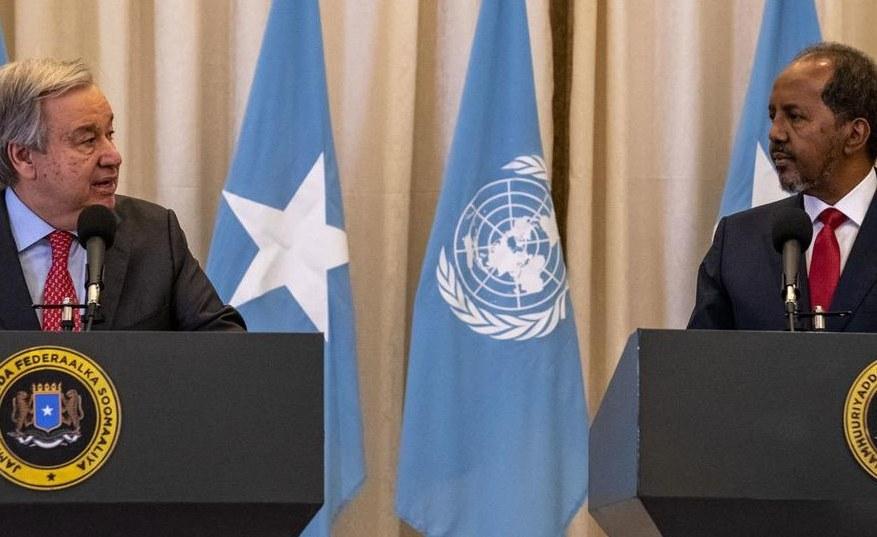

Somalia occupies a highly strategic geographic position that commands the vital interests of regional states and global superpowers.
Its extensive coastline, maritime ports, critical choke points along the Red Sea and the Gulf of Aden, and the ongoing counter-insurgency campaign against Al-Shabaab have rendered the nation a primary theater where numerous foreign powers actively project political, economic, and security influence.
This geopolitical reality has reignited intense debate regarding the motives behind foreign states extending financial and security backing to President Hassan Sheikh Mohamud’s administration, particularly as Somalia grapples with a severe domestic crisis concerning the constitutional term limits of federal institutions and a landmark Supreme Court ruling.
The central question persists: Are foreign governments supporting Somalia’s stability and state-building enterprise, or are they primarily safeguarding their own strategic and political self-interests?
Political friction in Somalia has escalated steadily since disputes erupted over constitutional amendments and the extension of federal institutional mandates.
On November 5, 2026, the Supreme Court issued a definitive ruling addressing a legal petition filed by former President Sharif Sheikh Ahmed. According to reports by the Associated Press, the court ruled that the President’s constitutional term of office expired on May 15, 2026, while the Parliament’s mandate concluded on April 14, 2026.
Furthermore, the court decreed that the newly enacted term extensions cannot be automatically applied to incumbent officeholders, granting political stakeholders a strict 30-day window to negotiate a consensual electoral framework, with national elections mandated to take place within 90 days. While the federal government and opposition factions remain deeply divided over the implementation of this verdict, profound questions linger regarding how the ruling will be enforced.
This political deadlock is of paramount concern to Somalia’s international partners, who retain a vested interest in preventing the nation from plunging into a systemic crisis that would jeopardize domestic security and compromise foreign operational footprints.
Why Do Foreign States Fund Somalia?
International governments and multilateral bodies supporting Somalia do not share a monolithic agenda. While certain actors prioritize counter-terrorism and regional security, others focus on commerce and foreign direct investment, and some seek to project geopolitical leverage across the Horn of Africa.
Somalia boasts an extensive coastline fronting the Indian Ocean and the Gulf of Aden. Its positioning along major global maritime corridors makes it indispensable for international shipping lanes and global commerce.
Additionally, international partners remain acutely concerned that an resurgent Al-Shabaab would pose an existential threat to domestic stability and regional security across neighboring states.
Foreign powers are also intent on preserving commercial agreements, investment portfolios, port concessions, and bilateral military cooperation frameworks established within Somalia.
Foreign Aid and the Fiscal Dependency of Somalia’s Budget
External financial assistance wields profound influence over Somalia’s macroeconomic stability. According to the federal government’s 2026 budget framework, projected domestic revenues and anticipated grants totaled approximately $1.36 billion, with external grants accounting for an estimated $878.8 million.
This indicates that foreign aid comprised approximately 64.7 percent of the overall projected budget revenues and grants, underscoring Somalia’s enduring structural reliance on international assistance.
Nevertheless, these funds are not remitted directly to the presidential palace or the executive branch. Portions are integrated into the national budget, while other tranches are administered directly by international organizations to execute public health, education, developmental, and security projects.
While external financial support assists the government in delivering public services and sustaining state functions, it simultaneously engenders structural dependency in the absence of robust domestic revenue mobilization and institutional accountability.
Turkey: Security, Investment, and Strategic Influence
Turkey stands out as one of the most prominent external actors in Somalia. Bilateral relations are anchored in military cooperation, institutional training programs, direct investment, and major economic infrastructure projects.
Ankara operates a major military training base in Mogadishu, manages critical municipal and logistical infrastructure such as the airport and seaport, and maintains close cooperation in maritime security and petroleum exploration.
A Chatham House analysis published on October 16, 2026, observed that Turkey functions as a pivotal external arbiter in Somali politics, maintaining close alignment with the federal government. While Turkish officials maintain that their interventions exclusively support legitimate Somali state institutions, various opposition figures have questioned Ankara’s neutrality amid the prevailing political crisis.
It is evident that Turkey’s engagements in Somalia extend far beyond humanitarian assistance. Maritime security, commercial investment, energy exploration, and a durable strategic footprint in the Horn of Africa collectively define this multifaceted relationship.
The United Arab Emirates: Ports and Political Networks
The United Arab Emirates maintains extensive commercial and investment interests in Somalia, concentrated primarily in port infrastructure and regional development. Emirati corporations hold strategic investment and operational ties with ports in Bosaso and Berbera, alongside parallel engagements with various Somali regional state administrations.
In January 2026, the Federal Government of Somalia formally announced the cancellation of security and defense cooperation agreements concluded with the UAE, citing overriding imperatives of national sovereignty.
Chatham House analyses have highlighted that while Turkey maintains a close alliance with the federal government, the UAE cultivates diversified relationships across various regional administrations. This divergence in foreign alignment underscores the broader competition for external influence inside Somalia.
Egypt: Defense Cooperation and Counter-Balancing Ethiopia
Egypt maintains strong political and defense ties with Somalia. Cairo is strategically invested in projecting its presence within the Horn of Africa, particularly against the backdrop of its long-standing Nile water dispute and diplomatic impasse with Ethiopia concerning the Grand Ethiopian Renaissance Dam (GERD).
For Egypt, Somalia represents a vital geopolitical anchor situated along strategic maritime avenues, whereas Cairo offers Mogadishu a valuable partner for military cooperation and diplomatic advocacy.
However, these bilateral ties must be evaluated through formal agreements and verified state actions, avoiding the assumption that every diplomatic maneuver executed by Egypt inside Somalia is exclusively tied to its rivalry with Addis Ababa.
The United States and the European Union: Regional Security and Stability
Washington provides critical support to Somalia centered on counter-terrorism operations, military force development, and security stabilization. United States strategic priorities dictate denying extremist networks a permanent territorial sanctuary from which to launch regional and international attacks.
Similarly, the European Union provides substantial financial backing to the African Union peacekeeping mission in Somalia (AUSSOM). In April 2026, the EU announced a €75 million allocation dedicated to the military component of the mission to enhance operational readiness and civilian protection protocols.
Underpinning the support of these Western allies is the shared objective of enabling Somali security forces to progressively assume independent responsibility for national defense.
Are Foreign Powers Tolerating Illegality in Somalia?
This pressing inquiry is frequently raised by opposition figures and domestic political analysts, driven by the observation that international partners continue diplomatic and financial engagement with the administration despite profound legal controversies surrounding executive term limits.
However, no empirical evidence suggests that donor governments have coalesced around a deliberate strategy to sustain Somalia under unconstitutional conditions.
It remains imperative to distinguish between support for the continuity of the Somali state and endorsement of the current political leadership. External actors may continue funding institutional security, public health, and social services without implying tacit approval of every unilateral decree issued by the executive branch.
When a foreign government is perceived as backing actions that contravene a binding judicial ruling, rigorous scrutiny must be applied to interrogate its underlying motivations, strategic gains, and potential ramifications for Somali sovereignty.
Why Foreign Powers Exercise Caution Amid Political Turmoil
Major international powers harbor critical national interests that they seek to insulate from domestic shocks. Political instability in Somalia directly threatens security pacts, commercial investments, port operations, and ongoing counter-Al-Shabaab military campaigns.
Consequently, many foreign capitals frequently prefer discreet diplomatic back-channel mediation over public condemnations of political stakeholders.
The October 2026 Chatham House assessment warned that intense geopolitical competition among external powers risks exacerbating domestic fragmentation within Somalia. The report specifically singled out Turkey and the UAE as influential external actors whose divergent regional rivalries intersect directly with current internal polarization.
Is Somalia Vulnerable to Proxy Competition Among External Powers?
Somalia’s prime geopolitical location renders it a prime target for competing global and regional ambitions. Its maritime ports, offshore hydrocarbon reserves, fisheries, maritime security corridors, and strategic sea-lanes continuously attract intense foreign investment and interstate rivalry.
The gravest systemic risk materializes when domestic Somali political elites leverage international rivalries to advance parochial factional interests. If the federal government and regional member states affiliate with opposing foreign patrons, internal political fractures risk deepening significantly.
Such dynamics threaten national cohesion, potentially reducing Somalia to a proxy arena where external states contend for hegemony.
Imperatives for the Federal Government and the Opposition
It remains paramount that the federal government and opposition factions resolve their disputes through constructive dialogue and established legal frameworks. The Supreme Court’s ruling demands a substantive, institutional response that steers the nation away from violent confrontation or severe political destabilization.
Furthermore, the Somali public retains an absolute right to transparency regarding bilateral agreements concluded with foreign states, the allocation of external funds, administrative oversight mechanisms, and the strategic obligations demanded of Somalia.
International partners extending support to Somalia are likewise expected to strictly respect national sovereignty, the independence of the judiciary, and the democratic aspirations of the Somali people.