

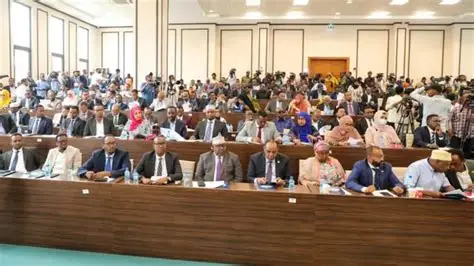

A session of the House of the People of the Federal Parliament of Somalia was marked by heated debate, sharp exchanges, and procedural friction among lawmakers.
The legislative agenda focused on proposed amendments to the Central Bank Act, the national currency’s strategic role, alignment with Islamic jurisprudence principles, and the broader constitutional framework.
Various MPs took the floor to express divergent viewpoints regarding the bill under consideration, while others voiced criticism over parliamentary management and the leadership’s handling of floor proceedings.
Debates also addressed public socio-economic conditions, the regulatory authority of the Central Bank, safeguarding national resources, regional developments concerning Puntland, and allegations that certain legislators faced restrictions in fully voicing their positions.
Member of Parliament Ilkacase underscored the bill’s critical importance, arguing that a sovereign currency represents far more than a medium of exchange, functioning as a primary symbol of national sovereignty and independence: ‘This law is vital, and the currency is a symbol of state sovereignty,’ MP Ilkacase stated.
The legislator further addressed economic pressures facing citizens, particularly low-income populations struggling to access transactional currency, emphasizing that citizens require a sovereign tender to meet daily needs.
Continuing his submission, he noted that the Central Bank currently operates predominantly in foreign exchange—specifically the US dollar—framing this as a compelling argument for establishing a fully functional national monetary architecture.
This debate illustrates the priority parliamentarians attach to the future of Somalia’s monetary system, the institutional authority of financial regulatory bodies, and the legal role of national currency within the economy.
Legislative discussions surrounding the national currency necessitate a clear strategy for macroeconomic stability, Central Bank operational capacity, inflation control, and building public trust in the financial system.
Another central point highlighted by lawmakers was ensuring legislative conformity with Islamic principles.
‘The currency law must be grounded in Islamic jurisprudence,’ one MP remarked during floor arguments.
This position reflects a demand among several legislators that financial and legal statutes adhere to Islamic principles alongside standard economic framework design.
The bill proposing amendments to the Central Bank of Somalia Act (Law No. 130 of April 20, 2012) had previously been introduced and processed through parliamentary legislative procedure.
The debate surrounding the bill highlights that parliamentarians maintain fundamental questions and divergent perspectives regarding clauses to be incorporated, provisions requiring amendment, and mechanisms for ensuring statutory alignment with the Provisional Constitution of Somalia.
Deliberations periodically veered away from the technical provisions of the legislation, with several lawmakers voicing criticism regarding the leadership’s management of the sitting.
Member of Parliament Sadaq sharply criticized the conduct of the Second Deputy Speaker of the House of the People, Abdullahi Omar Abshirow, demanding that he vacate the chair: ‘This man must leave the parliamentary session.
He speaks dismissively on his phone, ignores parliamentarians, and should return to his office,’ MP Sadaq asserted.
This exchange underscored the severity of the friction regarding floor management and the strained dynamic between parliamentary leadership and specific legislators.
Another lawmaker echoed concerns regarding the presiding leadership, contending that parliamentarians remain dissatisfied with session management, pointing to broader disputes over leadership authority and the procedural handling of points of order.
These criticisms underscore the imperative of governing House sittings strictly in accordance with parliamentary standing orders, granting lawmakers equal opportunity to air their floor submissions while respecting the leadership’s prerogative to maintain order and procedural integrity.
Member of Parliament Yusuf Hussein Ahmed Gamadiid broadened the debate to encompass the country’s overall constitutional situation, asserting that Somalia faces a broader constitutional crisis: ‘The country is navigating a constitutional crisis, and the provisions referenced in this bill must be removed,’ the MP stated.
His remarks reflect deep concerns over specific clauses embedded within the proposed bill and their compatibility with the Federal Constitution.
Constitutional disputes have recently emerged as a central flashpoint in national politics, driven by competing interpretations of constitutional provisions, institutional authorities, and the verification of legislative constitutionality.
MP Gamadiid insisted that the contentious provisions undergo formal legal review rather than advancing legislation burdened by unresolved constitutional concerns.
This dynamic demonstrates that parliamentary debates extend beyond monetary and economic policy, touching directly upon core questions of national institutional legitimacy and legislative jurisdiction.
The session concluded with calls for formal apologies and a re-evaluation of inter-institutional working relationships during legislative proceedings.
Chairman Jama and Member of Parliament Gaaraxo addressed an issue concerning an official apology, with the party offering the apology stating: ‘I issue a full apology, yet I maintain my substantive reservation on the matter.’
This remark underscores an effort to delineate between issuing a formal procedural apology and preserving a legislator’s right to express opposition on unresolved substantive issues.
Concurrently, exchanges arose regarding Cabinet Minister Xaange and his designated seating within the parliamentary chamber.
Chairman Jama was quoted as directing: ‘The Minister should take a seat among the parliamentarians and vacate his current position.’
This instruction became part of the verbal exchanges among officials, though the complete context behind the seating dispute remains unclarified.
Several floor statements touched upon legislative independence and the ability of lawmakers to express political viewpoints.
It was asserted that certain parliamentarians operate as ‘hostages’—an allegation highlighting claims that some members face constraints in freely executing their constitutional duties.
Every member of parliament carries a legal mandate to represent the public, debate legislation, and exercise institutional oversight over government entities.
Consequently, allegations concerning legislative autonomy demand evidentiary substantiation and formal responses from relevant authorities.
Member of Parliament Dahir Amin Jesow featured prominently in the day’s floor proceedings, with his contributions addressing legal frameworks, constitutional issues, and the broader political landscape.
A sharp verbal altercation reportedly erupted between MP Jesow and MP Aweys, with aggressive exchanges further elevating tension across the floor.
Outcries were overheard urging parties to ‘step outside,’ alongside taunts questioning who would restrain the opposing side.
Such remarks illustrate how parliamentary floor debate briefly transcended policy exchanges and verged on personal confrontation.
Member of Parliament Faaisa Mohamed Jeyte delivered a floor statement expressing deep frustration over the conduct of the parliamentary session: ‘The grief far exceeds the goat—who initiated this catastrophe? The theatrics unfolding in this Parliament are intolerable,’ MP Faaisa Jeyte declared.
Her statement highlighted severe dismay regarding the noise and confrontational exchanges dominating the floor at a time when deliberations were intended to focus on statutory provisions.
MP Faaisa’s critique touched upon a fundamental imperative of legislative governance: that parliamentary proceedings must maintain structured, productive decorum to effectively serve the public interest.
Parliament is a legislative institution wherein floor debates are expected to remain anchored in presented statutory provisions, empirical evidence, and legal reasoning, rather than degenerating into personal animosities.
The monetary debate also evoked exchanges combining humor and critique regarding the iconography of past currency and the potential design of the proposed tender.
One floor submission noted: ‘The old currency featured the image of Haawa Taako—is this new issue going to depict the emergency rescue teams [Birmad]?’
This remark reflected underlying discussions regarding the national symbols and imagery depicted on paper currency, given that sovereign legal tender carries historical heritage and national identity dimensions.
Deliberations of this nature present an opportunity to examine the visual identity of Somali currency, national symbols to be featured, the preservation of historical heritage, and the importance of designing banknotes that foster public trust in the financial system.
Member of Parliament Dahir Amin Jesow further raised a scenario concerning Somali business owners in Turkey and potential asset repatriation.
MP Jesow stated: ‘If a citizen businessman in Turkey has their assets seized and returned to the country…’ The transmitted statement concludes there, leaving the full details and intent behind his remark unclarified.
Deliberations touching upon private property, diaspora assets, and transnational legal cooperation require precise definitions regarding property rights, due process, and the jurisdiction of relevant state institutions.
Concurrently, Member of Parliament Saddam asserted that Puntland authorities are holding Turkish suspects whom he characterized as affiliated with ISIS (IS-Somalia).
That claim warrants independent verification and formal confirmation from relevant security agencies or regional administrative authorities.
MP Jesow ultimately brought the floor focus back to constitutional matters and national statutes, stating: ‘The country operates under two competing constitutions—I have run out of legal avenues.’
The legislator’s statement reflects deep-seated frustration regarding ongoing constitutional disputes and divergent interpretations of national statutory frameworks.
This sitting of the Somali Parliament underscored sharp ideological and procedural clashes among lawmakers concerning monetary law, alignment with Islamic jurisprudence, constitutional preservation, and the governance of legislative floor debate within the House of the People.