

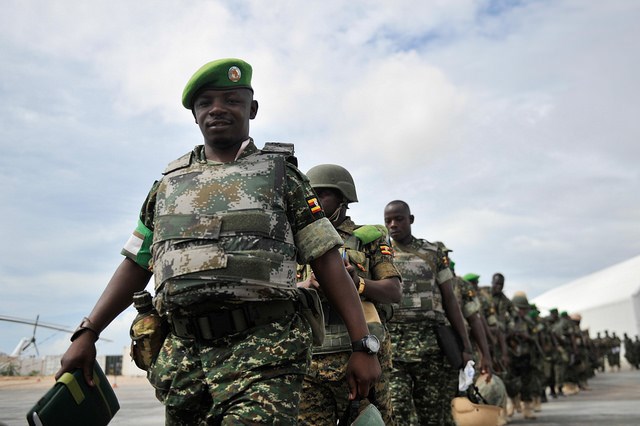

Ugandan troops operating under the African Union Support and Stabilization Mission in Somalia (AUSSOM) have welcomed a new contingent of their forces, designated as the 48th Battalion (BG-48), which replaces the 45th Battalion previously deployed in Somalia.
According to a release issued by the Uganda People’s Defence Forces (UPDF), the incoming battalion is commanded by Colonel Michael Opio Ocuka.
Its arrival included orientation briefings from senior UPDF officers, who issued operational directives to the personnel prior to their full assumption of mission duties.
This rotation forms part of the standard force renewal process for Ugandan military contingents deployed to Somalia, ensuring uninterrupted delivery of the mandate authorized for African Union forces supporting national security and stabilization efforts.
The 48th Battalion Assumes Duties of Predecessor Unit: The 48th Battalion arrived in Somalia to relieve the 45th Battalion, which served among the active Ugandan contingents under AUSSOM.
Contingent rotation represents a vital mechanism for operational continuity, enabling units completing their theater tours to redeploy home while fresh units assume primary responsibilities.
This framework also facilitates unit familiarization with local security conditions, geographic sectors, and command protocols by leveraging operational handover knowledge from outgoing personnel.
The UPDF release did not specify the total troop strength of the incoming battalion, its exact tactical Sector deployment, or the precise date on which the 45th Battalion concluded its tour.
Consequently, those operational specifics await further confirmation from UPDF Command or AUSSOM mission Headquarters.
Brigadier General Jackson Kayanja Briefs Incoming Troops: The Commander of Uganda’s Contingent Sector One, Brigadier General Jackson Kayanja, urged the newly arrived troops to demonstrate strict discipline, military professionalism, and continuous operational readiness throughout their tour of duty.
General Kayanja emphasized that individual discipline forms the bedrock of a soldier’s success, charging the personnel to uphold the chain of command, respect superior officers, and foster unit cohesion and camaraderie across the ranks.
He further noted that the troops must embody discipline built on comprehension, sound judgment, and responsibility, rather than executing orders blindly without tactical awareness or due care.
The commander’s address highlights the high priority Ugandan military leadership places on force conduct, particularly when operating in environments characterized by complex security challenges that demand constant vigilance.
Emphasis on Interoperability and Vigilance: Brigadier General Jackson Kayanja also called on the incoming battalion to strengthen coordination, dedication, and joint execution during operations.
According to the commander, these elements remain vital for fulfilling the force mandate and mitigating security threats encountered by troops supporting Somali national stabilization.
Interoperability across different units plays a pivotal role in operational integration, tactical intelligence-sharing, and executing assigned mission tasks.
Likewise, continuous vigilance represents a core component of force readiness required for personnel deployed to high-risk operational sectors.
However, the published briefing did not reference any specific operations in which the new battalion has already engaged, nor is there any indication that the 48th Battalion has commenced direct combat engagements against Al-Shabaab.
Colonel Jude Rukubya Urges Adaptation to Operational Environment: The Deputy Commander of Sector One, Colonel Jude Rukubya, similarly counseled the incoming troops to rapidly adapt to Somalia’s operational climate and local security dynamics.
Colonel Rukubya encouraged the soldiers to remain eager to master new operational procedures while building upon the practical experience of veteran personnel deployed long-term in the country.
He emphasized the critical value of operational adaptability, learning from peer experiences, and executing mission objectives collectively.
Such guidance proves particularly essential for newly arriving contingents integrating into an international mission framework, as personnel must thoroughly grasp operational protocols, inter-agency coordination procedures, and the specific terrain dynamics of their assigned sector.
Adapting to the Somali operating environment further requires an understanding of local socio-cultural dynamics, seamless civil-military coordination with Somali security forces, and executing mission directives while prioritizing civilian protection.
Ugandan military leadership additionally underscored the imperative of Pan-African solidarity and a clear alignment with the core strategic objectives of the AUSSOM mission.
Uganda has maintained a sustained troop deployment in Somalia for nearly two decades, having served as a cornerstone of successive African Union peacekeeping iterations prior to AUSSOM’s launch.
The AUSSOM mission officially transitioned into operational force on January 1, 2025, succeeding the African Union Transition Mission in Somalia (ATMIS).
The current mission mandate focuses on bolstering Somalia’s defense architecture and developing the independent capacity of the Somali National Armed Forces.
As established in official mission frameworks, African Union contingents operate in direct support of Somali security institutions, reinforcing stabilization operations and securing high-risk operational sectors.
The concept of Pan-African solidarity highlighted by Ugandan commanders reflects the broader doctrine of African-led solutions to regional security crises, advancing collective peace and stability across the Horn of Africa.
For Somalia, the deployment of African Union forces remains governed by formal mission mandates and structural alignment with federal authorities and national defense institutions.
Uganda was among the first nations to deploy troops to Somalia as part of the African Union Mission in Somalia (AMISOM), which launched in 2007.
Since then, Ugandan forces have participated in numerous operations supporting security in Mogadishu and other regions across the country.
As AMISOM transitioned into ATMIS, and subsequently into AUSSOM, Ugandan troops continued their involvement in African Union security initiatives in Somalia.
A report published by AUSSOM in November 2025 noted that Ugandan forces contributed to stabilization operations, the protection of critical infrastructure, and the securing of main supply routes (MSRs) in areas including Barawe.
The report also highlighted ongoing operational coordination between Ugandan units and Somali security forces.
This data demonstrates that Uganda’s involvement extends beyond mere troop presence to encompass supporting stabilization and security operations executed within the framework of the African Union mission.
The rotation of the 45th Battalion and the deployment of the 48th Battalion reflect the continuity of Uganda’s military presence in Somalia and the standard force-renewal protocols governing participating units.
Such rotations remain essential for personnel management, mission continuity, and ensuring incoming troops receive comprehensive operational orientation before assuming command.
However, unit rotations alone do not indicate an increase or decrease in the overall strength of Ugandan forces in Somalia, nor do they signal changes to the mission’s overarching strategic concept of operations or geographic areas of responsibility.