

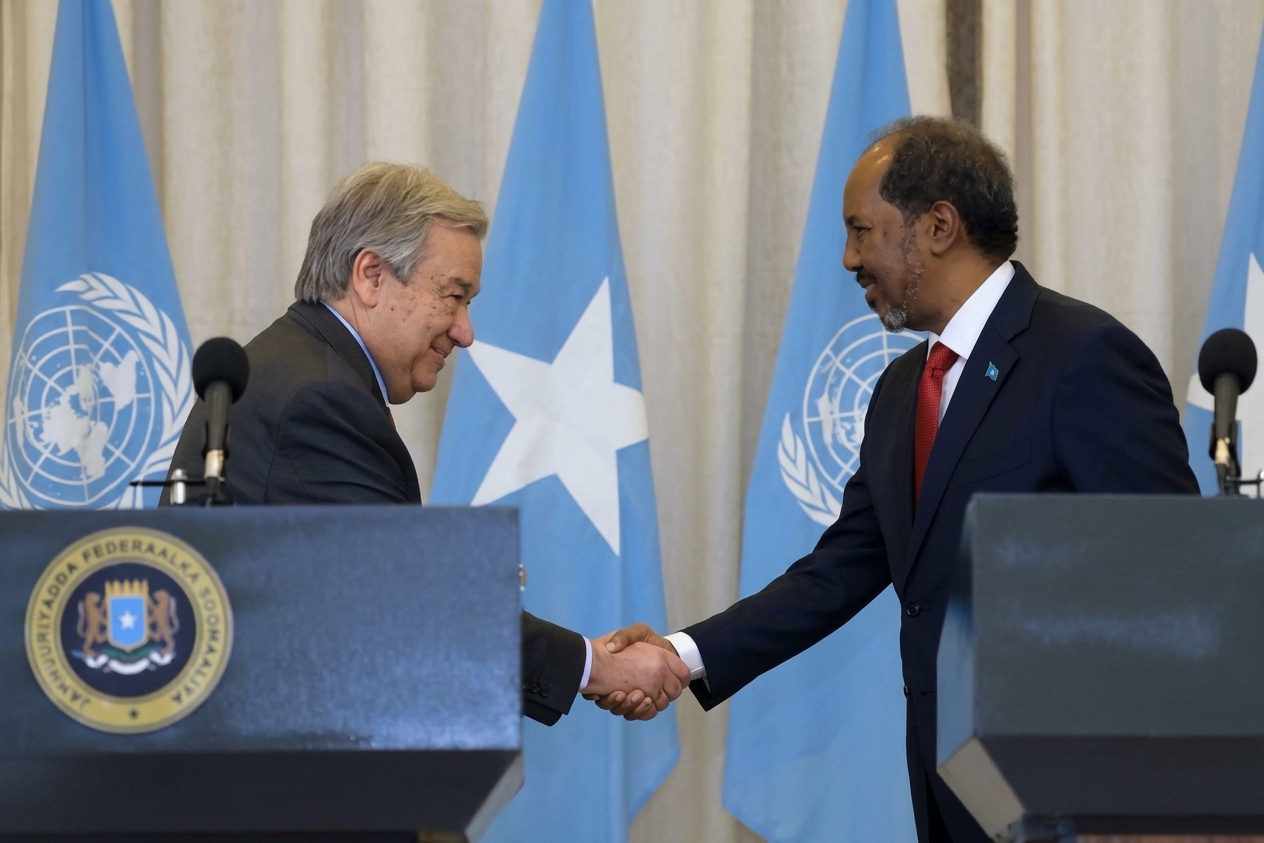

The UN Secretary-General announced that the United Nations Transitional Assistance Mission in Somalia (UNTMIS) is concluding its operations on October 31, 2026, following a two-year transition plan designed to downscale the UN mission’s role in the country.
This decision marks the end of a critical phase in Somalia–UN relations, with the country entering a new era regarding how international agencies support the government—particularly in peace, security, reconciliation, state-building, and institutional capacity building.
In his statement, the Secretary-General commended Somalia’s progress in state-building and national institutional strengthening, affirming that the United Nations will continue its support for Somalia despite UNTMIS concluding its mandate.
Future support will be funneled through other UN agencies and offices operating in Somalia, which will maintain activities focused on peace, stability, human rights, and national development.
UNTMIS was established on November 1, 2024, succeeding the UN Assistance Mission in Somalia (UNSOM), following a request submitted by the Federal Government of Somalia to the UN Security Council.
The Somali government sought a two-year transition window to hand over the mission’s operational responsibilities to Somali state institutions and partner UN bodies, aiming to reinforce national ownership over state-building and peacebuilding processes.
On October 30, 2024, the Security Council adopted Resolution 2753, mandating that the new mission officially commence its transition on November 1, 2024, and wrap up operations by October 31, 2026 at the latest. Resolution 2809, adopted in December 2025, reaffirmed this timeline.
The transition process was structured into two phases: Phase One focused on supporting state-building, human rights, justice, security sector reform, and international aid coordination.
Phase Two centered on progressively handing over these functions to Somali national institutions and resident UN offices.
The conclusion of UNTMIS does not signify a total UN withdrawal from Somalia. The Secretary-General clarified that UN agencies operating in-country will sustain support across development, peace, stability, human rights, and social services.
UNTMIS responsibilities have been transferred to Somali government bodies and various UN entities, including specialized UN agencies, funds, and programs.
Additionally, the United Nations Support Office in Somalia (UNSOS) will maintain its logistical support mandate for the African Union Support and Stabilization Mission in Somalia (AUSSOM) and other mandated stakeholders.
Consequently, the primary shift lies in the management framework of political support and state-building functions, rather than a termination of international assistance.
Although the UN acknowledged Somalia’s state-building strides, the end of UNTMIS coincides with ongoing political, security, and institutional development challenges facing the country.
A major concern centers on the domestic political landscape—specifically ongoing friction between the Federal Government and certain Federal Member States, alongside disputes over constitutional review and electoral frameworks.
Questions also persist regarding the continuation of political dialogue, reconciliation, and international aid coordination following the departure of a long-standing mission deeply integrated with Somali political entities and government institutions.
On the security front, Somalia continues its counter-insurgency operations against Al-Shabaab, where national forces and AU AUSSOM troops play pivotal operational roles.
Therefore, ensuring Somali security institutions possess adequate capacity and readiness to assume primary security responsibilities while strengthening partnerships with international allies remains critical.
The UN Secretary-General urged the international community to sustain its support for Somalia, particularly in institutional capacity building, peacebuilding, reconciliation, and development.
This appeal highlights that while the UNTMIS political mission is ending, the UN considers ongoing international backing for Somalia essential.
Sustained cooperation among the Somali government, the UN, the African Union, and donor partners remains vital to prevent the transition from generating new obstacles to national peace and stability.
The conclusion of UNTMIS marks a critical testing ground for national institutional capabilities across politics, security, reconciliation, and state-building.
The Federal Government of Somalia now faces heightened responsibility in managing functions previously supported by the UN political mission.
The central question remains whether state institutions can fully absorb these mandates while sustaining strong diplomatic and technical partnerships with the international community.
Observers also question how political facilitation will be maintained during internal disputes, particularly when Somalia encounters friction over constitutional amendments, electoral models, and federal-state relations.
Ultimately, the wrap-up of UNTMIS does not signal an end to the UN-Somalia partnership, but rather the conclusion of a specific two-year transition mission designed to hand over operational responsibilities to local and multilateral partners.