

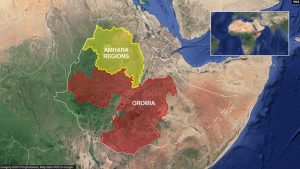

Heavy fighting was reportedly underway in the border town of Moyale on Friday morning, amid escalating tensions between communities in Ethiopia’s Somali and Oromia regional states.
Residents reported hearing gunfire and explosions in several parts of the town, raising fears that renewed clashes could spread to neighbouring areas.
Initial accounts suggest that the security situation has deteriorated again, although the circumstances surrounding the latest fighting, including which side initiated the clashes and the number of casualties, have not been independently verified.
The reported violence comes after several weeks of recurring confrontations in and around Moyale, which have resulted in deaths, injuries, property damage and large-scale displacement.
The town lies along the boundary between Ethiopia’s Somali and Oromia regions, where disputes over administrative borders, land ownership, grazing areas and local authority have persisted for years.
Tensions intensified on October 18, 2026, after the Somali regional administration reportedly opened a new office in a contested part of the town and raised the Somali regional flag at the location.
The move triggered opposition from some Oromo residents and groups, leading to confrontations between Somali regional police and Oromo armed groups.
A 13-year-old Oromo girl was reportedly killed during the clashes that followed, further inflaming tensions between the two communities.
Subsequent days saw demonstrations, road closures and additional armed confrontations. Attempts by traditional elders and security representatives to calm the situation have so far failed to resolve the underlying dispute.
Fighting reported on October 22 extended beyond central Moyale to several surrounding locations, including Malab, Chamuk, Bole, Kebele 01 and Waqo Dogo.
Further clashes were also reported in Melka Guba, Melka Adi, Melka Chophi and Ela Orbi, areas associated with the Gumi Eldallo, Wachile and Arero districts on the Oromia side.
An account published by Addis Standard said forces from the two regional administrations and armed local groups had confronted one another. Residents described heavy gunfire, houses being set on fire and civilians fleeing areas affected by the fighting.
The opposing sides have blamed one another for fuelling the violence, but no independent investigation has yet established responsibility for all the reported incidents.
Other accounts have described damage to homes and businesses, disruption to public transport and difficulties for residents trying to carry out their daily activities.
The full number of people killed or injured remains unclear, with figures varying between accounts from residents and media reports.
Civilians have borne much of the impact, particularly women, children and older people living in Moyale and nearby settlements.
Many have crossed the border into Kenya, seeking safety in Marsabit County as the fighting has disrupted normal life and raised fears of further attacks.
The scale of the displacement has drawn attention from humanitarian organisations.
The conflict-monitoring organisation ACLED reported that at least 30,000 people crossed into Marsabit between October 19 and 26, fleeing clashes in Moyale and surrounding areas.
An Associated Press report published on October 27 put the number of people who had fled to Kenya at 36,000, citing the United Nations. Most of those displaced were reported to be women and children.
The sudden arrival of thousands of people is placing additional pressure on host communities and essential services, including access to food, clean water and healthcare.
Humanitarian agencies face the challenge of providing assistance while monitoring the possibility of further displacement if insecurity continues.
The renewed violence has also increased pressure on Ethiopia’s federal government and the administrations of the Somali and Oromia regions to prevent further escalation and protect civilians.
The federal authorities have a significant role to play because the dispute involves two regional states within Ethiopia’s federal system.
An independent investigation into reported civilian deaths, destruction of property and forced displacement would help establish the circumstances surrounding the violence and identify those responsible.
The parties involved are also under pressure to avoid actions that could deepen communal divisions or trigger further fighting.
If the latest reports of renewed clashes on Friday morning are confirmed, they would indicate that previous mediation efforts have yet to secure lasting stability in the area.
Continued fighting could disrupt trade, transport and social ties across the border.
Moyale is an important commercial and transport corridor linking Ethiopia and Kenya, meaning prolonged insecurity could have economic and humanitarian consequences extending well beyond the town itself.