


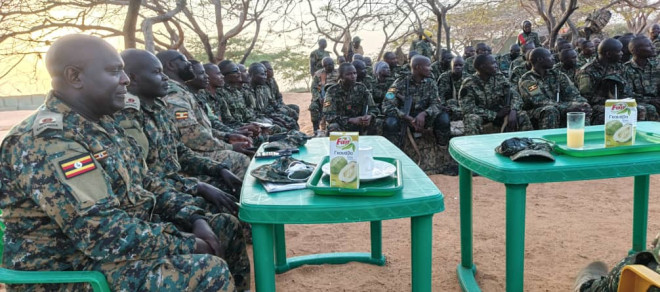


The withdrawal of Ugandan forces from key outposts in southern Somalia has generated fresh concerns regarding the security of the capital, Mogadishu, and surrounding areas, at a time when the country is experiencing a transformation in how African Union forces contribute to security maintenance and the counter-insurgency campaign against Al-Shabaab.
The outposts of Sabid and Caanoole, Bariire, Awdheegle, and Bululo-Gaduud are among the strategic locations situated within the Lower Shabelle region, which are vital for connecting southern territories to the capital, Mogadishu.
The withdrawal of Ugandan forces has heightened questions concerning who will fully assume control of these outposts, the capability of Somali forces to defend them, and how to prevent Al-Shabaab from exploiting the ongoing security transition.
The outposts of Sabid and Caanoole, Bariire, Awdheegle, and Bululo-Gaduud are located in terrain critical for troop movements and transit across the Lower Shabelle region.
This region has long been a theater of conflict involving the Somali government, African Union forces, and Al-Shabaab.
The importance of these locations is not restricted solely to defending the towns where they are situated, but is likewise tied to securing the roads and supply routes linking Mogadishu with other southern regions of the country.
A report published by the Associated Press stated that the AUSSOM mission is planning to replace forces at four outposts being vacated by Uganda—namely Sabid-Anole, Bariire, Awdheegle, and Bululo-Gaduud—to prevent Al-Shabaab from exploiting any security vacuum.
Regional security analyst Samira Gaid has similarly warned of the critical importance that areas surrounding Mogadishu—particularly Lower Shabelle and vital bridge crossings—hold for the defense of the capital.
Her perspective indicates that any alteration in force presence across these areas necessitates a meticulously prepared security plan.
The Ugandan military announced on November 2, 2026, the commencement of a phased plan to withdraw its forces from Somalia.
According to the Ugandan military’s statement, the initial contingents operating under bilateral agreements between Uganda and the Somali government have returned to their home country, while the broader withdrawal plan encompassing all Ugandan forces, including AUSSOM contingents, is scheduled for completion by the end of 2027.
Reports from AP and Reuters have confirmed the initiation of the withdrawal and the timeline announced by Uganda.
It is important to distinguish between the two categories of Ugandan forces: those stationed in Somalia under bilateral agreements and those participating in the African Union mission, AUSSOM. The ongoing withdrawal does not entail all Ugandan forces departing the country simultaneously.
Somali Forces Expected to Assume Security Responsibilities:
The Somali government has stated that the National Armed Forces are fully prepared to take over locations vacated by foreign troops.
The Commander of the Armed Forces, Mohamed Ali Bariise, stated that handover planning for these outposts has been prepared in advance.
Nevertheless, the pivotal question is whether this plan is backed by sufficient manpower, transport, logistical supply, weaponry, and sustained support capable of securing these sites.
Taking over a military outpost entails far more than raising the Somali flag at the location; it requires the combat capacity to defend it, secure supply routes, and execute sustained operations preempting Al-Shabaab attacks.
Consequently, the success of the transition will depend on troop readiness, logistical sustainment, and coordination between government forces and AUSSOM units.
One of the challenges confronting the AUSSOM mission is funding constraints that have impacted logistical supply, transport capacity, and operational tempo.
This difficulty arises at a time when African Union forces are preparing to take over outposts vacated by Ugandan troops, requiring adequate operational planning, personnel, and financial backing.
The Associated Press report highlighted that financial deficits and Somali force capacity limitations are among the central anxieties surrounding the security transition plan.
If logistical support and transport capacity dwindle, outposts stationed in remote areas risk being cut off from rapid reinforcement and continuous supply.
The paramount question remaining is how Al-Shabaab may react to the withdrawal of Ugandan forces and the restructuring of outposts across southern Somalia.
The Al-Shabaab militant group has long waged war against the Somali government and allied forces, persistently seeking to recapture territories from which it was previously dislodged.
Security analysts caution that if the handover of these outposts is mismanaged, the group may attempt to exert pressure on transitioning positions or vital transit corridors.
However, this threat is not a foregone conclusion. It will depend on how effectively Somali forces and AUSSOM manage the transition and maintain an unbroken, resilient security presence.
Uganda’s withdrawal thrusts Somalia into a critical phase concerning national security ownership.
Mogadishu and its environs require the rigorous protection of vital supply lines, regional transit corridors, and strategic military bases.
It is equally essential for the Federal Government, regional administration, and security forces to maintain a unified operational plan governing the defense of transitioned territories.
Should Somali forces succeed in continuously securing these outposts, the transition will mark a milestone toward reclaiming national security responsibilities. Conversely, should certain outposts suffer from insufficient troop and logistical backing, opportunities for armed militant exploitation could expand.