


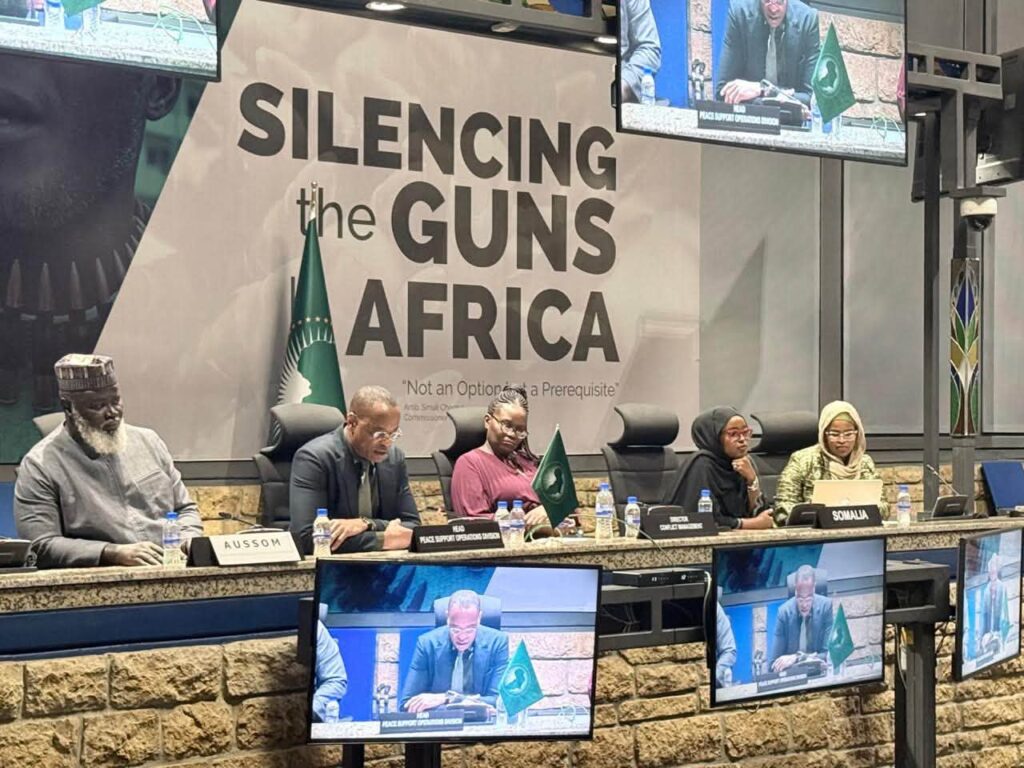


The African Union (AU) has held consultations in Addis Ababa, Ethiopia, on the future of its Support and Stabilization Mission in Somalia (AUSSOM), focusing on the country’s security transition and measures to prevent a security vacuum as African forces gradually reduce or end their presence.
The meeting brought together representatives of Somalia’s federal presidency and countries contributing troops to AUSSOM.
Discussions covered the security situation, the operational capacity of Somali forces and the mission’s future role as responsibility for national security is gradually transferred to Somali institutions.
During the consultations, participants presented the Integrated Security Transition Plan, a framework intended to guide the different stages of the transition and establish how security responsibilities will progressively pass from AU forces to Somalia’s national security institutions.
The plan is expected to be submitted to the AU Peace and Security Council for consideration, paving the way for further discussions on the future deployment of African forces and the direction of AUSSOM.
The Federal Government of Somalia has maintained that any reduction or withdrawal of AUSSOM troops should be guided by a realistic assessment of conditions on the ground rather than a fixed timetable.
Mogadishu wants a joint evaluation of the Somali National Army’s capabilities, the security situation in areas where AU forces are deployed and the country’s readiness to assume full responsibility for protecting its territory.
One of the main concerns is that a rapid withdrawal of AUSSOM forces without adequately prepared Somali troops to take over their bases and security responsibilities could create openings for Al-Shabaab to exploit.
This concern is particularly significant in regions where African forces currently support Somali troops, including the protection of strategic installations, major transport routes connecting towns and military operations against the militant group.
AUSSOM’s future is also complicated by several operational challenges, particularly funding, logistical support and the ability of Somali security forces to take over responsibilities currently carried out with international assistance.
In a report published on November 9, 2026, the Africa-focused research organization Amani Africa highlighted uncertainty surrounding the mission’s financial and logistical support, particularly the future of United Nations assistance to AU forces.
The report also noted that the AU Peace and Security Council was expected to hold a special meeting on November 10 to discuss AUSSOM’s situation and future.
An extraordinary meeting of AUSSOM troop-contributing countries held in Kampala in July 2026 had similarly emphasized the need for sustainable financing, military training, intelligence assistance and further investment in the capabilities of the Somali National Army.
The contributing countries also stressed the importance of a coordinated transition framework to ensure that security gains made in Somalia are not reversed as African forces scale down their operations.
Another major factor shaping AUSSOM’s future is the logistical assistance provided by the United Nations Support Office in Somalia (UNSOS).
UNSOS provides essential operational support to AUSSOM forces, including supplies, transportation, medical assistance and other services required to sustain military deployments across Somalia.
United Nations Security Council Resolution 2809, adopted in 2025, authorized AUSSOM to continue operating until December 31, 2026, while maintaining UN logistical support for the mission.
Meanwhile, the acting head of UNSOS, Qurat-ul-Ain Sadozai, was reported on November 12, 2026, to have visited AUSSOM facilities in Baidoa, Jowhar and Beledweyne, where she met military officers and mission officials.
The discussions focused on logistical requirements, security challenges and measures to ensure an orderly transition without disrupting support for forces operating in Somalia.
The proposed Integrated Security Transition Plan could provide a clearer timetable and framework for determining how responsibilities will be transferred between AU troops and Somali security forces.
The framework is expected to address several key areas, including the operational readiness of Somali forces, the number and deployment locations of AUSSOM troops, logistical arrangements, military training and measures to secure territories vacated by African forces.
It will also be important for the plan to clarify which Somali institutions and security units will assume responsibility for major towns and strategic military positions, as well as how they will receive the equipment and resources needed to maintain control.
Without adequate preparations, the transition could face significant difficulties, potentially weakening the government’s ongoing military campaign against Al-Shabaab.
A central concern surrounding any reduction or withdrawal of AU forces is the possibility that Al-Shabaab could exploit areas left behind if Somali troops are unable to take over immediately.
The militant group could attempt to return to previously recovered territories, launch attacks against military bases or disrupt movement along important roads.
For this reason, Somalia’s security transition is about more than the departure of foreign troops.
It is directly linked to the federal government’s ability to maintain control over liberated areas, protect strategic infrastructure and sustain military pressure against Al-Shabaab.
AUSSOM’s future will largely depend on the ability of the Federal Government, the African Union, the United Nations and troop-contributing countries to agree on a coordinated approach to the transition.
Two priorities will need to be balanced: enabling Somalia to gradually assume full responsibility for its security while avoiding an accelerated withdrawal of international forces before the country has the capacity to replace them.
The proposed submission of the transition framework to the AU Peace and Security Council could mark an important step in determining the mission’s next phase.
However, further details of the plan, the proposed withdrawal timetable and the decisions of the African Union and troop-contributing countries are still awaited.


