

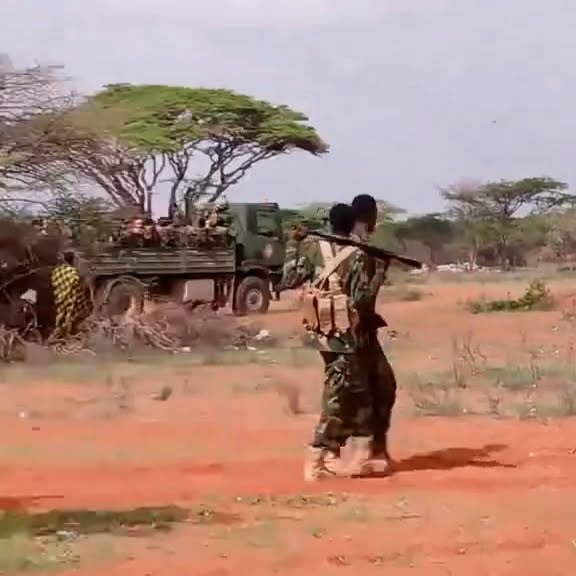

Beledweyne, the capital of Hiiraan Region, is facing growing political and security tensions amid reports that federal government troops stationed at military frontlines and other locations are moving towards the city following a call by Hawadle clan leader Ugaas Yusuf Ugaas Hassan Ugaas Khalif.
The reported movements come amid a deepening dispute between Hirshabelle’s leadership and sections of Hiiraan’s political establishment, traditional elders and local communities over the regional administration’s election held in Jowhar on October 24, 2026.
On November 7, Ugaas Yusuf urged security personnel from Hiiraan serving in government institutions to return to Beledweyne and refrain from participating in operations he described as being directed against the region’s population.
His appeal was followed by reports that armed personnel had arrived at his residence, while some media outlets said other troops were leaving their existing positions to head towards the city.
The developments have raised concerns about the possible consequences if troops withdraw from frontline positions and gather in Beledweyne, particularly for local security, the campaign against Al-Shabaab and the federal government’s authority over the national armed forces.
One of the main risks is a confrontation between security units operating under different chains of command or aligned with opposing political interests.
If incoming troops join armed groups supporting the traditional leader’s position while other forces remain loyal to government and Hirshabelle institutions, the city could face competing security structures with little trust between them.
Such a situation could threaten government facilities, military bases, key roads and civilian-populated areas. A misunderstanding, conflicting orders or an isolated incident could quickly trigger armed clashes and escalate the wider crisis.
Previous media reports have described federal troops and local armed groups facing each other near the Hirshabelle administration’s headquarters in Beledweyne.
Macawiisley fighters have also reportedly taken control of parts of the Lama-Galay headquarters and other locations in the city.
Although no direct fighting was reported at the time, the presence of armed groups with opposing positions has increased the risk of confrontation.
Beyond the immediate threat to the city, concerns are growing over the possible impact of troop movements on military operations against Al-Shabaab.
Federal forces operating in central Somalia and Hiiraan play an important role in defending towns, securing roads and supporting offensives against the militant group.
If key units abandon their assigned positions to become involved in a political dispute in Beledweyne, the areas they leave behind could face security gaps.
Al-Shabaab could exploit any fragmentation among government forces, particularly if units that previously coordinated their operations become preoccupied with internal disagreements.
The group could use such opportunities to increase its movements, put pressure on military positions or disrupt civilian and commercial traffic.
This does not necessarily mean that Al-Shabaab would immediately seize territory abandoned by government forces. However, it highlights the strategic risks that could arise if internal political tensions weaken ongoing security operations.
Another major concern is the potential damage to the command structure and discipline of the Somali National Army.
The national military is expected to operate under lawful government authority and an established chain of command, rather than allowing individual soldiers to make deployment decisions in response to political pressure or clan-based appeals.
If soldiers and officers leave their assigned positions without formal orders from their commanders, confidence in military discipline and institutional cohesion could deteriorate.
Media reports published on November 9 said additional troops were joining the movements towards Beledweyne and that some units had reportedly left their previous positions.
However, the number of personnel involved, their military affiliations and whether they formally withdrew from their assignments have not been independently verified.
The Federal Government and military command have also not issued comprehensive public statements addressing all the reports.
If the situation continues, it could expose a wider institutional problem in which political disputes increasingly influence the cohesion and operational independence of Somalia’s national armed forces.
Al-Shabaab has repeatedly benefited from political divisions, community tensions and disagreements among government forces. When security personnel become distracted by internal disputes, their ability to confront a common enemy can be weakened.
Hiiraan remains an important theatre in the campaign against the militant group, with several parts of the region having experienced prolonged military operations.
Any disruption to those efforts could therefore have consequences extending well beyond Beledweyne.
There is also a risk that Al-Shabaab could use propaganda to portray the troop movements as evidence of divisions within the Somali military.
Such messaging could undermine soldiers’ morale and public confidence in government security institutions, particularly if the situation creates the impression that national forces are no longer united in their mission.
Civilians in Beledweyne are likely to bear the greatest cost if the tensions escalate into armed confrontation.
Businesses, transport, education and healthcare services could all be disrupted, while residents living near government offices and military positions could face intimidation, displacement and interruptions to their daily lives.
Beledweyne has already endured armed conflict, recurrent flooding and prolonged security challenges. A new confrontation arising from a political disagreement would place additional pressure on a population that has repeatedly suffered the consequences of instability.
The Federal Government therefore faces a serious responsibility to prevent the Hirshabelle dispute from undermining the national military.
The military command needs to clarify the situation surrounding the reported troop movements and ensure that units do not abandon assigned positions without authorisation or operate under conflicting orders.
The government must also avoid actions that could be interpreted as using military force to suppress the political grievances of Hiiraan’s communities.
Disagreements over regional leadership and representation should be addressed through negotiations, mediation and an agreement acceptable to the parties involved.
Hirshabelle’s leadership, Ugaas Yusuf, traditional elders, regional politicians and federal authorities all have a role in reducing tensions and ensuring that security forces are not drawn into a confrontation with one another.
Preserving military unity and protecting civilians must remain priorities as efforts continue to resolve the political crisis.


