

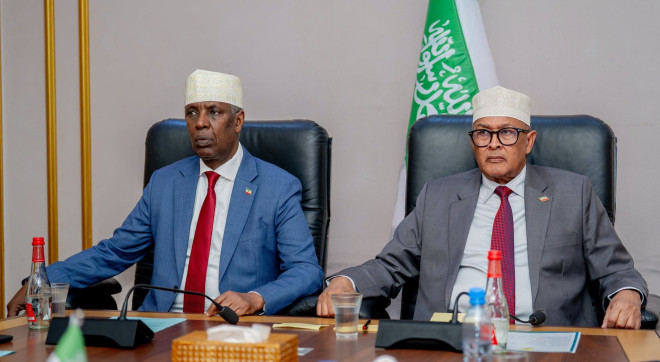

The Government of Somaliland has reaffirmed its stance permitting Ethiopia access to the sea, stating that mutually beneficial agreements can drive economic cooperation and development across the Horn of Africa region.
This position was outlined in a statement issued on October 3, 2026, by the Ministry of Foreign Affairs and International Cooperation of Somaliland, which also served as a response to ongoing discussions and debates regarding relations between Somalia, Somaliland, and Ethiopia.
Dawan Africa media broadcast details of the statement, reporting that Hargeysa maintained its firm stance on its foreign relations and agreements entered into with other parties.
The Somaliland Ministry of Foreign Affairs stated that it has long supported negotiated agreements granting Ethiopia maritime access, emphasizing that such pacts must be anchored in shared interests and mutual benefit.
Somaliland’s position is rooted in the perspective that landlocked Ethiopia requires a reliable corridor to import and export its goods through a regional port.
Somaliland’s statement further indicates that Hargeysa does not view Ethiopia’s acquisition of maritime access as something that should be universally blocked, but rather as a matter resolvable through direct bilateral negotiations among the concerned parties.
This development reignites the intense diplomatic friction sparked by the January 1, 2024 Memorandum of Understanding between Ethiopia and Somaliland.
That memorandum triggered severe diplomatic tensions, as Somalia insisted that Somaliland constitutes part of its sovereign territory and rejected any external agreements independently concluded by Hargeysa concerning coastal access or territories claimed by Mogadishu.
That friction ultimately formed part of the Turkish-mediated efforts that culminated in the Ankara Declaration of December 2024.
The Ankara Declaration explicitly stated that Somalia and Ethiopia respect each other’s sovereignty, unity, and political and territorial independence. At the same time, that same document acknowledged the potential benefits of Ethiopia securing reliable maritime access through commercial arrangements operating under Somalia’s sovereign authority.
The core pillar of the Ankara Declaration was the endeavor to decouple two distinct issues: Ethiopia’s need for maritime access and Somalia’s territorial sovereignty.
According to the declaration, Somalia and Ethiopia agreed to formulate mutually beneficial commercial frameworks—such as contracts, lease agreements, or alternative modalities—providing Ethiopia with secure, continuous access to the sea.
However, it was stipulated that such maritime access would function under the sovereign jurisdiction of the Federal Republic of Somalia.
Somaliland maintains that it possesses the sovereign right to enter into agreements with external partners, whereas Somalia insists that territorial matters and such compacts fall exclusively under the purview of the federal government’s sovereignty.
Hargeisa’s recent statement also carried a direct political message: Somaliland stated that it will not accept interference in the agreements it concludes with other entities.
The Somaliland Ministry of Foreign Affairs asserted its intent to continue pursuing agreements it deems respectful of its self-governance and conducive to regional development and prosperity.
Hargeysa specifically linked this stance to the 2024 agreement with Ethiopia, which Mogadishu strongly opposed.
A report published on October 3 indicated that Somaliland also rejected the assertion that Mogadishu holds the authority to dictate its external relations or arbitrate the agreements Somaliland enters into with foreign states.
From Somalia’s perspective, the position remains grounded in the constitutional principle that Somaliland constitutes an integral part of Somalia; consequently, any agreement concerning territory, coastline, or ports located within that region cannot be independently contracted by Hargeysa with a foreign government.
This stance formed the core of Somalia’s rejection of the 2024 Ethiopia-Somaliland agreement.
Nevertheless, the current dynamic indicates that Mogadishu is attempting to present Ethiopia with an alternative pathway to secure maritime access, anchored in an agreement in which Somalia participates.
The Ankara Declaration previously established this framework, with both nations agreeing that Ethiopia could secure sea access while upholding Somalia’s sovereignty.
Ethiopia maintains an overriding strategic need for maritime access, given that it is one of the most populous landlocked nations in Africa.
Consequently, acquiring a reliable port and commercial transit corridor is vital for the country’s import and export sectors, especially as Ethiopia’s economy relies heavily on regional trade integration.
The Ankara Declaration formally acknowledged that Ethiopia could derive significant benefits from dependable maritime access, with Somalia and Ethiopia agreeing to resolve the matter through commercial contracts. At the time, the United States government welcomed the agreement, stating that Ethiopia’s maritime access could be advanced while fully respecting Somalia’s territorial integrity.
The Port of Berbera is situated on the Gulf of Aden, occupying a strategic nexus linking the commercial shipping lanes of the Red Sea, the Gulf of Aden, and the Indian Ocean.
This geography renders Somaliland a central focal point in the debate over how Ethiopia can secure sea access.
The 2024 Memorandum of Understanding specifically tied Berbera to Ethiopia’s maritime strategy, a pact that subsequently triggered profound diplomatic friction between Mogadishu and Addis Ababa.
Somaliland’s stance coincides with a period in which the Horn of Africa is once again navigating shifting political and security dynamics.
This context renders the issue of Ethiopia’s maritime access far more than a matter of simple commerce; it is intimately linked to regional politics, security architectures, and the broader strategic competition unfolding across the Red Sea and the Horn of Africa.
Although Somalia and Ethiopia agreed in 2024 to pursue a commercial framework granting Ethiopia sea access, it remains essential to distinguish between the foundational principle of the agreement and the actual implementation of a functioning port accord.
The Ankara Declaration established a framework for dialogue and commercial compacts, but the technical specifics regarding port selection, duration, tariff structures, administration, security protocols, and operational implementation necessitate separate, detailed agreements. The formal declaration mandated the launch of technical negotiations facilitated by Turkey.
Consequently, Somaliland’s reiteration of support for Ethiopia’s maritime access transcends economics; it intersects directly with the overarching debate over which entity holds the legitimate legal and political authority to contract agreements concerning Somaliland’s coastline.
The first tier of the conflict centers on the political dispute over Somaliland’s status and Somalia’s assertion of territorial unity.
The second tier involves Ethiopia’s strategic imperative for sea access and the pursuit of a corridor acceptable to all relevant stakeholders.
Combined, these dual dimensions ensure that any formal port or coastal agreement remains inextricably tied to the fundamental question of who possesses the sovereign mandate to execute such pacts.
This is precisely why the 2024 agreement proved so combustible, while the Ankara Declaration subsequently attempted to anchor Ethiopia’s maritime access within commercial frameworks operating under Somalia’s sovereign authority.