

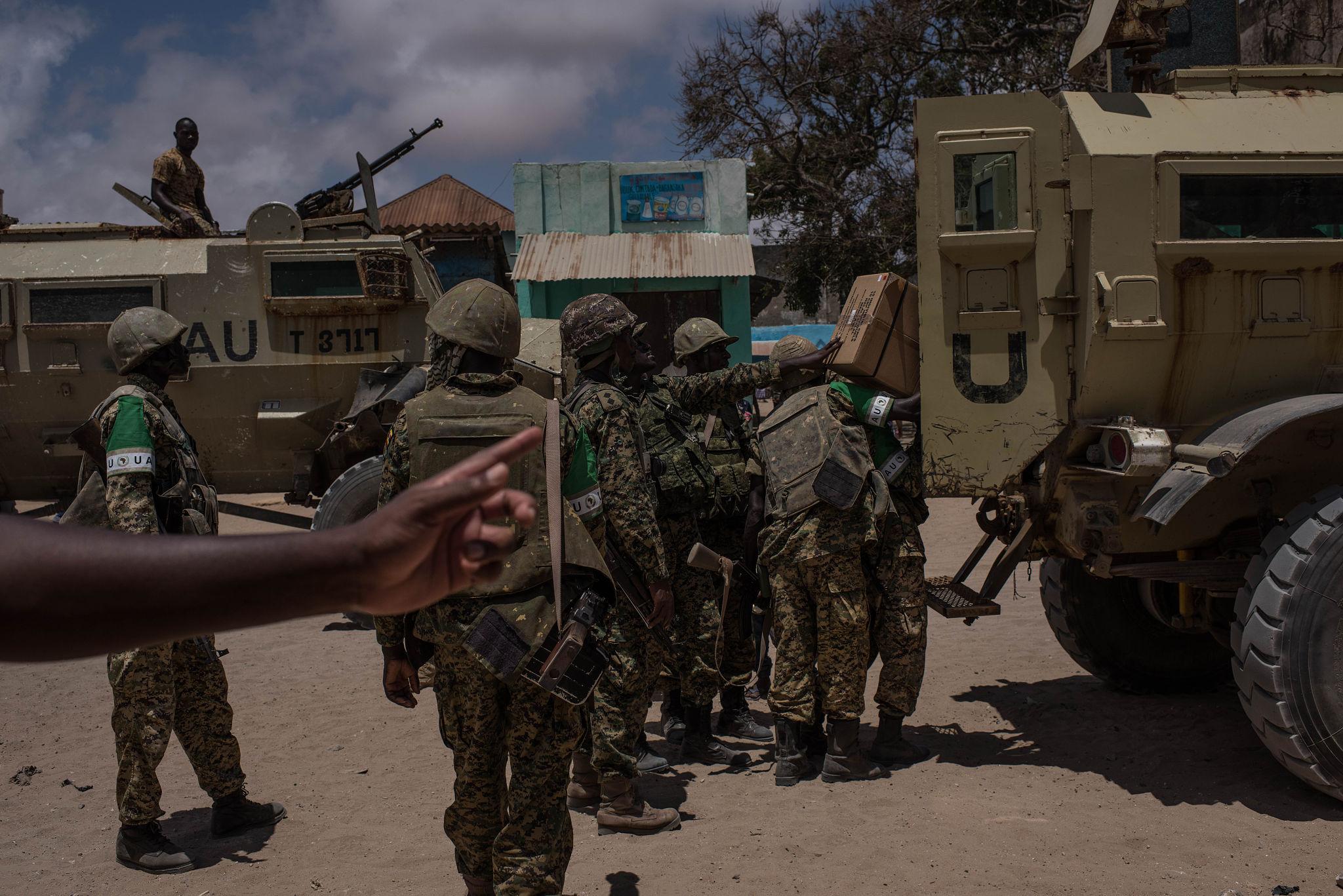

Somali federal government forces reportedly took nine days to reach the coastal town of Barawe in Lower Shabelle region while escorting a convoy of Ugandan troops and military vehicles being withdrawn from bases where they had been deployed.
The journey, covering approximately 210 kilometres, was reportedly marked by repeated security incidents.
Security officials cited by local media said the convoy came under attack more than five times along the route, resulting in damage to military vehicles and casualties among Ugandan personnel.
However, the number of attacks and the extent of the reported losses have not been independently confirmed.
The prolonged journey highlights the security challenges facing military movements along roads in Lower Shabelle, particularly when large convoys carrying troops, armoured vehicles and other military equipment travel between bases.
Reports said the attacks caused delays and forced the escorting forces to maintain additional security. Somali and Ugandan officers reportedly celebrated after the convoy finally arrived in Barawe.
The movement comes as Uganda begins withdrawing troops from Somalia following nearly two decades of involvement in the country’s security operations.
On November 2, 2026, Ugandan military spokesperson Colonel Chris Magezi confirmed that the first group of soldiers had returned home.
He said personnel deployed under the bilateral security arrangement between Somalia and Uganda would leave gradually.
Uganda has separately announced that all its forces in Somalia, including those serving under the African Union Support and Stabilization Mission in Somalia (AUSSOM), are expected to withdraw by the end of 2027.
The two deployments operate under different arrangements, however, and their withdrawals are proceeding on separate timelines.
The current movement primarily concerns troops deployed under the bilateral agreement, rather than an immediate withdrawal of Uganda’s entire AUSSOM contingent.
Ugandan forces have maintained a longstanding presence at strategic locations in Lower Shabelle, including Barawe and other military positions along routes linking towns in the region.
Barawe, a coastal town approximately 220 kilometres southwest of Mogadishu, is also the administrative capital of South West State and holds strategic importance because of its location, port facilities and proximity to key security corridors.
An Associated Press report published on November 3 said Ugandan forces were pulling out of the Barawe area.
It also reported that AUSSOM was preparing to take over four military positions: Sabiid-Anole, Bariire, Awdheegle and Buulo Nagaad.
These bases are considered important to the security of Mogadishu and surrounding areas, particularly in efforts to prevent Al-Shabaab from exploiting gaps during the transition.
A letter sent by AUSSOM to the United Nations Support Office in Somalia, dated October 31, reportedly identified the four positions as important to the protection of the capital.
However, the proposed handover has not clarified who will assume responsibility for all the locations being vacated by Ugandan forces, particularly Barawe and other bases outside the four identified positions.
The reported attacks on the convoy, if confirmed, underline the risks facing military transport operations in Lower Shabelle.
They also raise questions about the ability of Somali forces to secure major supply routes and protect personnel and equipment as international troops reduce their presence.
Reports that Uganda acknowledged vehicle damage and casualties require further clarification, including the number of personnel affected and the circumstances of the incidents.
Somalia’s military leadership has been increasing its engagement with forces deployed in the region as the withdrawal process advances.
Somali National Army Commander Major General Ibrahim Mohamed Mahmoud visited troops in Barawe, where he received briefings on the local security situation.
According to Associated Press reporting, he urged the soldiers to remain vigilant and intensify operations against Al-Shabaab.
The report did not establish whether Somali government forces would take over every base vacated by Uganda or whether some positions would remain under the protection of other AUSSOM contingents.
That uncertainty is significant because any poorly coordinated handover could create opportunities for Al-Shabaab to expand its operations or threaten key transport routes.
Uganda was among the first countries to deploy troops to Somalia in 2007, when Al-Shabaab controlled significant areas of Mogadishu and parts of southern Somalia.
Its forces subsequently played a major role in African Union operations to push the militant group out of several urban centres and secure strategic installations.
In recent years, Ugandan troops have continued to protect key bases and transport corridors as part of international efforts to support Somali security forces.
Their gradual departure comes while Al-Shabaab remains capable of carrying out attacks across several parts of the country.
Associated Press has also reported concerns among security analysts over whether Somali forces have sufficient personnel, equipment and logistical capacity to assume all the responsibilities being relinquished by foreign troops.
The transition therefore involves more than the physical withdrawal of military personnel. It requires a coordinated plan for replacing forces, maintaining supplies, securing transport routes, ensuring reliable communications and protecting strategic installations.
The reported nine-day journey to Barawe illustrates the difficulties Somalia could face as it assumes greater responsibility for security in areas where international forces have operated for years.