

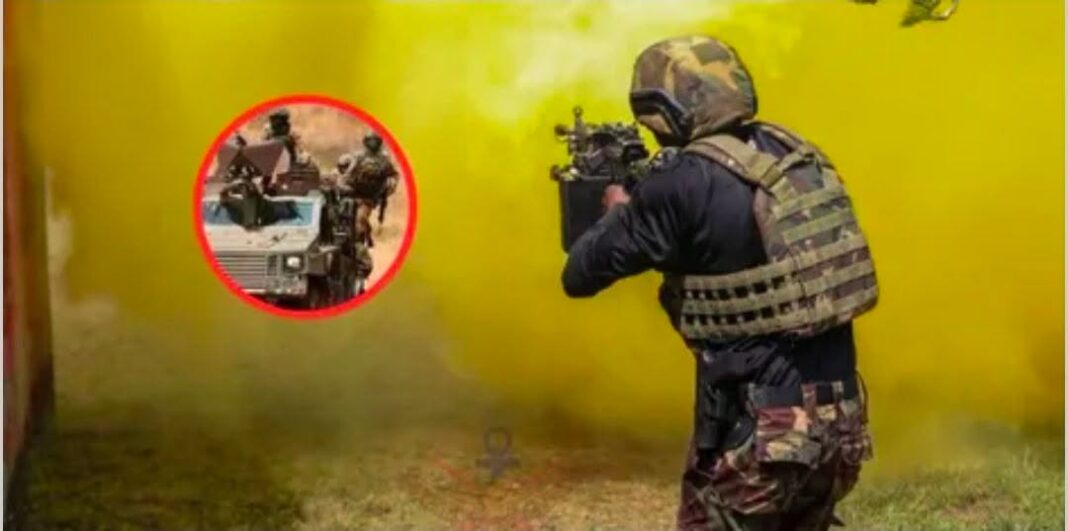

The Government of Kenya has dispatched military officers and experts from its defense forces to South Africa to acquire expertise in handling threats arising from chemical, biological, radiological, nuclear (CBRN), and explosive hazards.
This visit, which took place in November 2026, is part of Kenya’s ongoing efforts to strengthen its armed forces’ capacity to counter security threats requiring technical knowledge, specialized equipment, and rapid response capabilities.
The Kenyan delegation visited the headquarters of the 7th South African Military Health Regiment, located in Centurion, where they met with officers and experts from the South African Military Health Service.
The delegation was led by Brigadier General Benedetta Margaret Kikechi of the Kenya Air Force, who serves as the head of research and development for the Defence National Security Industries agency. The delegation was received by Brigadier General Mcebisi Mdutywa, Deputy Surgeon General of the South African Military Health Service.
The objective of the visit was for Kenyan experts to study procedures for identifying hazardous materials, verifying the nature of threats, and executing rapid emergency responses in the event of accidents or attacks involving toxic and explosive substances.
The Kenyan delegation included members of the committee responsible for developing military doctrine and procedures relating to chemical, biological, nuclear, and explosive hazards. This committee is tasked with preparing and developing protocols utilized by Kenyan forces in such scenarios.
On the South African side, the 7th Military Health Regiment possesses specialized expertise in hazard detection, threat verification, decontamination of affected areas, and emergency medical service delivery.
The regiment’s experts also provide medical support for special operations and possess the capability to manage hazardous situations across combat zones, aviation operations, and diving missions.
The Kenyan delegation’s visit follows another training program conducted by South Africa in September 2026 for military officers from various African nations.
That training took place at the Ditholo training ground, north of Pretoria, focusing on methods for responding to accidents and hazards stemming from chemical substances.
The program was linked to capacity-building efforts by the Organisation for the Prohibition of Chemical Weapons (OPCW), which works to control and prevent the proliferation of chemical weapons.
This cooperation indicates that Kenya is seeking to upgrade the technical knowledge and operational procedures of its military institutions, rather than relying solely on conventional military training programs.
Kenya has long faced security threats associated with Al-Shabaab attacks, particularly in regions bordering Somalia, such as Mandera, Garissa, Wajir, and Lamu.
Bombings and targeted assaults against security forces remain prominent challenges managed by the Kenyan government. Consequently, enhancing capabilities in hazardous material identification and emergency response is vital for protecting both military personnel and civilians.
Nevertheless, the visit to South Africa was not officially framed as a counter-Al-Shabaab training initiative. The stated primary objective was a technical exchange concerning chemical, biological, radiological, nuclear, and explosive hazards. However, this expertise naturally contributes to Kenya’s broader national security mitigation posture.
The defense cooperation between Kenya and South Africa can serve as part of broader African initiatives to enhance indigenous defense capacities and emergency response readiness.
Kenya is also a troop-contributing nation to the African Union Support and Stabilization Mission in Somalia (AUSSOM), with its forces operating across southern sectors, particularly the Juba regions and parts of Lower Shabelle.
Accordingly, advancing Kenyan military proficiency in handling explosives and complex hazards holds potential security significance beyond Kenya’s borders, although no formal plan has been announced regarding the deployment of this specialized expertise within AUSSOM operations.
The anticipated outcome of this visit is the establishment of regularized training programs, new operational protocols, and enhanced tactical capabilities utilized by Kenyan forces to counter multifaceted regional security threats.