


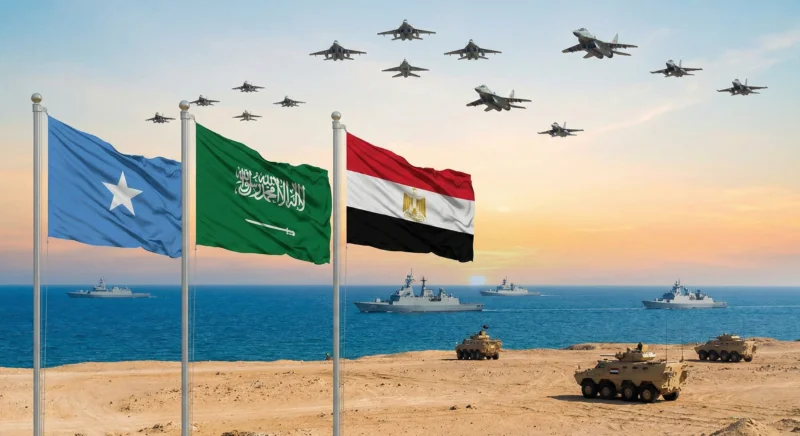


Saudi Arabia, Somalia, and 12 other countries have announced the formation of a new maritime security alliance aimed at safeguarding Bab al-Mandab Strait, the Red Sea, and the Gulf of Aden.
The initiative marks a significant shift in the region’s security architecture as heightened tensions between Iran and the United States continue to threaten global energy shipments through the Strait of Hormuz.
The Saudi Ministry of Defense said the alliance brings together Saudi Arabia, Somalia, Turkey, Kuwait, Bahrain, Qatar, Jordan, Egypt, Pakistan, Djibouti, Bangladesh, Yemen, Sudan, and the Comoros.
The United Arab Emirates and Oman have not joined the initiative despite their strategic interests in the region. Saudi officials described the coalition as a defensive framework that remains open to additional members once they complete their domestic accession procedures.
A Strategic Response to Regional Security Challenges
The announcement comes amid growing instability in one of the world’s most critical maritime corridors.
The Bab al-Mandab Strait, a narrow waterway separating the Horn of Africa from the Arabian Peninsula, serves as a vital gateway linking the Red Sea to the Gulf of Aden.
An estimated 10–12 percent of global trade passes through the route each year.
The new alliance follows heightened maritime threats, including attacks on commercial shipping by Yemen’s Houthi movement and broader regional tensions that have disrupted shipping through the Strait of Hormuz, a route that handles roughly one-fifth of global oil and gas exports.
Regional analysts have also linked the initiative to recent discussions involving Saudi Arabia, Somalia, and Egypt over expanding security cooperation in the Red Sea, suggesting the new coalition represents a broader regional effort to strengthen collective maritime security.
Somalia’s Expanding Strategic Role
Somalia’s participation underscores its growing importance in Red Sea security. With Africa’s longest coastline, Somalia occupies a strategic position along key international shipping lanes connecting the Middle East, Africa, and Asia.
In recent months, Mogadishu has confirmed discussions with Saudi Arabia and Egypt on expanding maritime security cooperation while also strengthening bilateral partnerships in port development, naval cooperation, and maritime infrastructure.
Saudi Arabia has consistently reaffirmed its support for Somalia’s sovereignty, territorial integrity, and efforts to combat Al-Shabaab. The new alliance could represent one of Riyadh’s most significant direct security engagements with Somalia in recent years.
UAE’s Absence Draws Attention
The absence of the United Arab Emirates has attracted particular attention given Abu Dhabi’s longstanding investments in ports across the Horn of Africa, including Berbera in Somaliland and Bosaso in Puntland.
Relations between Somalia and the UAE have experienced periodic strains over port and security agreements, while Saudi Arabia, Egypt, and Turkey have continued to publicly support Somalia’s territorial integrity.
The new coalition is therefore viewed by some observers as reflecting evolving regional alignments in the Red Sea.
Focus on Maritime Security
Member states said the alliance is founded on the principle that maritime security is a shared responsibility requiring closer regional cooperation.
Planned activities include intelligence sharing, operational coordination, joint maritime patrols, surveillance, and coordinated naval operations aimed at protecting international shipping routes. However, several operational details remain unclear.
Saudi Arabia has not announced where the alliance will be headquartered, how participating naval assets will be integrated, or how the initiative will coordinate with existing international missions such as the European Union’s Operation Aspides, which already protects commercial shipping in the Red Sea.
Looking Ahead
The establishment of the new maritime coalition represents a major development in the evolving security landscape of the Red Sea and the Horn of Africa.
For Somalia, membership offers an opportunity to strengthen its maritime security capabilities and deepen strategic partnerships with Saudi Arabia and other regional powers.
The alliance’s long-term effectiveness, however, will depend on the willingness of member states to commit military resources, coordinate operations, and address the underlying drivers of maritime insecurity.
The absence of both the UAE and Oman also raises questions about how comprehensive the coalition’s regional reach will ultimately be as geopolitical tensions continue to shape security dynamics across the Red Sea and Gulf of Aden.