

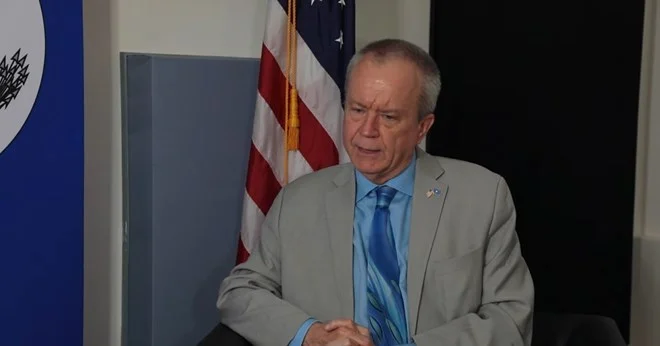

Former U.S. Ambassador to Somalia, Larry André Jr., has delivered a sharp rebuke regarding the political and security situation in Somalia, focusing specifically on the armed conflict in Baidoa, the regional capital of Bay region.
He accused the Federal Government of Somalia of deploying national security forces to advance its political confrontation against the South West State administration and opposition factions.
Larry André, who served as the U.S. Ambassador to Somalia between 2022 and 2023, addressed the escalating crisis in an interview with Sky News, calling on the international community to exert pressure on the administration of Hassan Sheikh Mohamud to halt hostilities and safeguard civilians.
The former diplomat questioned the legitimacy of the Federal Government, alleging that security forces are being weaponized for political agendas rather than prioritizing civilian protection and mitigating severe humanitarian distress.
These remarks come at a juncture where political gridlock and armed clashes in South West State have heightened alarm over the security of Baidoa and the vulnerable populations displaced by the conflict.
Larry André accused the Federal Government of utilizing its troops as political instruments, emphasizing that this practice severely aggravates living conditions for communities in conflict-affected zones.
The former ambassador argued that the political impasse between Mogadishu and the South West State administration cannot be resolved through military force, stressing that all parties must urgently return to political dialogue.
The ongoing standoff in Baidoa centers on intense political rivalries between the Federal Government and factions aligned with the former leadership of South West State.
The clashes have undermined urban security, driving fears that continued hostilities will cause further mass displacement.
André’s allegations form part of broader criticisms levied against the Federal Government regarding its management of internal political disputes and its reliance on military force.
Another highly sensitive aspect of Larry André’s remarks involves reports concerning Turkish F-16 fighter jets, which have been accused of conducting airstrikes across sectors of South West State.
These allegations raise critical questions surrounding the framework of Somali-Turkish military cooperation, particularly amidst internal political friction and domestic armed confrontations.
Should airstrikes in civilian-populated zones be verified, independent investigations into the executing party, targeted locations, and resulting casualties will be vital.
The humanitarian crisis in Baidoa continues to deteriorate as civilians face displacement, severe food insecurity, and inadequate basic services.
A report released in early October by the United Nations High Commissioner for Refugees (UNHCR) indicated that armed clashes in Baidoa have displaced over 5,600 individuals.
This displacement intensifies urgent requirements for food, potable water, emergency shelter, medical supplies, and health services.
Families fleeing the hostilities are frequently forced to abandon their assets, livestock, and primary livelihoods.
Children, pregnant women, the elderly, and malnourished individuals remain among the most vulnerable demographics in this crisis.
Sustained hostilities threaten to inflate the population requiring emergency relief, while kinetic operations simultaneously obstruct aid delivery channels across affected territories.
The clashes around Baidoa coincide with widespread food insecurity across Somalia.
The World Food Programme (WFP) and partner UN agencies issued warnings on September 23, 2026, stating that millions of Somalis could face acute levels of food insecurity between October and December 2026.
Assessments released by aid agencies project that 5.4 million people could face crisis-level or worse food insecurity, with approximately 1.5 million individuals at risk of emergency levels of hunger.
The report specifically highlighted the acute danger in Baidoa, where internally displaced persons face severe threats of extreme starvation and widespread malnutrition.
Relief organizations further warned that anticipated flooding and dwindling donor funding could severely compound the crisis, issuing calls for urgent supplementary financing to support vulnerable households.
It is critical to clarify that a famine risk warning is not synonymous with a formal declaration of famine across the entire region; nevertheless, reported conditions underscore the imperative for immediate intervention.
The deteriorating environment across southern Somalia evokes parallels with the catastrophic famine that struck the country in the early 1990s.
During that era, civil war, state collapse, aid blockades, and severe food shortages resulted in mass mortality, displacement, and widespread destruction of livelihoods.
While today’s political and security dynamics differ from that historical period, the convergence of active conflict, severe hunger, and declining humanitarian assistance dramatically heightens the threat of a severe humanitarian emergency.
Consequently, warnings surrounding Baidoa emphasize the vital necessity of addressing the root drivers of conflict, supporting displaced populations, and ensuring unhindered delivery of food assistance and medical care to the most vulnerable demographics.
Larry André was also linked to severe criticism regarding the incident surrounding the demolition of a World Food Programme warehouse located inside Mogadishu Port in January 2026.
That incident sparked a diplomatic rift between the United States and Somalia, following Washington’s accusations that port authorities demolished a warehouse containing U.S.-funded relief food and unlawfully impounded aid supplies.
The Somali government initially denied that food aid had been looted, stating that the humanitarian supplies remained under WFP custody.
For its part, WFP confirmed that the warehouse had been demolished, but noted that it had recovered 75 metric tons of specialized nutritional supplies.
This episode underscored the critical necessity of protecting humanitarian assets and ensuring transparent supply chain management for vulnerable populations.
It also raised serious questions regarding relations between the Federal Government and international donor partners, particularly at a time when Somalia remains heavily dependent on external humanitarian assistance.
Larry André called on the international community to exert pressure on the Somali government to halt hostilities and alleviate the suffering of civilians.
He further criticized what he characterized as an international aid response insufficient to meet the needs of the Somali population, drawing a contrast between the substantial funding mobilized during the 2022 drought and current commitment levels.
Somali political actors must prioritize civilian protection, peaceful conflict resolution, and ensure that humanitarian assistance remains insulated from political rivalries.
Concurrently, international agencies and donors must step up emergency assistance covering food, healthcare, clean water, and emergency shelter, particularly across regions hosting high concentrations of displaced populations.
Assessments released by aid agencies project that 5.4 million people could face crisis-level or worse food insecurity, with approximately 1.5 million individuals at risk of emergency levels of hunger.
The report specifically highlighted the acute danger in Baidoa, where internally displaced persons face severe threats of extreme starvation and widespread malnutrition.
Relief organizations further warned that anticipated flooding and dwindling donor funding could severely compound the crisis, issuing calls for urgent supplementary financing to support vulnerable households.
It is critical to clarify that a famine risk warning is not synonymous with a formal declaration of famine across the entire region; nevertheless, reported conditions underscore the imperative for immediate intervention.
The deteriorating environment across southern Somalia evokes parallels with the catastrophic famine that struck the country in the early 1990s.
During that era, civil war, state collapse, aid blockades, and severe food shortages resulted in mass mortality, displacement, and widespread destruction of livelihoods.
While today’s political and security dynamics differ from that historical period, the convergence of active conflict, severe hunger, and declining humanitarian assistance dramatically heightens the threat of a severe humanitarian emergency.
Consequently, warnings surrounding Baidoa emphasize the vital necessity of addressing the root drivers of conflict, supporting displaced populations, and ensuring unhindered delivery of food assistance and medical care to the most vulnerable demographics.
Larry André was also linked to severe criticism regarding the incident surrounding the demolition of a World Food Programme warehouse located inside Mogadishu Port in January 2026.