


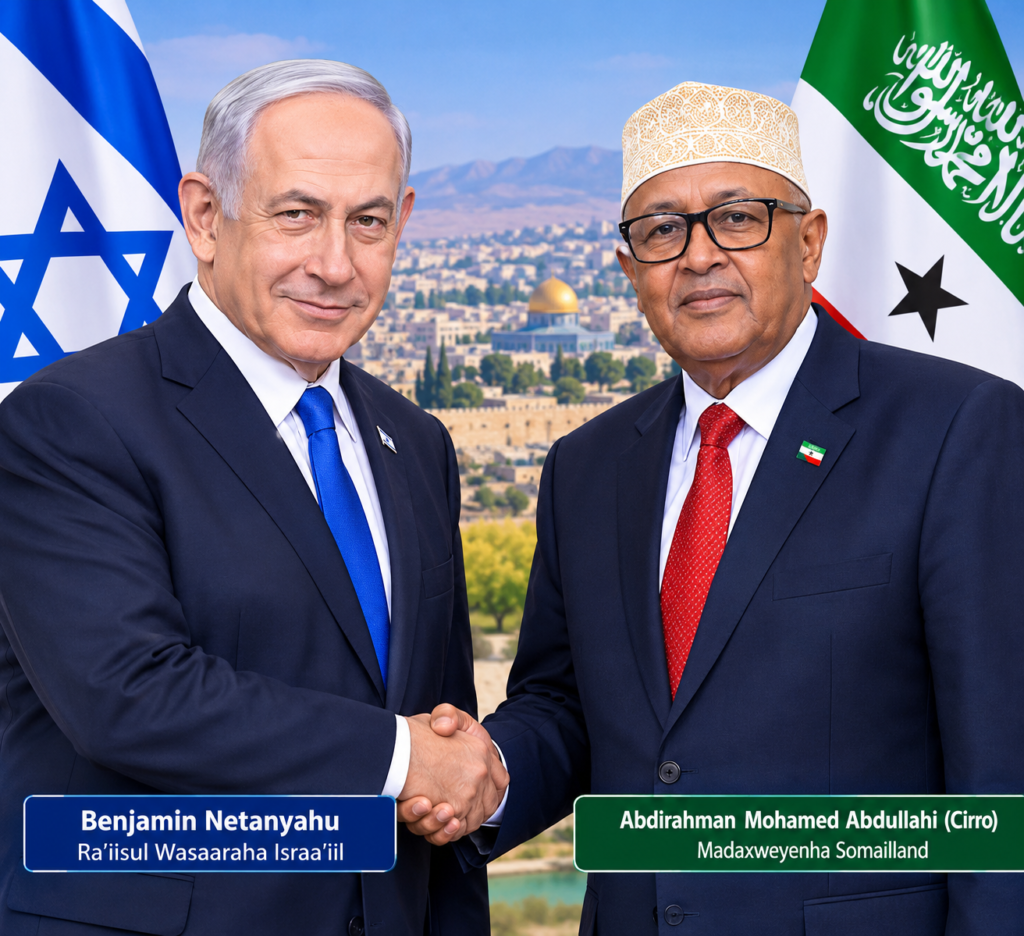


Israel’s changing political landscape could influence its diplomatic priorities across Africa and the wider Red Sea region, with potential implications for Somaliland’s efforts to expand international recognition.
The future of relations between the two sides will depend on the government formed in Jerusalem, its foreign-policy priorities and the response of regional and international actors.
Preliminary results from Israel’s October 27 election indicated that the bloc led by Prime Minister Benjamin Netanyahu was projected to win 53 seats in the 120-member Knesset, compared with 48 for the opposition bloc led by Gadi Eisenkot. Arab-led parties were projected to secure 19 seats.
With at least 61 seats required for a parliamentary majority, neither main bloc had enough support to govern independently. The figures remained preliminary as vote counting continued.


For Somaliland, the election matters because relations with Israel have already moved beyond speculation. Israel formally recognised Somaliland as an independent state on December 26, 2025, becoming the first country to do so.
Somaliland President Abdirahman Mohamed Abdullahi, widely known as Irro, subsequently visited Israel in June 2026, where he was received at the Knesset.
Somaliland also opened a diplomatic mission in Jerusalem, marking a significant development in the relationship.
The central question is whether Israel’s next government will maintain the existing course and expand cooperation with Somaliland.
A government led by Netanyahu could seek to continue the diplomatic approach initiated under his leadership, but the election result alone does not establish what policies the next administration will adopt.
Any assessment will depend on official decisions and agreements announced by the government.


Somaliland occupies a strategically important position along the Gulf of Aden, across from Yemen and near the Bab al-Mandab Strait, a major route linking the Red Sea with the Indian Ocean.
The passage is important for international shipping and energy trade, making security around it a concern for countries well beyond the region.
Berbera port is another factor in the relationship. Its location and commercial infrastructure give it potential significance for trade, logistics and maritime security.
Closer ties with Israel could create opportunities for cooperation in technology, agriculture, water management, healthcare and commercial investment.
However, the possibility of such cooperation should be distinguished from claims about military facilities or basing arrangements, which require clear official evidence.
The broader strategic environment is also important. Türkiye, the United Arab Emirates, Saudi Arabia, Ethiopia and China all have interests in the Horn of Africa and the Red Sea region.
Closer Israeli engagement with Somaliland could therefore intersect with existing competition over ports, trade routes and regional influence. The extent of any effect would depend on the nature of the agreements reached and how other governments respond.
For Somaliland, the main diplomatic objective is to turn its relationship with Israel into broader international engagement. Formal recognition by one country provides an established bilateral relationship, but it does not automatically lead other states to follow suit.
Somaliland would still need to build support through diplomatic outreach, economic partnerships and engagement with African governments and international institutions.


Somalia’s federal government strongly opposes Israel’s recognition of Somaliland, arguing that it violates Somalia’s sovereignty and territorial integrity.
President Hassan Sheikh Mohamud has also expressed concern about the possibility of an Israeli military presence in Berbera. Those statements represent Mogadishu’s position and do not, by themselves, establish that a military base has been agreed or built.
The African Union has likewise continued to support Somalia’s territorial integrity and rejected unilateral recognition of Somaliland. These positions remain significant obstacles to wider regional acceptance of the new relationship.
Security is another concern. Yemen’s Houthi movement has warned against an Israeli presence in Somaliland, amid wider tensions around the Red Sea and attacks on shipping.
If cooperation between Israel and Somaliland were to expand into an overt security or military partnership, it could attract additional scrutiny and potentially expose related interests to threats.
Diplomatic and commercial cooperation, by contrast, would present a different set of risks and opportunities. The actual consequences will depend on what the two sides formally agree to pursue.
Several developments will be important to watch in the coming months: the formation and policy priorities of Israel’s next government; any new agreements with Somaliland on trade, technology, investment or maritime security; and whether other countries establish formal relations with Hargeisa or reaffirm their support for Somalia’s territorial integrity.
Israel’s political transition could affect the pace and scope of its engagement with Somaliland, but it is too early to conclude that a change in government will either expand or weaken the relationship.
For Somaliland, the challenge will be to consolidate its existing diplomatic ties while seeking wider recognition and managing the regional sensitivities surrounding its relationship with Israel.