


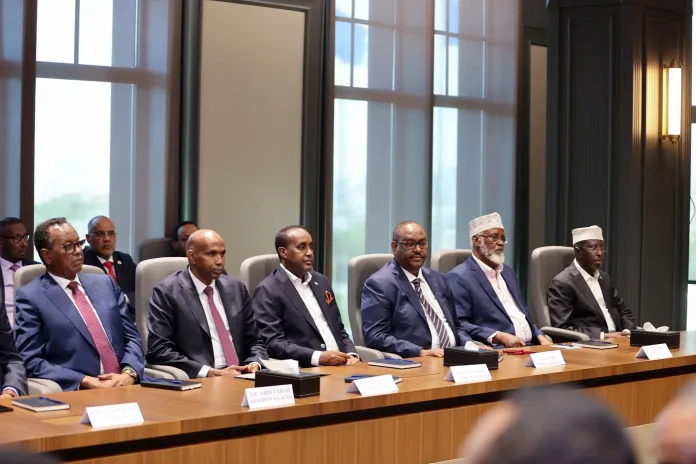


A political alliance between Puntland, Jubaland and opposition leaders in Mogadishu could significantly reshape Somalia’s political landscape, particularly if the groups move beyond coordinating their positions and announce an alternative national leadership.
Such a development could deepen the dispute over constitutional authority, elections and the distribution of power between the federal government and member states, with possible consequences for security, international relations and the economy.
The outcome would depend largely on the form the alliance takes.
A coalition seeking negotiations with the federal government would be fundamentally different from a transitional administration established through a negotiated agreement, or a rival government claiming to hold national authority.
Each scenario would raise different legal and political questions.
The debate comes amid continuing disagreements over Somalia’s constitutional framework, the terms of public institutions and the electoral process.
A Chatham House analysis published on October 16, 2026, reportedly highlighted the growing political tensions and warned of the risks posed by unresolved disputes between federal authorities and other political actors.
The central challenge is whether the parties can reach an agreement on the rules governing the country before their differences further undermine political stability.
If Puntland, Jubaland and opposition leaders were to declare a rival national government, Somalia could face competing claims to political legitimacy.
The Federal Government of Somalia would likely continue operating the presidency, parliament, cabinet and institutions under its control, while the alliance might seek to establish a separate leadership council, transitional administration or alternative electoral framework.
Such a development would raise difficult questions about who has the lawful authority to govern, manage national resources, issue security directives, sign agreements on behalf of the country and represent Somalia internationally.
A political declaration alone would not automatically transfer constitutional powers or establish a new government’s legal authority.
The dispute is closely linked to disagreements over constitutional changes and the future electoral system.
Federal authorities have defended their approach to constitutional reform and direct elections, while Puntland, Jubaland and opposition figures have challenged aspects of the process, arguing that key political changes require broader agreement.
A new alliance could therefore seek a different electoral roadmap, including negotiations on the terms of public office, the selection of national leaders and arrangements for elections acceptable to the competing sides.
If both camps maintain incompatible plans, uncertainty could deepen. Institutions may issue conflicting decisions, and citizens and public officials could face confusion over which political arrangements apply.
The resulting stalemate could also make it more difficult to agree on national priorities, public spending and the implementation of government programmes.
Puntland and Jubaland could use a joint front with Mogadishu-based opposition leaders to strengthen their bargaining position in negotiations with the federal government.
By coordinating their demands, the three groups might press for a broader political settlement covering elections, constitutional authority and relations between federal and state institutions.
However, an alliance would not necessarily mean that its members agree on every issue.
Puntland and Jubaland have distinct administrative, security and economic interests, while opposition leaders in Mogadishu may differ over national leadership and the future structure of government.
Its effectiveness would depend on a clear agreement defining shared objectives, decision-making procedures, the powers of participating members and mechanisms for resolving internal disputes.
If the alliance attracted support from a broad range of politicians, traditional elders, civil society groups and other constituencies, it could increase pressure on the federal government to reopen negotiations.
That pressure might take the form of political conferences, calls for mediation, opposition to the existing electoral timetable or efforts to secure intervention by domestic and international facilitators.
The federal government, in turn, could insist that existing constitutional institutions continue operating and that political disagreements be resolved through established legal procedures.
Whether the confrontation leads to negotiations or a prolonged impasse would depend on the willingness of both sides to compromise and the strength of any proposed settlement.


One of the most serious risks would arise if the political dispute spilled over into the security sector.
If an alternative leadership claimed authority over security forces or competing sides sought control of government facilities, military bases and strategic locations, the possibility of clashes could increase.
Conflicting orders to armed units could also complicate command structures and create further instability.
Somalia has previously experienced confrontations linked to disputes between federal authorities and member states.
The BTI 2026 country assessment documented earlier clashes involving federal forces and Jubaland forces amid political disagreements and disputes over the legitimacy of regional leadership.
Such precedents illustrate the potential dangers, although the formation of a political alliance would not, by itself, mean that armed conflict was inevitable.
The security implications would extend beyond the immediate political contest. A prolonged dispute could weaken coordination between federal forces and regional security units, disrupt intelligence-sharing and divert resources from operations against Al-Shabaab.
If security institutions become preoccupied with internal rivalries, the militant group could find opportunities to regroup or exploit areas where pressure from government forces has diminished.
Civilians could bear the consequences through deteriorating security, disrupted transport routes and greater difficulty accessing essential services.
Communities in areas affected by armed operations could face renewed displacement, while efforts to secure territory and protect residents could suffer setbacks.
Any political agreement would therefore need to preserve security cooperation and prevent institutional disagreements from undermining operations against armed groups.


The international response would be another major uncertainty.
The United Nations, African Union, Intergovernmental Authority on Development and Somalia’s international partners could face difficult questions about whom to engage, how to support political dialogue and how to maintain cooperation with national institutions.
However, the creation of a rival administration would not automatically lead to international recognition.
Foreign governments and international organisations would consider the legal basis of the competing claims, the extent of political agreement behind them and the implications for Somalia’s constitutional order and territorial integrity.
An alliance could gain political influence without being recognised as a separate or replacement national government.
A prolonged crisis could also affect investment, trade and development programmes. Businesses may become more cautious if political uncertainty raises security risks or disrupts the movement of goods between regions.
Disagreements between institutions could complicate the delivery of public services and the coordination of development projects.
Poorer households, displaced people and communities dependent on humanitarian assistance could be particularly vulnerable if the dispute worsens the operating environment for aid organisations.
There is, nevertheless, a possible alternative to confrontation.
If Puntland, Jubaland and opposition leaders use their cooperation to negotiate a settlement accepted by the federal government and other stakeholders, the alliance could help reopen political dialogue and establish a mutually agreed electoral process.
Such an outcome would require more than a shared opposition position: it would depend on specific commitments, credible implementation arrangements and safeguards against renewed disputes.
Ultimately, the consequences would depend on whether the alliance seeks to negotiate within Somalia’s existing constitutional framework, proposes a transitional arrangement agreed by the relevant parties, or attempts to establish a competing national authority unilaterally.
The first two approaches could create opportunities for a political settlement if they are inclusive and legally grounded. The third could intensify the dispute over legitimacy and increase the risks of institutional fragmentation, international uncertainty and security deterioration.
The central question is therefore not simply whether Puntland, Jubaland and the Mogadishu opposition can form an alliance, but what authority they would claim, how that authority would be established and whether the wider political community would accept the process.
A negotiated settlement could help address the disputes driving the crisis, while a unilateral move to establish rival national leadership could make Somalia’s political and security challenges more difficult to resolve.