




Hiiraan Region is emerging as an increasingly important area in the wider geopolitical competition between Egypt and Ethiopia, two countries with significant security and strategic interests in Somalia.
Ethiopia’s long-standing military presence in the region and Egypt’s growing defence cooperation with Mogadishu, including its planned contribution to the African Union Support and Stabilization Mission in Somalia (AUSSOM), have raised questions about whether Hiiraan could become another arena for regional rivalry.
Located in central Somalia, Hiiraan occupies a strategic position linking southern and central parts of the country with the Ethiopian border.
Beledweyne, the regional capital, and surrounding areas have long been important operational centres for Somali and Ethiopian forces fighting Al-Shabaab.
The region is also facing internal political tensions over representation, power-sharing and the future leadership of Hirshabelle State, creating an increasingly complex security and political environment.
These developments have prompted questions about whether competing Egyptian and Ethiopian interests could intersect in Hiiraan, particularly as the two countries remain at odds over issues extending well beyond Somalia.


Ethiopia has maintained a military presence in Somalia for years, particularly in areas close to their shared border. Its forces have operated in Hiiraan as part of African Union-backed security arrangements and bilateral cooperation with the Somali government.
On September 7, 2026, AUSSOM announced a troop rotation involving Ethiopian forces stationed in Beledweyne and at the Halgan base.
Newly deployed personnel took over from soldiers who had served in the area for three years, assuming responsibility for continued security operations under the mission’s Sector Four.
The rotation underscored the military dimension of Ethiopia’s presence in Hiiraan, which extends beyond diplomatic relations between Mogadishu and Addis Ababa.
Ethiopian forces have played a longstanding role in operations against Al-Shabaab, particularly in border areas, making any significant adjustment to their deployment potentially consequential for security in Hiiraan and neighbouring regions.


Egypt, meanwhile, has considerably strengthened its relations with Somalia in recent years, particularly through defence cooperation, military training and security arrangements.
The two governments signed a military cooperation agreement on August 14, 2024, against the backdrop of rising tensions between Cairo and Addis Ababa over Ethiopia’s Grand Ethiopian Renaissance Dam (GERD) and wider regional strategic interests.
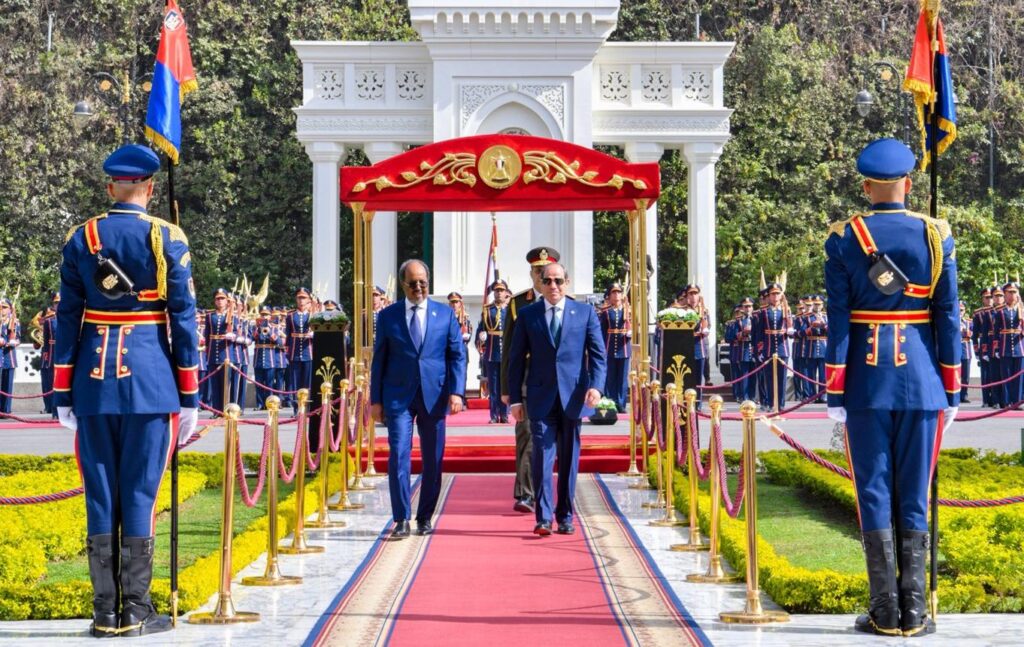
On February 12, 2026, President Hassan Sheikh Mohamud attended a ceremony in Egypt marking preparations for Egyptian troops expected to join AUSSOM. Egyptian officials said the deployment was intended to support security and stability in Somalia.
However, it is important to distinguish between Egypt’s confirmed plans to contribute troops to AUSSOM and claims about where those forces might be stationed.
Some earlier reports raised the possibility of Egyptian deployments to Gedo and Hiiraan, but the deployment arrangements announced by the Somali government identified AUSSOM’s Sector Five in Middle Shabelle, particularly the area between Balcad and Mahaday, as the intended area of operation for Egyptian forces.
There is therefore insufficient confirmation that Egypt has been assigned bases in Hiiraan.
This distinction matters because Egypt’s planned participation in the African Union mission is an established development, while the suggestion that its troops will operate directly in Hiiraan remains unverified.


Hiiraan’s strategic importance stems from several factors. Its long border with Ethiopia makes it particularly relevant to Addis Ababa’s security calculations, while Beledweyne serves as an important economic, administrative and military centre.
The Halgan base and roads connecting central regions are also significant for troop movements and the transportation of supplies.
The region has been a major theatre in the campaign against Al-Shabaab, with security developments there affecting movement between central Somali regions and the federal government’s ability to maintain control over liberated areas.
At the same time, political disagreements in Hirshabelle, particularly over Hiiraan’s representation and influence in the state administration, have added another layer of complexity.
The rivalry between Egypt and Ethiopia, however, did not originate in Somalia. It is rooted largely in their longstanding dispute over the Nile River and Ethiopia’s construction of the GERD.


Egypt, which relies heavily on Nile waters, regards developments affecting the river’s flow as a major national security concern. Ethiopia considers the dam essential to its electricity generation, economic development and broader national ambitions.
Their competing interests also extend to maritime security. Ethiopia has sought access to the sea to strengthen its trade and strategic position, while Egypt is concerned about security in the Red Sea and the Bab el-Mandeb Strait, one of the world’s most important maritime routes.
Germany’s Institute for International and Security Affairs (SWP) warned in an October 28, 2024, analysis that tensions involving Egypt, Ethiopia and Somalia could become increasingly interconnected, with external rivalries potentially aggravating Somalia’s internal disputes.
Similarly, the Critical Threats Project warned in an August 28, 2025, assessment that Somalia could become an arena for competing Egyptian and Ethiopian interests if their regional confrontation becomes entangled with the country’s domestic political divisions.
Against this background, Ethiopia’s established military presence in Hiiraan and Egypt’s expanding security partnership with Somalia have fuelled speculation about whether the region could be affected by the rivalry.


However, there is no sufficient evidence that Egypt intends to deploy troops directly to Hiiraan to counter Ethiopian forces.
Several developments could nevertheless influence the situation. Any reduction or restructuring of Ethiopia’s military presence in Somalia could alter the security balance in Hiiraan.


Further expansion of Egypt-Somalia defence cooperation could also make the location and responsibilities of Egyptian forces under AUSSOM increasingly significant.
Meanwhile, continued political instability in Hiiraan could create opportunities for external actors to pursue their interests through local alliances.
Changes in AUSSOM’s force composition may also affect security arrangements, given that the mission relies on troops contributed by several countries.
The central concern is therefore not simply that Egypt and Ethiopia have military interests in Somalia, but that their wider rivalry could become entangled with domestic disputes and make political reconciliation more difficult.
These regional developments are unfolding as Hiiraan faces a period of heightened political tension.
Recent meetings in Beledweyne have involved traditional leader Ugaas Yusuf Ugaas Hassan Ugaas Khalif, lawmakers and other regional political figures, amid disagreements over political representation, power-sharing within Hirshabelle and the process through which the state’s new leadership was elected.
On November 9, 2026, President Hassan Sheikh Mohamud announced that the capital of Hirshabelle State would be relocated to Hiiraan Region.
He said the process would follow official government procedures and that residents of the region would be expected to propose a suitable city to serve as the state capital.
The announcement could address one of Hiiraan’s longstanding political grievances, particularly demands for greater representation and a stronger role in Hirshabelle’s administration.
However, important questions remain over the legal process, the selection of the proposed city, the authorities responsible for approving the decision and when it might be implemented.
Relocating the capital alone would not necessarily resolve the region’s wider political and security disputes.


Ethiopia is also facing internal security challenges, including renewed tensions involving Tigray and other parts of the country.
On November 5, 2026, Somalia’s State Minister for Foreign Affairs, Ali Mohamed Omar, commonly known as Ali Balcad, warned that instability in Ethiopia could have direct consequences for Somalia because of their shared border and longstanding social, economic and historical ties.
He cautioned that a worsening security situation could prompt Addis Ababa to recall troops deployed in Somalia, potentially affecting AUSSOM and the campaign against Al-Shabaab.
Such a development would be particularly significant for Hiiraan, where Ethiopian forces maintain positions in Beledweyne and Halgan.
A substantial reduction in their numbers or operational capacity could create security gaps, requiring Somali forces and AUSSOM to prepare alternative arrangements to maintain stability and prevent Al-Shabaab from exploiting any disruption.
The Federal Government therefore faces the dual responsibility of safeguarding Somalia’s sovereignty while ensuring that foreign military partnerships do not intensify domestic political divisions.
It needs to clarify where contributing countries’ forces will operate, the command arrangements governing their deployments and the specific responsibilities assigned to each contingent.
The government must also reassure communities in Hiiraan that cooperation with Egypt and Ethiopia will not be used to support competing political factions or influence local disputes.
Federal authorities, Hirshabelle’s administration, traditional leaders, lawmakers and residents all have a role in pursuing a political settlement that is independent of external rivalries.
Egypt’s expanding defence relationship with Somalia and Ethiopia’s longstanding military presence in Hiiraan give the region a significant place in the wider strategic competition between the two countries.
But the available information does not establish that Egyptian and Ethiopian forces are directly competing against each other inside Hiiraan.
Egypt’s planned AUSSOM deployment has been associated with Middle Shabelle, while Ethiopia continues to maintain forces in Beledweyne and Halgan.
Whether Hiiraan becomes an example of regional security cooperation or is drawn further into external rivalries will depend largely on how Somalia manages its foreign partnerships, addresses local political grievances and maintains a coordinated national security strategy.