


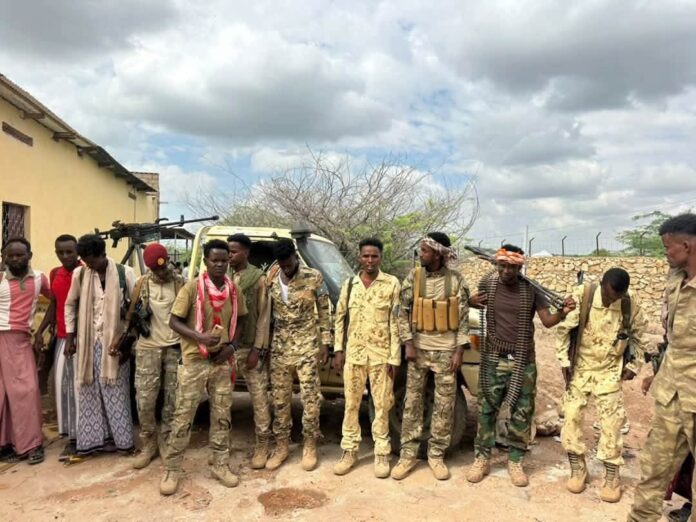


Tensions in Beledweyne have taken a new turn following reports that members of Somalia’s National Intelligence and Security Agency (NISA) have abandoned their government duties and joined the Hiiraan Front, an armed group supporting Ugas Yusuf Ugas Hassan Ugas Khalif.
The personnel reportedly arrived at the traditional leader’s residence in Beledweyne in an armed technical vehicle, where they expressed support for him and opposed what they described as an assault on the Ugas and the community he represents.
The reports have raised serious questions about the relationship between Somalia’s federal security institutions, political leadership and traditional authorities in Hiiraan.
However, the number of personnel involved, their official institutional affiliation and their current employment status have yet to be independently established.
The reported development followed a press conference by Ugas Yusuf at his residence, where he addressed the deteriorating political and security situation in the region.
He accused individuals allegedly approaching Hiiraan under the authority of the federal government of posing a threat to local communities.
He also appealed to government security personnel from the Hawadle clan to stand with their communities and avoid being used in military operations against local residents.
His remarks attracted considerable attention among politicians, security personnel and residents of Beledweyne.
Local media reports said armed government personnel from the Hawadle community had arrived at the Ugas’s residence in a military vehicle.
Some accounts identified them as members of the Somali National Army, while other information described them as NISA personnel. The discrepancy means their precise affiliation requires independent verification.
The legal implications would depend largely on whether the individuals are still serving members of a government security institution, whether they had authorisation to leave their posts and what actions they took after arriving at the Ugas’s residence.
NISA is a national security institution responsible for intelligence gathering, counterintelligence and other duties related to protecting Somalia’s national security.
Its personnel are expected to operate within established command structures and comply with applicable laws and service regulations.
If investigations establish that serving NISA personnel abandoned their assigned duties and formally joined an armed group outside the agency’s command, they could face disciplinary or legal consequences under the laws and regulations governing their service.
The circumstances could also warrant an investigation into possible breaches of military or security procedures.
Questions would include whether the personnel had been granted leave, formally resigned, disobeyed orders or deserted their posts.
If they took government-owned weapons or vehicles with them, authorities would also need to establish who authorised their use, who was responsible for the equipment and whether it was unlawfully retained or deployed.
However, expressing support for a traditional leader or visiting his residence does not, by itself, establish that a security officer has committed a criminal offence.
Any legal action would require evidence of specific misconduct and a clear assessment of the individuals’ employment status and actions.
The broader concern is that political and clan-based divisions in Beledweyne could begin affecting the national security institutions.
If serving personnel align themselves with competing political or community factions, the development could undermine command structures, weaken public confidence and make it more difficult to maintain a unified security force in the region.
The federal government is therefore expected to clarify the status of the personnel involved and establish the facts before taking action.
Any response should be based on verified evidence and applicable law, rather than unconfirmed reports or assumptions about the individuals’ clan affiliations.
The Hiiraan Front has attracted support from sections of the local community and politicians opposed to the political leadership and administration of Hirshabelle State.
Ugas Yusuf has emerged as one of the most prominent traditional figures calling for greater unity among Hiiraan communities and resistance to what he describes as an attempt to impose federal authority through force.
If former or serving government security personnel have genuinely joined the group, their involvement could give the movement a different security dimension.
However, the number of personnel, their operational capacity and whether their actions represent a coordinated decision remain unclear.
Other reports indicate that federal government troops who had left the Xananbuure area in Galgaduud region were heading towards Beledweyne, pointing to possible military movements amid the escalating tensions.
Their precise mission and the orders under which they are operating have not been independently confirmed.
The developments have placed several questions before the federal government and security commanders: whether serving NISA personnel have defected, how many are involved, what prompted their actions and whether they took government weapons or vehicles.
Authorities must also determine whether to pursue disciplinary investigations, open legal proceedings or seek a political solution to prevent further escalation.
The crisis in Beledweyne extends beyond the political dispute surrounding Hirshabelle’s leadership.
Hiiraan is strategically important in Somalia’s campaign against Al-Shabaab, with local forces, particularly the Macawiisley community militias, playing a significant role in operations against the militant group in recent years.
A further deterioration in relations between government forces, local security groups and traditional leaders could complicate those operations and weaken cooperation against Al-Shabaab.
Preventing political disagreements from dividing security personnel will therefore be critical to maintaining stability in Hiiraan.