

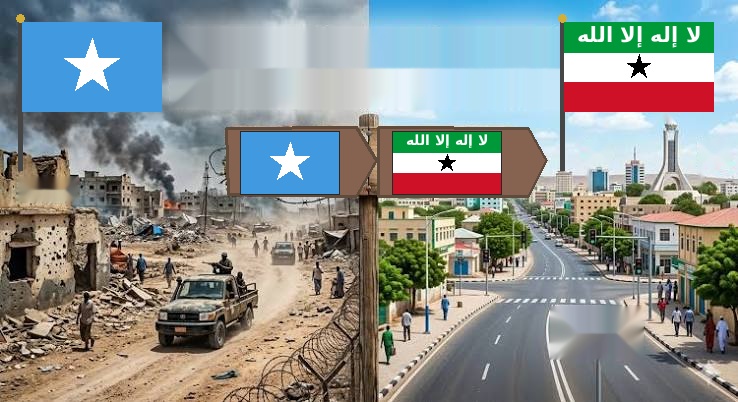

Debate is intensifying regarding the underlying factors behind Somaliland’s advancements in governance, security, and economic infrastructure, with many observers drawing direct comparisons between Somaliland’s trajectory and that of the rest of Somalia.
A segment of political analysts contends that Somalia’s persistent political friction, power-sharing disputes, and allegations of clan patronage continue to impede the establishment of a unified state structure.
Critics holding this view also raise fundamental questions regarding President Hassan Sheikh Mohamud’s administration of federal authority and his broader management of political alignments.
Detractors of the federal executive maintain that executive overreach, constitutional disputes, and political rivalries risk further eroding public trust unless sustainable resolutions are reached to address the ongoing stalemates.
However, the assertion that Somaliland’s progress is directly attributable to Hassan Sheikh’s leadership or internal federal policies remains independently unverified.
This comparative dynamic must be evaluated through the distinct historical trajectories, administrative institutions, security architectures, and economic realities of both jurisdictions.
Since declaring its separation from Somalia in 1991, Somaliland has developed independent administrative institutions, establishing democratic frameworks, multi-party electoral cycles, and an economic system sustained by domestic revenue generation and commerce.
The Port of Berbera, livestock exports, private enterprise, and diaspora remittances serve as primary drivers of Somaliland’s economy.
A report published by the Financial Times in March 2026 highlighted the strategic role of Berbera Port, private commercial investment, and diaspora capital flows in driving the regional economy.
On the other hand, research conducted by scholars affiliated with Oxford University demonstrates that Somaliland possesses long-standing administrative and political progress, though persistent challenges remain regarding internal disputes, social representation, and territorial conflicts.
These dynamics illustrate that Somaliland’s progress is not attributable to a single leader or isolated policy, but rather to a convergence of factors including social pacts, commercial activity, institutional development, and security conditions.
Debates concerning the leadership of Hassan Sheikh Mohamud have focused on constitutional revisions, term lengths for state institutions, and friction between the federal government and several federal member states.
A report published by the European Union Asylum Agency EUAA in June 2026 stated that disputes over constitutional reviews and the extension of presidential and parliamentary mandates have contributed to political divisions in Somalia.
The report also noted that sections of the political opposition rejected term extensions, while friction between the federal government and member states affected the country’s broader political relationships.
Critics of these measures argue that political disagreement delays agreed-upon electoral processes and complicates operational cooperation among state institutions.
Conversely, the federal government and its supporters characterize constitutional reforms as an essential component of finalizing the state-building architecture.
Consequently, debates over the legitimacy and procedural execution of these changes remain a key political issue requiring broad-based consensus.
A primary critique frequently directed at Somali politics is that clan-based power-sharing influences official appointments, resource management, and strategic policy decisions.
Proponents of this view maintain that government institutions should operate on the basis of statutory law, meritocracy, and institutional accountability, rather than having critical decisions tied to political alignments or clan interests.
The BTI 2026 Country Report for Somalia highlights that power networks and clan-based affiliations continue to exert strong influence over the country’s governance, alongside ongoing challenges in enforcing the separation of powers and adhering to the rule of law.
However, allegations that the current administration operates solely in pursuit of particularistic clan interests must be evaluated against empirical evidence regarding executive appointments, budget allocations, public service delivery, and dispute-resolution mechanics.
Is there an imminent risk of Mogadishu descending into armed political conflict?
A cross-section of political analysts and concerned stakeholders warn that political disputes between the federal executive and opposition factions could degenerate into armed confrontations if inclusive dialogue and political consensus are not achieved.
Mogadishu has historically endured devastating urban warfare and political instability that inflicted catastrophic impacts on civilians.
Consequently, any security concerns regarding political gridlock escalating into kinetic violence warrant serious strategic assessment.
Nevertheless, there is currently insufficient empirical evidence to conclude that renewed armed conflict in Mogadishu is inevitable or imminent.
It remains essential to distinguish between political posturing/warnings and verified intelligence indicating an immediate operational security threat.
Averting such a contingency depends on sustained political dialogue between the federal government and opposition caucuses, strict adherence to constitutional legality, mitigating inflammatory rhetoric, and resolving institutional disputes through negotiated political frameworks.
Ultimately, the comparative assessment between Somalia and Somaliland underscores several vital imperatives: establishing functional state institutions, building durable social pacts, maintaining public security, supporting private enterprise, and securing genuine public trust.
Somaliland faces its own distinct set of challenges, including territorial disputes, investment limitations, and the ongoing need to further strengthen social representation.
Meanwhile, the rest of Somalia confronts multifaceted hurdles relating to security, power-sharing frameworks, constitutional disputes, and the task of building state institutions that operate uniformly across the entire national territory.