

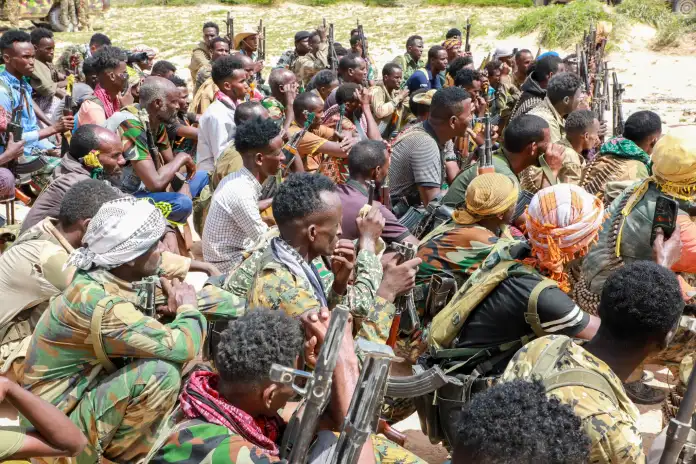

The Macawisley community defense forces have withdrawn from several frontline positions and are streaming into the city of Beledweyne, as the political conflict between federal government leadership and regional community leaders continues to intensify.
The Macawisley have for several years played a vital role in counter-insurgency operations against Al-Shabaab alongside the Somali National Army (SNA).
However, the political crisis in Hiiraan has now impacted the security operations led by these local forces across the region.
Reports indicate that several local defense contingents have vacated their assigned outposts, triggering deep concerns over regional security and the trajectory of the counter-insurgency campaign against Al-Shabaab.
According to available intelligence, Macawisley fighters abandoned forward defensive trenches on the outskirts of Buuloburde and Matabaan districts, while other units are planning to withdraw from the Jalalaqsi district sector.
This troop movement comes as a massive concentration of Macawisley forces—estimated at nearly 2,000 fighters—has assembled inside Beledweyne city.
On Friday, these forces took control of portions of the Lama Galaay military camp, which houses Hiiraan regional administrative headquarters and security bases, with no clashes reported between the Macawisley and government troops.
The tactical movement of these forces is linked to the ongoing political standoff surrounding the Hiiraan regional administration—specifically disputes over the regional governorship and plans by local politicians and traditional elders to establish an autonomous administration separate from HirShabelle State.
Macawisley elements are reportedly backing this regional administrative shift, which is spearheaded by local political figures and traditional clan leaders.
The proposal under discussion entails forming a dedicated Hiiraan regional authority based in Beledweyne, operating independently of HirShabelle State.
Further reports suggest regional community leaders plan to integrate the Macawisley as the primary security force for the newly proposed administration to support its institutional setup and defense.
However, the framework for this prospective administration remains unclear, with stakeholders awaiting formal responses from the Federal Government of Somalia (FGS) and HirShabelle State leadership.
The Macawisley’s troop movements are escalating political pressure on both the FGS and the HirShabelle administration.
Hiiraan political figures have previously expressed outright rejection of current regional governance arrangements, advocating for a localized administration acceptable to the resident population.
Should this impasse persist, it threatens to degrade relations between the federal government and Hiiraan community leaders, further complicating political conflict resolution efforts.
Concurrently, concerns are mounting that local SNA units originating from the region may also abandon their defensive lines, compounding Hiiraan’s security collapse.
A major strategic concern stemming from the Hiiraan crisis is that Al-Shabaab will exploit the operational disunity between government forces and local defense contingents.
The Macawisley and local SNA units have collaborated for several years in counter-insurgency operations against Al-Shabaab, playing a crucial role in liberating extensive territories.
If these forces vacate their defensive lines, Al-Shabaab could retake previously liberated areas, particularly outside major urban centers.
The SNA High Command also faces severe personnel shortfalls and limited capacity to backfill defensive perimeters vacated by local defense units.
Consequently, political instability poses a grave threat to regional security operations, as government forces may be forced to consolidate and focus solely on defending major urban hubs and key supply corridors.