

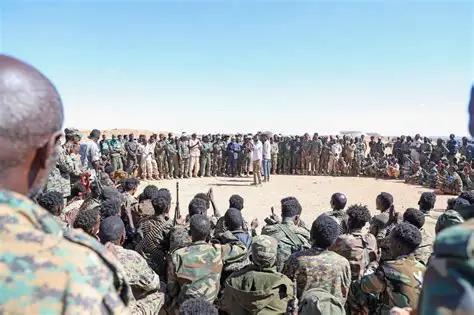

The Federal Government of Somalia has taken a new step regarding the restructuring and expansion of the Somali National Army (SNA) following the reorganization of the SNA’s 26th Division, with Lieutenant Colonel Abdirahman Awad Abdirahman appointed as its commander.
The newly formed division is scheduled to operate in the northeastern regions of Somalia, with its command base established in the Northeast area, while the forces are slated to deploy across wide expanses including parts of northern Galkayo and coastal areas of Sanaag.
The reconstitution of this division holds special significance, as it represents a dedicated SNA unit structured to maintain a permanent operational presence in territories that have long lacked a formal federal military footprint.
The 26th Division is not a novel designation within Somali military history, but rather part of the historical organizational architecture of the former national armed forces.
The collapse of Somalia’s central government in 1991 led to the disintegration of the national military structure, after which regional territories relied heavily on localized militias and regional security forces.
In recent years, the federal government has pursued a structured plan to restore the national military framework by rebuilding divisions and brigades to operate across various regions.
The 26th Division now joins the roster of newly established units through which the government aims to reinforce the presence of the Somali National Army in the Northeast.
Lieutenant Colonel Abdirahman Awad Abdirahman has been appointed to command the 26th Division.
Awad previously served as the Commander of the Somali Navy and is regarded as part of the new generation of military officers within the armed forces.
The officer is also among those who received military training in Eritrea, which formed part of broader efforts to cultivate a new cadre of Somali officers prepared to lead the national armed forces.
Awad’s appointment is thus considered a crucial step for the leadership of the new division, requiring an officer capable of coordinating large troop formations and wide-area operations.
Prior to the new commander’s appointment, the SNA Command reportedly authorized the disbursement of salaries for the personnel slated to comprise the 26th Division.
The total strength of the forces designated to operate within this division stands at 2,500 troops.
Such a troop strength could position the 26th Division as a major military unit, provided all of those forces are fully operationalized.
However, building a military division encompasses far more than just personnel.
A force of this nature requires permanent infrastructure, transport, weaponry, communications, medical facilities, logistical supply lines, fuel, ongoing training, and a structured administrative framework.
Consequently, the next critical phase will focus on how the federal government ensures that the 26th Division receives the essential material and services required for sustained, continuous operations.
The reconstitution of the 26th Division comes at a time when northeastern Somalia has assumed heightened strategic importance within the national security framework.
The region encompasses vast expanses of territory, multiple international borders, and a lengthy coastline stretching along the Indian Ocean and the Gulf of Aden.
A formalized national military presence in these territories can afford the government enhanced capability to secure state institutions, critical transit routes, maritime borders, and frontier zones.
Furthermore, federal forces can play an integral role in countering militant groups and combating illicit activities across remote interiors and coastal domains.
One of the most compelling dimensions concerning the 26th Division is the operational plan to extend forces into parts of Sanaag.
The newly appointed division commander, Abdirahman Awad, originates from the Sanaag region.
This background has drawn public attention, with expectations that his localized familiarity and contextual expertise will aid in navigating the intricate security and social dynamics of the region.
Nevertheless, executing a military deployment in Sanaag will necessitate comprehensive strategic planning, alongside deep coordination with local communities and administrative bodies.
Sanaag represents a politically and administratively sensitive zone, underscoring the imperative that any military operation be underpinned by a clear strategy prioritizing regional stability and the protection of civilians.
The coastline of Sanaag holds specialized strategic significance.
The expansive northern maritime borders of Somalia lie adjacent to critical shipping lanes essential for regional commercial transit.
Accordingly, the deployment of federal forces can bolster coastal surveillance, combat illegal, unreported, and unregulated (IUU) fishing, and mitigate maritime piracy and smuggling networks.
National forces can likewise enhance operational synergy with the Somali Navy and other maritime security agencies dedicated to defending territorial waters.
Ultimately, the restructuring of the 26th Division provides the federal government with an enhanced mechanism to project central state presence throughout the Northeast.
For a prolonged period, the security of numerous regions across Somalia has been managed by local administrations, police forces, and community militias.
In recent years, the Federal Government has sought to augment the capabilities of the Somali National Army, aiming to consolidate security responsibilities under a unified national force operating under a single command structure.
The Federal Government is currently prioritizing the comprehensive reform of the Somali National Army.
The stated objective is to establish a force characterized by a clear organizational structure, continuous training, and the operational capacity to project power across all regions of the country.
The reconstitution of military divisions is equally critical to the government’s long-term strategy, particularly as international peace enforcement and security missions draw down or conclude their deployments in Somalia.
As foreign troop levels diminish, an increased burden falls upon the federal government to prepare its domestic forces to fully assume national security responsibilities.
The deployment of federal forces in the Northeast will similarly necessitate close cooperation with local administrative authorities.
While the Somali National Army carries national security mandates, regional authorities retain primary responsibility for numerous aspects of internal governance and localized policing.
Should both tiers of governance collaborate effectively, federal forces can secure vital social and administrative backing to facilitate their operations.
Conversely, potential friction regarding authority, command hierarchy, or operational jurisdictions could undermine the efficacy of the new division.
The commander is tasked with coordinating a substantial troop force, establishing a functional command chain, enforcing rigorous training and disciplinary standards, and aligning closely with the overarching strategy of the SNA General Command.
His prior leadership experience within the Somali Navy may also prove advantageous should elements of the division be deployed to coastal sectors.
Nevertheless, commanding a ground-based military division presents distinct operational challenges, particularly when conducting maneuvers across vast and varied rural and coastal terrain.
One of the primary mandates expected of the 26th Division is active participation in regional security stabilization and the counter-insurgency campaign against armed groups.
Northeastern Somalia harbors various armed factions and networks operating across both interior lands and maritime domains.
A permanent federal military footprint in the region can provide the government with enhanced intelligence gathering capabilities, secure critical supply routes and state installations, and mount rapid responses to security threats.
Should these forces be deployed to coastal districts, the government’s capacity for maritime surveillance and defense will likewise be significantly reinforced.
On a community level, the presence of the national military could catalyze a positive shift in security dynamics if the forces are deployed to protect civilians and counter armed elements.
Communities residing in remote interiors have long confronted severe vulnerabilities regarding physical security, transit infrastructure, and state service delivery.
A permanent, localized military presence could facilitate broader efforts by the government to extend civil administration and institutional services to these regions.
Conversely, local populations harbor clear expectations that the newly constituted units will strictly safeguard human rights and remain insulated from political and clan-based rivalries.
The reconstitution of the 26th Division forms a core component of Somalia’s broader strategic roadmap to build a professionalized national army capable of independently assuming full responsibility for internal stability.
Somalia has historically relied heavily on international security assistance and multilateral peace operations.
However, the federal government is presently steering a transition toward empowering the Somali National Army and auxiliary security apparatuses to progressively reclaim security primacy.
Maintaining a force numbering thousands of active-duty personnel demands a consistent, predictable fiscal allocation to sustain monthly salaries, rations, logistical transport, armaments, and medical infrastructure.
Equally vital is ensuring that deploying units receive rigorous tactical training and modern equipment packages.
An additional structural challenge lies in the sheer geographical scope of the division’s assigned operational zone.
Northeastern Somalia encompasses vast topography, posing logistical obstacles for a single division attempting to maintain continuous surveillance across all designated sectors.
The immediate priority for the 26th Division will involve finalizing its internal structural organization, ensuring that assigned personnel receive comprehensive training, standardized gear, and clear operational mandates.
Concurrently, Commander Awad is expected to initiate force mobilization and operational planning.
Regional observation remains sharply focused on the Northeast and Sanaag corridors, as stakeholders await the formal commencement of operations and the establishment of tactical coordination mechanisms with other state security entities.
Thus, the restructuring of this division represents a tentative fresh chapter for federal military projection in the Northeast, though its ultimate efficacy will be judged by operational outputs and the concrete execution of its mandate in the field.