

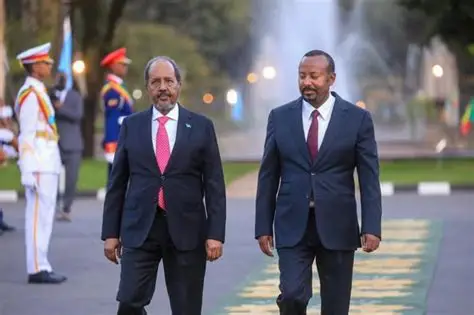

President Hassan Sheikh stated that the Federal Government of Somalia is prepared to permit Ethiopia to utilize two or three Somali ports for importing and exporting goods.
Hassan Sheikh made these remarks in an interview with Al Jazeera, days after meeting with Ethiopian Prime Minister Abiy Ahmed in Addis Ababa.
Hassan Sheikh emphasized that Somalia is not opposed to landlocked Ethiopia securing commercial access to the sea, provided that such an arrangement is established through a formal bilateral agreement between the two governments.
“We are ready to allow Ethiopia to use two or three Somali ports to import and export goods,” Hassan Sheikh said.
Hassan Sheikh also noted that port utilization could be regulated through commercial agreements specifying customs, fees, and other conditions governing port services.
Additionally, Hassan Sheikh stated that while Ethiopia has communicated its need for maritime access to Somalia, it has yet to submit a formal, detailed request specifying the exact nature of the access it seeks.
Hassan Sheikh’s remarks come days following his meeting with Abiy Ahmed in Addis Ababa, during which both sides discussed bilateral relations between Somalia and Ethiopia, as well as broader regional developments in the Horn of Africa.
To date, the two governments have not announced a final, definitive agreement regarding which specific port Ethiopia will utilize.
The Ankara Agreement remains the fundamental basis for bilateral discussions between the two sides concerning Ethiopia’s maritime access.
In December 2024, Somalia and Ethiopia reached a Turkey-mediated agreement in Ankara, stipulating that Ethiopia can secure secure, consistent, and reliable commercial maritime access, provided that the arrangement preserves the sovereignty and territorial integrity of Somalia.
The two nations subsequently launched technical talks to implement that accord; however, no definitive agreement has yet been announced regarding the specific port or ports that Ethiopia will utilize.
Meanwhile, President Hassan Sheikh did not name the two or three Somali ports that Somalia might permit Ethiopia to use.
Details regarding the duration of the agreement, the transit corridors linking Ethiopia to Somali ports, and the regulatory framework governing port fees and services were likewise omitted.
The matter remains under active dialogue, with authorities awaiting a formal request from Ethiopia outlining its specific needs and preferred maritime corridor model.
Should both parties reach a final accord on utilizing Somali ports, Ethiopia could secure additional commercial pathways, while Somalia stands to generate revenue from port services, customs duties, and trade cooperation.
Nevertheless, the central lingering challenge is maintaining a clear distinction between standard commercial access through a sovereign Somali port and any broader demands—particularly given the historical friction triggered by the prior Ethiopia-Somaliland memorandum of understanding.
Hassan Sheikh’s remarks reaffirmed that Somalia is prepared to grant Ethiopia access to Somali ports, subject strictly to a formal, mutually agreed interstate framework.
Consequently, negotiations between Somalia and Ethiopia are expected to continue, with the specifics of any future agreement remaining contingent upon Ethiopia’s formal application and the terms set forth by Mogadishu regarding the utilization of national ports.