

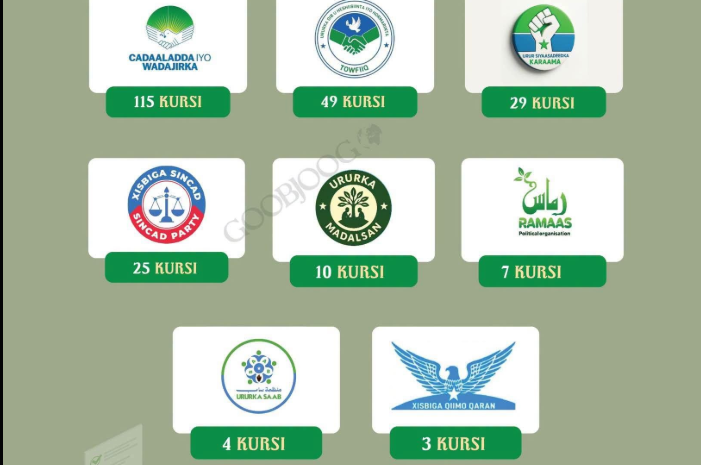

Somalia’s National Independent Electoral and Boundaries Commission (NIEBC) has announced the official results of Thursday’s Galmudug House of Representatives elections, declaring the Justice and Solidarity Party (JSP) the clear winner after securing 63 seats in the newly elected regional legislature.
According to the commission, the Towfiiq Party won 12 seats, followed by Sincad with six, Karaama with five, while Ramaas, Madalsan, and Saab each secured one seat.
The results establish JSP as the dominant political force in the Galmudug parliament, giving it a commanding majority in the regional assembly.
The newly elected House of Representatives is expected to play a key role in shaping Galmudug’s political future by passing legislation, overseeing the regional executive, approving budgets, and representing communities across the federal member state.
The election also forms part of the Federal Government’s broader effort to implement its one-person, one-vote electoral roadmap, which officials describe as a major step toward expanding democratic participation across Somalia.
However, the announcement has immediately triggered political controversy. The Towfiiq Party, led by Sheikh Mohamed Shakir Ali Hassan, rejected the official results, arguing that they do not reflect the actual outcome of the vote.
In a statement, the party accused the electoral commission of manipulating the election and violating agreed electoral procedures, saying it does not recognize the declared results.
Towfiiq also published its own tally, claiming it had won 47 seats, a figure that sharply contradicts the commission’s official allocation of 12 seats, further fueling questions over the credibility of the election.
The dispute comes amid broader political disagreements over Somalia’s electoral process.
Several opposition parties and some federal member states have opposed the Federal Government’s election roadmap, arguing that the transition to direct elections should only proceed after a broad political agreement among all stakeholders.
They have also questioned the independence of the electoral commission, alleging that it favors the ruling Justice and Solidarity Party (JSP)—claims the commission has consistently denied, insisting that the vote was conducted in accordance with Somalia’s electoral laws and regulations.
Despite the controversy, the official results mark another milestone in the Federal Government’s electoral agenda and pave the way for the formation of Galmudug’s new parliament.
The incoming legislature will be responsible for advancing governance, lawmaking, and institutional development within the state, although the opposition’s rejection of the outcome is expected to prolong political tensions and add to the wider debate over the legitimacy of Somalia’s ongoing electoral transition.