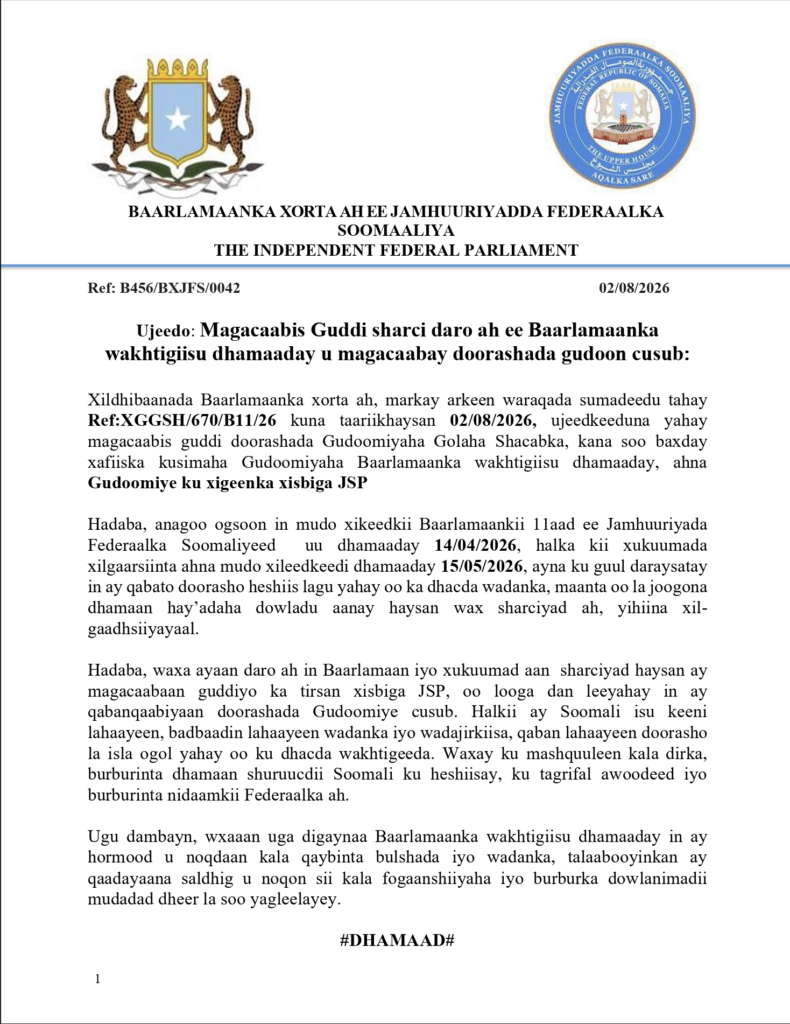

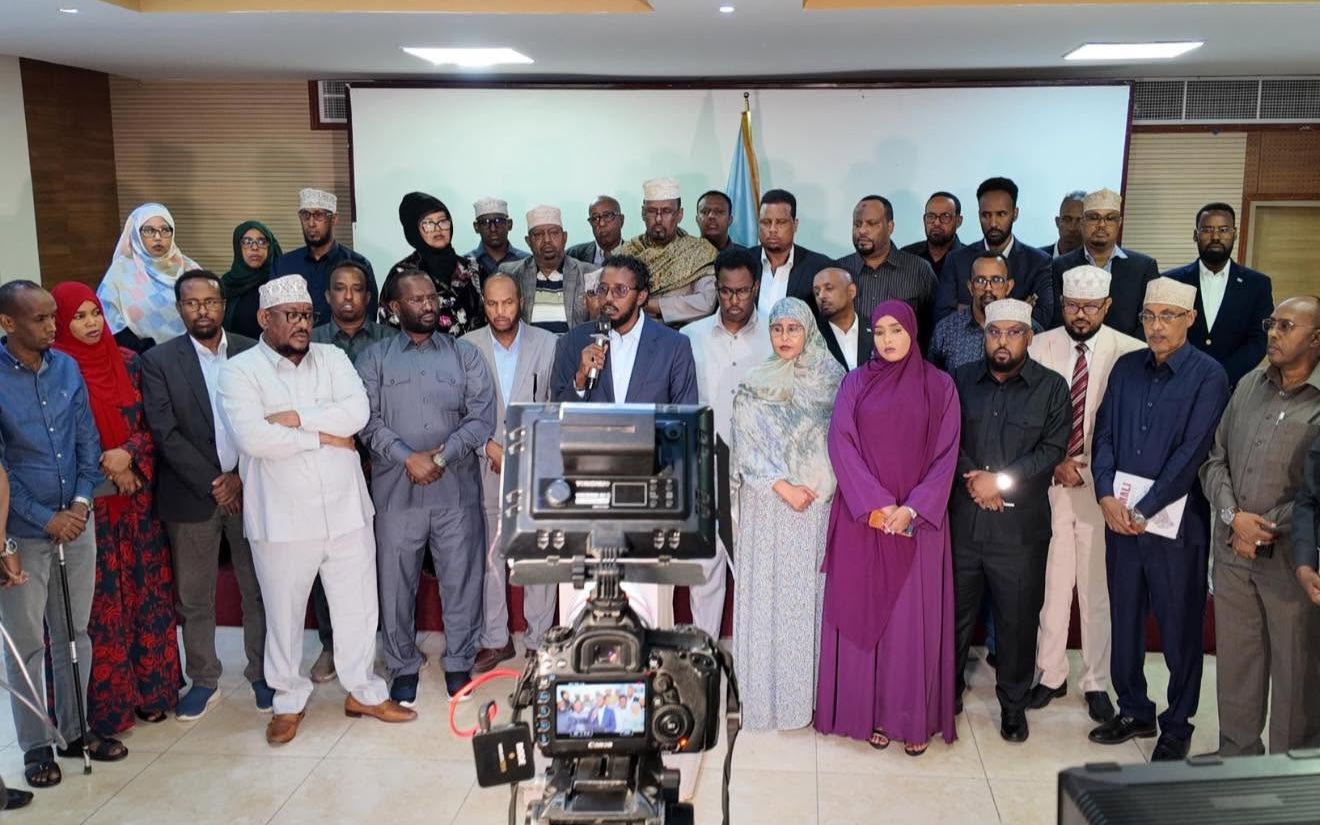

Lawmakers aligned with the Free Somali Parliament have rejected the appointment of an election committee formed by the expired Federal Parliament, describing the move as unconstitutional and lacking any legal authority.
The committee was tasked with organizing the election of a new Speaker of the House of the People, despite the legislature’s term having expired months earlier.
In a statement, the opposition lawmakers said the committee was established by officials whose constitutional mandates had already ended, arguing that any decisions taken by the outgoing parliament carry no legal legitimacy.
They accused the interim leadership of attempting to use expired state institutions to influence the selection of a new parliamentary speaker rather than pursuing an inclusive political settlement and nationally agreed elections.
The controversy follows the expiration of the Federal Parliament’s mandate in April 2026, while the mandate of the federal executive expired in May 2026.
Since then, Somalia has remained without renewed electoral legitimacy after political leaders failed to reach consensus on a nationwide electoral framework.
Opposition groups maintain that all current federal institutions are operating only in a caretaker capacity until a broadly accepted political agreement is reached.
The dispute intensified after former Speaker Adan Mohamed Nur (Adan Madobe) left parliament following his controversial installation as the leader of South West State, a political transition that came after federal military operations in Baidoa and was strongly criticized by opposition leaders.
His departure created a vacancy in the speakership, triggering efforts by the caretaker parliamentary leadership to organize a replacement.
Recent reports have also suggested that Villa Somalia is backing Minister of Ports Abdulkadir Mohamed Nur “Jama” for the speakership, a move that opposition figures claim reflects increasing executive influence over the legislature.
Although the federal government has not officially confirmed a preferred candidate, the reports have fueled accusations that the election process is being shaped by political interests rather than constitutional procedures.
In their statement, the Free Somali Parliament argued that instead of focusing on creating new parliamentary committees, Somalia’s caretaker institutions should prioritize convening an inclusive national dialogue aimed at resolving the country’s prolonged constitutional and electoral crisis.
They accused the federal leadership of undermining the federal system, weakening constitutional institutions, and deepening political divisions at a time when the country faces significant security and governance challenges.
The lawmakers warned that proceeding with a speaker’s election through institutions whose mandates have expired could further erode public confidence in the state and intensify Somalia’s ongoing political standoff.
They urged all political stakeholders to return to negotiations and agree on a credible electoral roadmap capable of restoring constitutional legitimacy to the country’s federal institutions.
The dispute comes amid heightened political tensions over Somalia’s constitutional future, electoral process, and security transition as the country prepares to assume greater responsibility from the African Union Support and Stabilization Mission in Somalia (AUSSOM).
Opposition leaders have repeatedly argued that lasting security gains cannot be achieved without first resolving the country’s constitutional and political disputes through broad consensus among the federal government, federal member states, and opposition groups.