


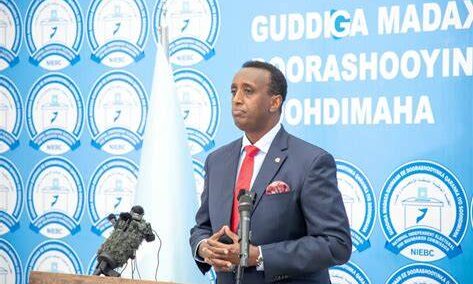


Somalia’s disputed National Independent Electoral and Boundaries Commission announced the timetable for Hirshabelle’s local council and House of Representatives elections, setting August 20, 2026, as polling day in what it describes as another step toward one-person, one-vote elections.
The process, however, is expected to deepen political tensions over the legitimacy of the electoral process.
According to the commission, voter registration and voter card distribution will begin on August 5, while the final voter register will be published on August 16. Candidates are scheduled to be announced on August 18, two days before voting.
The electoral calendar closely mirrors the phased process previously used during elections in South West State.
Hirshabelle formally launched its transition to direct elections in July 2025, when President Ali Gudlawe Hussein inaugurated voter registration, marking the beginning of preparations for the state’s first one-person, one-vote polls.
Federal Influence Raises Political Concerns
The announcement comes amid growing concerns over alleged federal government influence in regional electoral processes.
According to political sources, President Hassan Sheikh Mohamud intends to complete elections in three federal member states considered politically aligned with his administration, including Hirshabelle, before convening broader national consultations on Somalia’s electoral framework.
The same sources say discussions on the country’s future electoral model are expected only after those regional elections have concluded.
Political tensions first surfaced in July 2025, when Foreign Minister Ali Omar publicly criticized President Ali Gudlawe over plans to organize an indirect election despite the expiration of his constitutional term.
The dispute exposed widening divisions between Mogadishu and several federal member states over the pace and direction of Somalia’s electoral reforms.
The federal government has previously rejected regional electoral processes.
In March 2026, the Ministry of Interior refused to recognize the re-election of South West President Abdiaziz Hassan Mohamed (Laftagareen), raising concerns that similar disputes could emerge if Hirshabelle’s election is perceived to be influenced by federal authorities.
Security and Logistical Challenges
The election timetable also faces significant security and logistical obstacles.
Al-Shabaab continues to control territory across parts of central and southern Somalia, including areas of Hirshabelle, and has repeatedly demonstrated its ability to disrupt political and electoral activities.
President Ali Gudlawe recently visited frontline positions to assess ongoing military operations against the armed group, reaffirming that Hirshabelle would not become a safe haven for militants.
Questions also remain over whether the disputed electoral commission can effectively register voters and conduct polling in contested or insecure areas.
Humanitarian organizations have also warned of worsening conditions across the region, including flooding and displacement, which could further complicate preparations for the vote.
Democratic Progress or Another Disputed Election?
The publication of an election timetable represents an important milestone toward expanding direct elections in Somalia. However, analysts argue that the process remains vulnerable to political interference, security threats, and logistical shortcomings.
Critics point to the federal government’s previous involvement in regional electoral disputes, together with concerns over transparency in key appointments and political agreements, as reasons to question whether the August 20 vote will be genuinely free and fair.
While the commission has pledged to proceed according to its announced schedule despite the challenges, observers say the credibility of the election will ultimately depend on whether it is conducted independently and without political interference.
For many residents of Hirshabelle, the challenge extends beyond holding an election itself. They are seeking a credible process that accurately reflects the will of the electorate rather than another vote overshadowed by political disputes.