


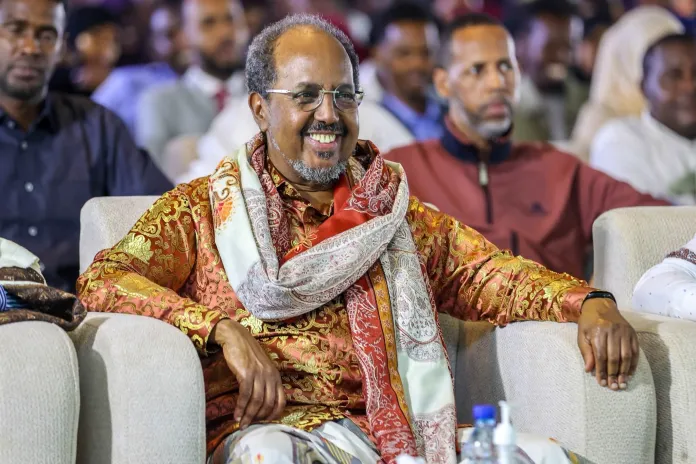


Somalia’s Presidency insists that today, November 14, 2026, the National Consultative Forum convened by President Hassan Sheikh Mohamud will proceed, despite resistance and prerequisites attached by some of the invited parties.
A press release issued by the Presidency stated that communications with invited parties are still ongoing, and final preparations for the consultative forum are underway.
The Presidency indicates that the meeting’s schedule has not been stalled, even though the political situation remains tense and it is uncertain whether all key parties will attend.
This forum was originally scheduled to take place in Mogadishu between November 14 and November 18, intended as a venue for political stakeholders to discuss federal electoral matters and the nation’s political disputes.
The primary parties expected to participate in the forum include the Somali Council of Futures, which encompasses Puntland, Jubaland, and the National Salvation Forum.
Reports concerning the meeting’s plan indicate that the leaders of Puntland and Jubaland are not prepared to participate in the forum under its current organizational framework, while the Salvation Forum has likewise expressed a stance distinct from that of the Presidency.
Former Somali President Mohamed Abdullahi Farmaajo has also attached conditions to his participation in the talks, insisting that the process be inclusive and built upon political trust.
On November 12, the Nabad iyo Nolol party denied reports that Farmaajo participated in a joint meeting between the government and the opposition, stating that a message delivered to Farmaajo from President Hassan Sheikh pertained strictly to the planned forum.
The Presidency’s insistence on holding the forum demonstrates that the Federal Government is determined for the meeting to take place, even in the absence of key parties that have not yet agreed to participate.
The Presidency’s press release noting that communications with invited parties are ongoing likewise indicates that the door to dialogue remains open.
Nevertheless, the persisting question is whether these communications will effect a shift in the positions of the parties refusing participation, and whether the government will accept the prerequisites set by the opposition for the talks.
The National Consultative Forum arrives at a juncture when the country is confronting intense political disputes rooted in electoral mechanisms, constitutional amendments, and the requisite consensus governing Somalia’s political future.
The Federal Government contends that the direct electoral process must be advanced, whereas the opposition and certain regional administrations insist that such matters be resolved through an inclusive political consensus.
This divergence has caused the forum convened by President Hassan Sheikh to encounter obstacles even before its opening.
It is likewise vital to recognize that a consultative forum lacking the participation of the principal parties to the conflict will struggle to produce a political agreement acceptable to all stakeholders.
What might happen if the forum opens in the absence of the opposition?
Should the Federal Government open the forum today without the presence of the leaders of Puntland, Jubaland, and key opposition factions, questions may arise regarding the political representation and legitimacy of the meeting’s outcomes.
The government may view the meeting’s convening as a step demonstrating that dialogue efforts are moving forward, whereas absent parties can argue that no satisfactory framework was achieved.
Conversely, should the Presidency and opposition factions succeed in reaching agreement on the prerequisites for dialogue, the forum could serve as an opportunity to mitigate the nation’s political friction.