

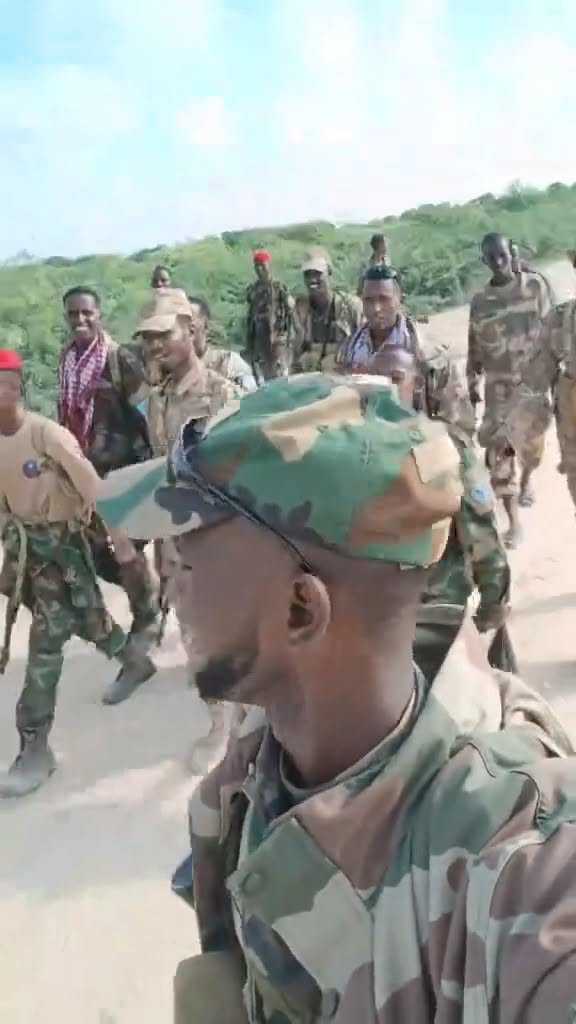

Ugandan troops serving under the African Union mission in Somalia have reportedly withdrawn from the coastal town of Barawe and the settlement of Shalanbod in Lower Shabelle region, as the Federal Government prepares to deploy Somali forces to assume responsibility for security in the two locations.
The reported withdrawal comes as Uganda begins reducing its military presence in Somalia, following nearly two decades of involvement in international security operations supporting the Somali government.
The transition has raised questions about the readiness of Somali security forces, the future security situation in Lower Shabelle and the measures being taken to prevent Al-Shabaab from exploiting any gaps created by the departure of foreign troops.
Reports indicate that federal government forces are being prepared to take over positions previously occupied by Ugandan troops.
Barawe, a strategically important coastal town in southern Lower Shabelle, and Shalanbod, located along a key route linking Mogadishu, Marka and southern Somalia, both hold significance for security operations and regional transport.
Control of these areas is important for protecting civilians, maintaining commercial activity and securing transport routes.
Somali troops expected to take over the positions will be responsible for protecting key installations, maintaining public security and preventing possible attacks by armed groups.
Uganda announced on November 2, 2026, that it had begun withdrawing some of its forces from Somalia as part of a gradual reduction of its military presence.
Ugandan military spokesperson Colonel Chris Magezi said the first group of troops deployed under a bilateral arrangement with the Somali government had returned home.
Kampala has also indicated that it intends to withdraw all its forces from Somalia by the end of 2027, including personnel serving under the African Union Support and Stabilization Mission in Somalia (AUSSOM).
Uganda first deployed troops to Somalia in 2007 as part of the African Union Mission in Somalia (AMISOM). Its forces subsequently served under the African Union Transition Mission in Somalia (ATMIS) before joining the current AUSSOM mission.
Over the years, Ugandan troops have played a major role in military operations against Al-Shabaab, securing parts of Mogadishu and protecting key government institutions.
Their presence has also been central to the African Union’s broader security support for Somalia.
Lower Shabelle has remained a major area of military activity involving Somali government forces, African Union troops and Al-Shabaab.
Barawe’s coastal location gives it strategic importance, while Shalanbod sits along transport routes connecting several important towns and settlements.
The security of both locations has implications for civilian movement, trade and the government’s ability to maintain control over surrounding areas.
Their transfer to Somali forces will therefore require careful coordination, sufficient personnel and logistical support to prevent security gaps or opportunities for militant attacks.
For the Somali government, the handover represents an important responsibility as it seeks to assume greater control over national security following years of reliance on international forces.
While the withdrawal of foreign troops could provide an opportunity to strengthen the country’s own security institutions, the transition also presents challenges if forces are not adequately prepared and supported.
The takeover of Barawe and Shalanbod will therefore serve as an important test of the federal government’s ability to deploy, sustain and coordinate its forces while maintaining security for local communities.
The effectiveness of the transition will depend not only on occupying former AU positions but also on the ability of Somali forces to protect civilians and prevent armed groups from regaining ground.