


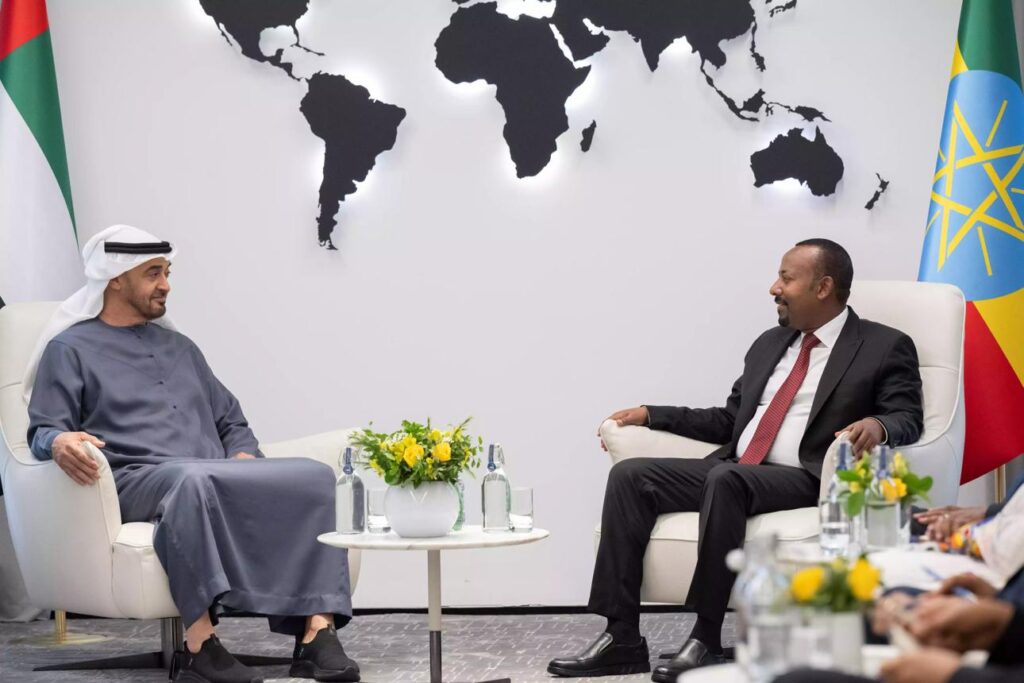


The relationship between the United Arab Emirates and Ethiopia is an important factor in the geopolitics of the Horn of Africa, particularly given their overlapping interests in ports, security, trade and regional political influence.
Both countries have strategic interests across the region, including securing commercial routes, protecting economic investments and expanding their political influence.
Their growing engagement has implications for Somalia, where questions over access to seaports and foreign involvement in strategic infrastructure remain highly sensitive.
The UAE has long maintained an interest in Somalia’s coastline and the wider Horn of Africa, investing in several strategically important ports.
Dubai-based DP World, for example, has been involved in agreements to develop and operate the Port of Berbera in Somaliland, turning it into an important commercial gateway for regional trade.
Ethiopia, a landlocked country, has also spent years seeking alternative maritime routes for importing and exporting goods.
Its foreign trade relies heavily on the Port of Djibouti, but Prime Minister Abiy Ahmed’s government has been pursuing additional access to the sea to reduce that dependence.
This is where the interests of Ethiopia and the UAE intersect. While the UAE has invested in Berbera, Ethiopia is interested in using the port as an alternative trade corridor.
The issue became particularly contentious following the memorandum of understanding signed by Ethiopia and Somaliland on January 1, 2024.
The agreement concerned access to the sea for Ethiopia, while Somaliland expected support for its longstanding pursuit of international recognition.
Somalia strongly opposed the agreement, describing it as a violation of its sovereignty and territorial integrity. The UAE’s role also attracted scrutiny because of its economic and political relationships with both Ethiopia and Somaliland.
However, no publicly available evidence has established that the UAE itself orchestrated the agreement.
For Ethiopia, access to alternative ports is an important economic and strategic priority. The country wants to reduce its reliance on Djibouti and secure additional routes for transporting goods.
The UAE, meanwhile, has commercial interests in meeting that demand through its investment in Berbera and its experience in port management and trade infrastructure.
These overlapping interests create opportunities for cooperation in trade, logistics and the movement of goods across the region.
Somalia, however, has maintained that any agreements involving its coastline and ports must be handled through the Federal Government, arguing that arrangements made without its involvement undermine national sovereignty.
A diplomatic breakthrough came with the Ankara Declaration, signed on December 11, 2024, under Turkish mediation. The agreement provided a framework for easing tensions between Somalia and Ethiopia.
Under the understanding reached, Ethiopia would be able to secure access to the sea through commercial arrangements negotiated under Somalia’s sovereignty, while respecting the country’s territorial integrity and political independence.
Relations between Mogadishu and Abu Dhabi deteriorated further in November 2026, when Somalia ordered the UAE ambassador to leave the country within 72 hours and withdrew its own ambassador from Abu Dhabi.
The dispute is also linked to the UAE’s agreements and involvement in the ports of Berbera, Bosaso and Kismayo, as well as its relationships with different regional administrations in Somalia.
Taken together, these developments illustrate how the UAE and Ethiopia have interconnected strategic interests, particularly in maritime access, trade and regional security.
Ethiopia is seeking reliable access to the sea, while the UAE aims to protect its investments and maintain its economic influence across the Horn of Africa.
Somalia views these developments as matters directly affecting its sovereignty, particularly when agreements involving its coastline and ports are pursued without the participation of the federal government.
The central question is whether the UAE and Ethiopia are primarily pursuing commercial interests or whether their strategic partnership could eventually have wider implications for Somalia’s political landscape, territorial unity and regional relationships.