


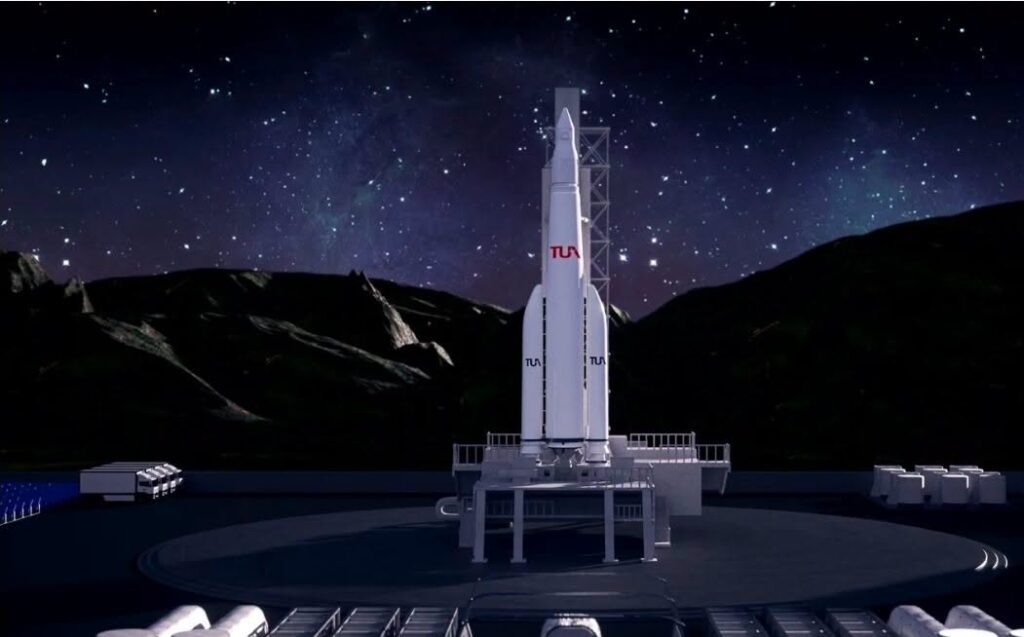


Türkiye is pursuing plans to establish a space launch facility in Somalia, with the proposed site located in Warsheikh, a coastal settlement in the Middle Shabelle region, approximately 70 kilometres north of Mogadishu.
The project forms part of Ankara’s broader ambition to develop an independent capability to launch satellites and other space vehicles, reducing its reliance on launch facilities and commercial providers in other countries.
Turkish President Recep Tayyip Erdoğan announced the plan towards the end of 2025, while Türkiye’s Minister of Industry and Technology, Mehmet Fatih Kacır, later outlined the strategic importance of Somalia’s location to the proposed facility.
Somalia’s geographical position is considered a major advantage, particularly its proximity to the Equator and its extensive coastline along the Indian Ocean.
Launching rockets from locations near the Equator can provide an additional boost from the Earth’s rotation, potentially reducing the fuel required or allowing rockets to carry heavier payloads, depending on the mission and launch direction.
The country’s coastline also offers a route for launching rockets over the Indian Ocean. This could allow discarded rocket stages and other components to fall into the sea rather than over populated areas, subject to carefully planned safety zones and flight paths.
Minister Kacır has said technical and economic assessments identified Somalia as a suitable location for the project.
Türkiye has invested heavily in its space programme in recent years, developing communication satellites and spacecraft designed for Earth observation.
However, manufacturing satellites and possessing the infrastructure to launch them are two different capabilities. A country may develop advanced satellites but still depend on foreign launch vehicles and facilities to place them into orbit.
The proposed Warsheikh facility could help Türkiye address that gap by providing a site where it can test launch systems and send satellites developed within its own space programme into orbit.
If completed and brought into operation, the project could also make Somalia one of the African countries hosting a major space launch facility.
The initiative could open a new chapter in Somalia’s involvement in international science and technology.
The Turkish Embassy in Somalia has previously indicated that the two countries were planning to launch Somalia’s first satellite in 2027 through their bilateral cooperation.
If the timetable is achieved, it would mark an important milestone for the country’s participation in space-related activities.
However, hosting a launch facility does not automatically mean that Somalia will possess the technology or independent capacity to manufacture and launch rockets on its own.
The extent of Somali participation in the programme will depend on the terms of cooperation, technology transfer and the responsibilities assigned to each country.
The project could offer Somalia economic and technological opportunities, including employment, specialised training and access to expertise in engineering, satellite technology, computing and equipment maintenance.
Construction and eventual operation could create jobs for local communities, particularly young people in Middle Shabelle and surrounding areas.
There may also be opportunities for Somali universities and research institutions to cooperate with Turkish scientific organisations and technology centres.
If the facility eventually provides commercial launch services to other countries or private companies, Somalia could potentially generate revenue through agreements and related services.
These benefits, however, will not materialise automatically. Their realisation will depend on whether the Somali government secures clear arrangements ensuring that local workers, businesses and institutions participate meaningfully in the project.
One of the central issues concerns the agreement governing the construction and operation of the facility. Kacır has said that land for the project was allocated to Türkiye under the cooperation agreement between the two countries.
However, published reports have indicated that important details, including the duration of land use and arrangements for sharing potential revenue, have not been fully disclosed publicly.
This leaves several questions that require clarification from the Somali government.
They include how long Türkiye will be entitled to use the site, what financial benefits Somalia will receive, how many Somali citizens will be employed and which authorities will have final responsibility for decisions concerning the facility’s operations.
The two governments also need to clarify their respective responsibilities in the event of an accident, environmental damage or harm to communities living near the proposed site.
Transparent arrangements would help ensure that the project operates as a mutually beneficial partnership rather than leaving Somalia with the role of simply providing land for a foreign facility.
Another issue attracting attention is whether the Warsheikh site will be used exclusively for civilian space activities or could also accommodate military-related missile testing.
A report published by French newspaper Le Monde in July 2026 suggested that the planned facility could have a dual purpose, combining space launches with tests involving long-range missiles.
Türkiye has not publicly provided a comprehensive explanation of the types of rockets or missiles that could be tested at the site.
The Somali government therefore needs to clarify what activities are permitted under the bilateral agreement and whether any military-related operations are included.
It is important to distinguish media reports from information officially confirmed by the two governments.
The possibility of military use remains an issue requiring further clarification rather than an established description of the facility’s approved activities.
A space launch centre would also require extensive security arrangements. Warsheikh is located in Middle Shabelle, a region that has faced persistent security challenges.
Protecting the facility, its personnel and the roads connecting it to surrounding areas could therefore become a major operational responsibility.
If the centre proceeds to regular operations, Somalia and Türkiye will need coordinated security arrangements, trained personnel and measures to protect nearby communities.
Any rocket testing would also require clearly defined exclusion zones, advance public information and procedures to manage risks associated with falling debris or other launch-related hazards.
Local residents have a direct interest in how the project will affect the land and coastline around Warsheikh. Many communities in the area depend on fishing, livestock and small businesses for their livelihoods.
The authorities will therefore need to explain how construction and launch activities could affect access to coastal areas and local economic activity.
If parts of the coastline or surrounding waters must be temporarily restricted during launches, residents should be informed about the reasons, duration and potential consequences.
Environmental assessments will also be important in identifying possible effects on marine life, coastal ecosystems and other natural resources.
The proposed space facility represents another stage in the expanding relationship between Somalia and Türkiye, which already covers security, education, healthcare, infrastructure development and military training.
The two countries have also developed cooperation in defence, energy and maritime resource exploration.
For Somalia, the Warsheikh project could extend that partnership into advanced technology and scientific research, creating opportunities beyond traditional development assistance and infrastructure cooperation.
For Türkiye, the proposed facility could provide a strategically valuable launch location as it seeks to strengthen its position among countries developing independent access to space.
Ultimately, the project’s significance will depend not only on whether the facility is constructed but also on the terms under which it operates, the benefits Somalia secures and the safeguards established for local communities and the environment.
Clear public disclosure of the agreement, meaningful Somali participation and effective oversight will be essential to determining how the project serves the interests of both countries.