


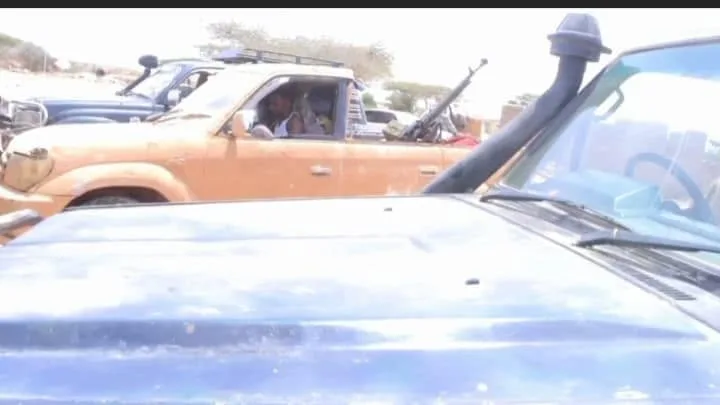


Troops and military vehicles reportedly belonging to units under Somalia’s North Eastern State administration have left their positions in the Sanaag region and moved towards Ceerigaabo, a city controlled by Somaliland, raising questions about military cohesion and federal security plans in the disputed territories.
The forces are said to have withdrawn from Fiqi-Fuliye on Sunday afternoon, taking with them two technical vehicles fitted with heavy machine guns and a Toyota Land Cruiser VX.
According to a report published by Somaliland Standard on November 16, 2026, the troops and vehicles reached the outskirts of Ceerigaabo.
The publication also claimed that one of the vehicles belonged to a former member of the North Eastern State parliament who had previously relocated to Hargeisa.
Sources cited as Somaliland military officials said the troops had been part of units being prepared for the 26th Division of the Somali National Army, which the Federal Government has reportedly planned to establish in the Sool region.
However, the number of soldiers involved, the reasons for their departure and the precise circumstances surrounding the movement of the military vehicles have yet to be independently verified.
It also remains unclear whether the withdrawal involved an entire military unit or individual soldiers acting separately.
If confirmed, the movement could present a challenge to federal plans to establish and coordinate military forces in Sool and other territories claimed by the North Eastern State.
It could also raise concerns about the loyalty and cohesion of forces being assembled for deployment in the region.
The departure may have implications beyond the loss of personnel and equipment. Soldiers moving between rival administrations could potentially carry knowledge of their former positions, unit structures and local security arrangements.
However, there is no confirmed information indicating that sensitive military information has been transferred.
The Federal Government has been working to establish and prepare military units intended to operate in Sool and other areas claimed by the North Eastern State.
The proposed 26th Division forms part of efforts to strengthen federal security structures and military presence in those territories.
The plan has already generated political tensions. On November 3, 2026, Somaliland President Abdirahman Mohamed Abdullahi, known as Irro, expressed opposition to reports that federal troops were being prepared for deployment in eastern Sool.
Irro said Somaliland was concerned about the Federal Government’s military activities in the disputed areas. His remarks highlighted the sensitivity surrounding the proposed 26th Division and the potential for further confrontation between the two administrations.
The reported movement from Fiqi-Fuliye comes amid heightened military activity in parts of Sool and Sanaag.
Somaliland has released footage showing its forces conducting preparations, at a time when the two administrations remain divided over control of the contested territories.
Although Irro has previously said he favours resolving disputes over areas controlled by the North Eastern State through peaceful means, the recent military movements and political statements indicate that the security situation remains fragile.
The dispute between Somaliland and the North Eastern State centres on competing political and territorial claims over Sool, Sanaag and Cayn.
It intensified following the 2023 fighting in Las Anod, which ended with Somaliland forces withdrawing from the city and the emergence of the SSC-Khaatumo administration.
SSC-Khaatumo subsequently developed into the North Eastern State administration, which was recognised as a federal member state within Somalia’s federal system.
Somaliland, however, continues to claim parts of Sool and Sanaag, while the North Eastern State considers the territories part of its own administrative jurisdiction.
A June 2026 report by the European Union Agency for Asylum (EUAA) highlighted the fragmented nature of administrative control in Sanaag.
It found that authority varies across the region, with Somaliland controlling parts of western Sanaag, including Ceerigaabo, while other areas are administered or influenced by different authorities and forces.
This complex distribution of control makes military movements particularly sensitive, as changes in troop positions could affect the balance of power and increase tensions between competing administrations.
The Federal Government is now under pressure to clarify whether the troops involved were formally attached to the planned 26th Division and what their departure means for the broader military recruitment and deployment programme.
Without an official explanation, competing accounts of the incident could deepen political mistrust and fuel further tensions between the parties.
The developments in Sool and Sanaag come against the backdrop of an unresolved dispute over the political future and administration of the territories.
If confirmed, the withdrawal from Fiqi-Fuliye could alter the local military balance, particularly if other units stationed in nearby areas follow a similar course.
The situation also raises concerns for civilians who have already experienced years of conflict and displacement. Any escalation between the rival forces could expose local communities to renewed violence and further instability.
A lasting solution will require political dialogue, an agreed framework for administering the disputed territories and restraint by all sides to prevent military movements from triggering another confrontation.