


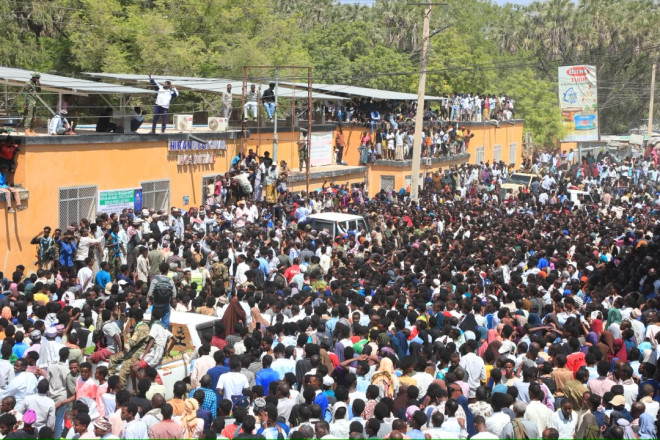


In the city of Beledweyne, the capital of the Hiran region, a protest attended by hundreds of people, politicians, members of parliament, and traditional leaders took place, opposing the Hirshabeelle administration and the process through which its leadership was elected in the town of Jowhar.
The demonstration was attended by Ugaas Yusuf Ugaas Hasan Ugaas Khalif, MP Abdullahi Mohamed Ali (Sanbaloolshe), MP Abdinasir Haji Shirwac, MP Abdirisaaq Abdullahi Maallin (Ciid), MP Abdirahman Gurey, MP Mohamed Abdullahi Buraale, and hundreds of citizens.
The protesters expressed their rejection of the new Hirshabeelle leadership, stating that political decisions affecting the Hiran region must be consulted with the local community and based on the will of the people living in the region.
This demonstration comes at a time when political tensions between certain politicians and intellectuals of Hiran and the Hirshabeelle administration are escalating, following the election held on October 24 in the town of Jowhar.
Ugaas Yusuf Ugaas Hasan Ugaas Khalif, speaking to the public outside the Hiran Regional General Hospital, emphasized in his speech the importance of community unity and working toward regional security.
The Ugaas noted that Somali youth previously played a major role in saving the country, urging the public to once again unite their efforts and work to prevent any hardships facing the people.
He stated: “As you know, 13 youth saved this country; it is desired that all of us together, exceeding those before us, save Somalia and Hiran. We will not return to the path we cleared yesterday, and those who are absent from us will come. Let us work for unity, security, and prevent anything that harms the public.”
This remark illustrates how Hiran’s traditional leadership links political matters to community unity and the future of the region. The Ugaas had previously announced that consultative conferences involving the clans inhabiting Hiran would be held to deliberate on the political situation and existing grievances.
MP Ciid States That Anyone Causing Harm to the Public Will Be Held Accountable
MP Abdirisaaq Abdullahi Maallin (Ciid) likewise addressed the protest, stating that anyone accused of harming the people of the Hiran region will be held accountable.
The MP stated that the people of the region have the right to choose who governs them and cannot accept their political future being decided through a process in which they did not participate.
He stated: “You own the region; letting a mercenary play with your future will not be tolerated. When our work here is concluded, anyone harming these people will be held accountable. While they are in good health, let them leave us; otherwise, we will defend ourselves, and the people will establish an administration of their own.”
Such remarks highlight the magnitude of political tensions in Beledweyne, as the factions contesting regional governance and representation remain deadlocked over a mechanism to resolve the dispute.
MP Abdinasir Calls on the Government to Listen to Hiran’s Grievances
MP Abdinasir Haji Shirwac called upon the Federal Government of Somalia to listen to the perspectives and grievances of the people of the Hiran region, stating that if the pending complaints are not resolved, the situation could reach a juncture more severe than the current reality.
The MP noted that the people of Hiran played a major role in the campaign against Al-Shabaab, yet feel that their priority rights and services have not been addressed.
He additionally touched upon public infrastructure facilities that he stated suffered damage from explosions and battles in the region, which have yet to be reconstructed.
His remarks form part of the appeals directed by regional politicians and intellectuals to the Federal Government, seeking a consultative political approach to Hiran’s grievances.
Sanbaloolshe Proposes Deciding Hirshabeelle Leadership Through the Votes of Hiran’s People
MP Abdullahi Mohamed Ali Sanbaloolshe, former Director of the National Intelligence and Security Agency (NISA), delivered a speech at the protest demanding that the residents of Hiran be given the opportunity to cast their votes on who should lead Hirshabeelle.
Sanbaloolshe proposed holding a public referendum on the regional leadership issue, arguing that the will of the local community is essential for political decisions affecting their future.
He drew parallels to the Brexit referendum in Britain, stating that political leaders must respect the decisions of the public.
Sanbaloolshe also stated that their stance is not intended to dismantle state institutions, but rather seeks an administrative framework grounded in community will and consultation.
He emphasized that the steps they have taken are peaceful, aiming to achieve their objectives through patience, compromise, and dialogue.
The ongoing crisis in Beledweyne stems from the Hirshabeelle leadership election held on October 24 in Jowhar, which re-elected Ali Abdullahi Hussein (Guudlaawe) as regional President, while Abdifataax Hasan Afrax was elected Vice President.
Certain traditional elders, politicians, and intellectuals of Hiran rejected the election results, arguing that the regional community was not adequately consulted and that grievances regarding political representation and power-sharing remain unaddressed.
Conversely, the Hirshabeelle administration maintains institutions and leadership elected through a political process conducted in Jowhar. The dispute has thus centered on the political legitimacy and acceptance of the election, community representation, and Hiran’s relations with the central Hirshabeelle administration.
Elders and politicians rejecting the election results are calling for a broad conference involving all clans of the region to forge a unified vision for Hiran’s future.
Ugaas Yusuf Ugaas Hasan previously announced that consultative meetings involving traditional elders, politicians, religious scholars, intellectuals, and various segments of the regional community will be held in Beledweyne.
These meetings aim to analyze the political situation, security, clan representation, and Hiran’s ties with the Hirshabeelle administration.
A prior press release issued by elders and intellectuals similarly called for an inclusive conference seeking a political solution involving all inhabiting clans of the region.
The elders stated that decisions impacting Hiran cannot remain restricted to a single party or political group, but require broad consultation. They also urged that public demonstrations expressing community stances remain peaceful without damaging public or private property.
The conflict in Hiran possesses a security dimension that cannot be ignored. In the days preceding the protest, statements and appeals concerning regional security forces emerged, with Ugaas Yusuf calling upon security personnel originating from Hiran on November 7 to assemble in Beledweyne and refrain from being deployed into confrontations against the local community.
This appeal coincided with reports of troop movements and standoffs between local militias and forces aligned with competing factions of the Hirshabeelle leadership. Certain details regarding these movements remain unverified independently.
Concerns are likewise raised that political friction might impact government force cooperation in the anti-Al-Shabaab campaign, given that Hiran remains a vital theater for security operations in central Somalia.
It is consequently vital that political factions avoid any measures triggering armed confrontation and insulate security forces from political rivalries.
The Beledweyne protest exerts political pressure on the Federal Government and the Hirshabeelle administration, demanding responses to the grievances raised by Hiran politicians and intellectuals.
The Federal Government faces questions regarding its handling of the dispute, while the Hirshabeelle administration is urged to demonstrate willingness for dialogue and establish a framework incorporating those rejecting the election results.
Meanwhile, Hiran traditional leaders and politicians are expected to clarify how they intend for grievances to be resolved and how political efforts can be ensured not to devolve into societal division or armed conflict.
Ultimately, the Beledweyne crisis has emerged as one of the primary political challenges confronting Hirshabeelle, with the future of the dispute hinging upon how opposing sides respond to calls for consultation and resolution.