


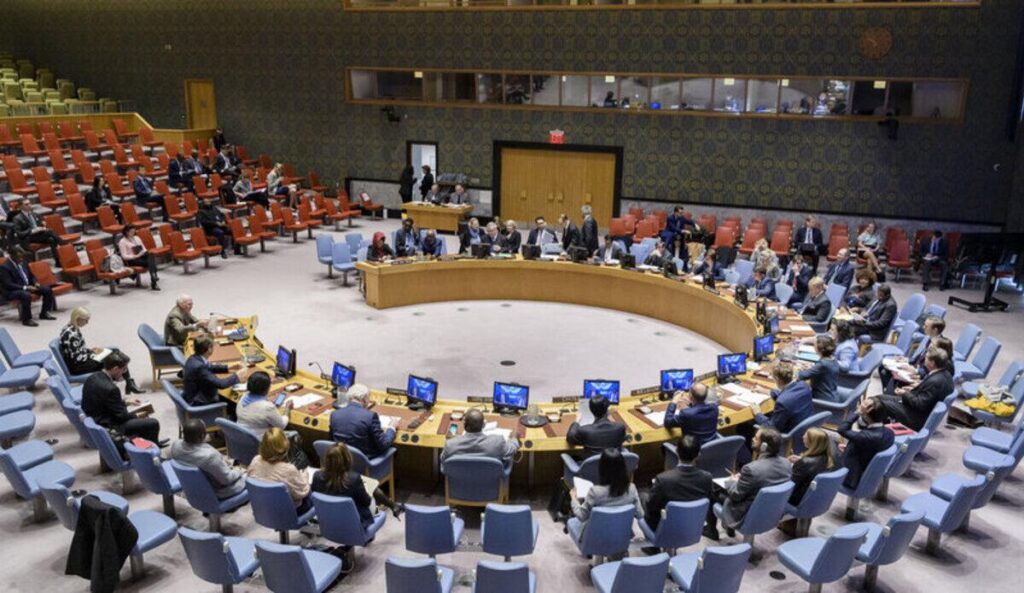


The political and security situation in Somalia has once again returned to the agenda of the United Nations Security Council, at a time when the country faces constitutional and electoral disputes, tensions between the Federal Government and regional member state administrations, and the ongoing war against Al-Shabaab.
The monthly forecast report by Security Council Report for November 2026 indicates that the Security Council is expected to hold a special closed-door meeting regarding the African Union Support and Stabilization Mission in Somalia (AUSSOM). The Council is also expected to receive a briefing concerning the Al-Shabaab sanctions committee.
**What is the Security Council expected to address?**
According to data from Security Council Report, the anticipated meeting in November will focus specifically on the AUSSOM mission and the operational challenges hindering sustained security support for Somalia.
Briefings during the session are expected to be delivered by Martin Kimani, the United Nations Assistant Secretary-General for Africa, and El Hadji Ibrahima Diene, the African Union Representative and Head of the AUSSOM mission.
The meeting agenda is anticipated to cover the state of Somali national forces, international support, counter-Al-Shabaab operations, and mechanisms to ensure a gradual transfer of national security responsibilities to Somali forces.
**Political Conflict and Electoral Disputes**
Political friction in Somalia remains a primary driver of concern among international bodies.
The Federal Government and opposition factions remain deadlocked over constitutional amendments, institutional term limits, and the electoral framework. Political relations between Puntland, Jubaland, and the central government have also deteriorated in recent months.
On October 15, 2026, the Federal Government announced a revised electoral timetable, scheduling House of the People parliamentary elections for April 15, 2027, while setting the Presidential election for May 15, 2027.
However, the Somali Future Council rejected this timetable, citing a lack of consensus and consultation with key political stakeholders. On October 25, Hassan Sheikh Mohamud renewed calls for the opposition to participate in dialogue to resolve the electoral impasse.
This dynamic presents the Security Council with the challenge of supporting an inclusive electoral model acceptable to all political factions to prevent constitutional disputes from undermining national stability.
**Al-Shabaab and the National Security Posture**
The conflict against Al-Shabaab remains a central operational challenge in Somalia.
The group continues to execute complex attacks, bombings, and ambushes across parts of central and southern Somalia. Concerns persist that internal political disputes could impact operational coordination between federal forces and regional member state forces.
The Security Council forecast report highlights that Al-Shabaab could exploit the prevailing political environment, capitalizing on administrative divisions and security gaps.
Furthermore, the Security Council is expected to review the Al-Shabaab sanctions regime, including arms control measures and interdiction operations against the group.
The sanctions regime under Resolution 2713 expires on November 30, 2026, while the mandate of the Panel of Experts supporting the sanctions committee concludes on December 31. The Council is expected to deliberate on renewing both frameworks.
**The Future of AUSSOM Forces and International Support**
A key item on the agenda concerns the strategic future of the AUSSOM mission, which supports the Somali government in counter-insurgency operations and territorial defense.
The mission faces structural financial and logistical sustainment deficits. Troop-Contributing Countries (TCCs) held an extraordinary summit in Kampala, Uganda, between July 29 and July 31, 2026, addressing the imperative for predictable funding and an orderly drawdown roadmap.
The Kampala summit emphasized that the mission requires continued operational support for a period of 18 to 24 months to build Somali security institution capacity and prepare for force handovers.
Concurrently, on September 10, 2026, the United States notified the African Union of its decision to discontinue financial support for the United Nations Support Office in Somalia (UNSOS) upon the expiration of the current authorization mandate on December 31.
This decision raises critical questions regarding who will fund logistical, transport, and operational support for AUSSOM in the absence of alternative funding mechanisms.
**UNTMIS Exit from Somalia and Resulting Questions**
Another significant development is the conclusion of the United Nations Transition Mission in Somalia (UNTMIS), which wrapped up its operations at the end of October 2026.
Established as a successor to UNSOM, UNTMIS was designed as a two-year transition mission to hand over core functions to Somali state institutions and specialized UN agencies.
The United Nations confirmed that UNTMIS responsibilities were transferred to the Somali government and UN bodies in alignment with the agreed transition framework.
However, the exit of the mission coincides with ongoing constitutional and political friction in Somalia. Consequently, how the United Nations will maintain political engagement, support state institutions, and facilitate inter-Somali dialogue remains a critical consideration.
**Somalia as a Member of the Security Council**
An important contextual factor is that Somalia currently serves as a non-permanent member of the UN Security Council, providing the nation with a direct platform in global peace and security decision-making.
According to Security Council Report, Somalia has preferred that its domestic security and political situation be discussed in closed-door sessions rather than open debates. A previous closed session in June 2026 concluded without a formal outcome statement after Council members failed to reach consensus on the text.
This dynamic underscores the complex nature of the situation, as Somalia acts simultaneously as a Council member and as a state under active international security monitoring.
**What is expected from the Security Council’s decisions?**
The upcoming November session will be critical across several operational and diplomatic fronts:
• Evaluating the security and political posture of Somalia.
• Addressing financial deficits impacting AUSSOM operations.
• Clarifying international support frameworks for Somali security forces.
• Reviewing and renewing Al-Shabaab sanctions mandates.
• Encouraging inclusive political dialogue to resolve electoral and constitutional disputes.
• Assessing the UN’s political and technical role following the exit of UNTMIS.