

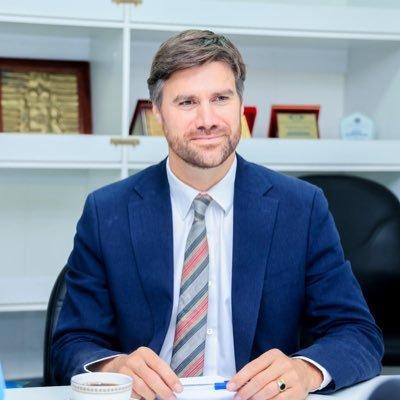

The British government demonstrated its diplomatic engagement with the new leadership of Galmudug, following a telephone conversation between the UK Ambassador to Somalia, Charles King, and Liban Ahmed Hassan.
The discussion, which the British Embassy described as productive, focused on long-standing cooperation between the UK and Galmudug, as well as the overall political and security situation in Somalia.
The focus of attention has been the terminology utilized by the Ambassador regarding Liban Ahmed Hassan, who was described as the “newly elected Galmudug State President.” This diplomatic phrasing differs from the language adopted by the Federal Government of Somalia during regional leadership inauguration ceremonies, where the title “Leader” (*Hoggaamiye*) was utilized.
What Does the UK’s Terminology Signify?
The British Embassy’s use of the title “President” has sparked questions regarding how the international community views Galmudug’s new leadership and its relationship with the Federal Government of Somalia.
In diplomatic practice, the title “President” is standard nomenclature used for the heads of Somalia’s Federal Member States, and international media and multilateral institutions routinely refer to regional leaders in this manner.
However, against the backdrop of political disputes surrounding the constitution, elections, and power-sharing between the Federal Government and Federal Member States, the deployment of this terminology carries political significance.
It is essential to distinguish between diplomatic recognition of a regional executive and formal legal endorsement of a constitution or electoral mechanism. An embassy addressing Liban as “President” does not, in itself, indicate that Great Britain has either formally accepted or rejected Somalia’s amended constitution.
Support for Direct Elections and Constitutional Disputes: Somalia has recently experienced significant political friction regarding electoral modalities, constitutional amendments, and federal-state relations.
The Federal Government continues to advocate for one-person, one-vote direct elections, whereas opposition coalitions and select Federal Member States have raised concerns regarding the procedural process of constitutional amendments and the necessity for broad political consensus.
Federal Government documentation regarding constitutional amendments notes that parliament approved revisions in March 2024, including direct elections, a multi-party system, and a five-year executive mandate. Nevertheless, political debate regarding the legal consensus of those changes persists.
Galmudug and International Community Engagement: Liban Ahmed Hassan was elected President of Galmudug on October 22, 2026, securing 72 out of 89 votes cast by members of the regional parliament. The official transfer of office occurred on November 4, followed by his inauguration ceremony on November 5 in Dhusamareb.
The ceremony was attended by Federal Government officials, regional leaders, and international diplomats.
The consultation between the British Ambassador and Liban comes as the new regional administration faces key priorities, including security operations against Al-Shabaab, local reconciliation, and institutional capacity development.
The UK maintains long-standing partnerships with Somalia across security, development, and state-building sectors. The UK Embassy reaffirmed its goal of supporting Somalia toward stability, security, and economic development.
International Posture on Somali Politics: Consultations between international representatives and Somali leaders demonstrate that diplomatic channels and security cooperation remain active despite internal political disputes over the country’s governance roadmap.
However, principle-level support for direct elections is not equivalent to endorsing all provisions of the revised constitution or the specific process of its passage. Likewise, meeting regional leaders and using their official titles does not signify a definitive legal stance on constitutional disputes.
The international community has repeatedly called on Somali political stakeholders to resolve electoral and constitutional disputes through dialogue. Reports published in July 2026 indicated that the UN, EU, and Western embassies urged continued political dialogue to establish an agreed electoral framework.
Key Takeaways from the UK Action: The conversation between Charles King and Liban Ahmed Hassan confirms direct British engagement with Galmudug’s new leadership and sustained interest in the state’s political and security environment.
However, whether the UK explicitly endorses or opposes the new constitutional framework remains unstated in the embassy’s initial release. Verifying that stance requires formal policy declarations defining the UK posture on constitutional and electoral mechanics.
Meanwhile, using “President” instead of “Leader” highlights subtle differences between federal and international terminology, particularly during a period requiring political consensus.
Ultimately, this engagement between the UK Ambassador and Galmudug’s new President represents one of the administration’s first high-level diplomatic contacts, as international partners navigate relations with regional leadership and broader political dynamics in Somalia.