

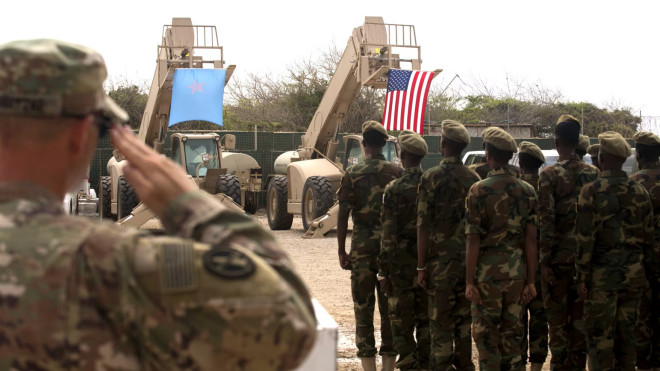

U.S. forces have reportedly withdrawn from the Baledogle military base located in the Lower Shabelle region, which has long served as a critical operational hub for U.S. counter-terrorism operations against the Al-Shabaab group.
According to a report by the newspaper Stars and Stripes, all U.S. troops recently departed from the Baledogle military airfield, situated approximately 96 kilometers northwest of the capital, Mogadishu.
The Baledogle base played a vital role in intelligence operations, support for Somali security forces, and the training of counter-terrorism units fighting Al-Shabaab.
United States Africa Command (AFRICOM) has neither explicitly confirmed nor denied reports of the troop departure from the base. A command spokesperson stated that due to operational security concerns, they could not provide detailed information regarding force movements.
The spokesperson also noted that U.S. forces periodically reposition to other locations better suited for executing counter-terrorism operations.
To date, the exact number of U.S. troops departing Baledogle and their new deployment location have not been disclosed.
Additionally, it remains unclear whether this exit represents a temporary shift or forms part of a broader posture adjustment governing the U.S. military footprint in Somalia.
If officially confirmed, this movement would mark a significant shift in U.S. military presence in Somalia, given Baledogle’s enduring status as a focal point for military assistance and counter-Al-Shabaab operations.
The Baledogle installation stands among the key military facilities underpinning Somalia–U.S. security cooperation.
It has been utilized for training elite Somali forces, supporting security operations, and executing counter-terrorism missions.
The facility was equally central to providing air support and operational enabling capabilities to Somali forces conducting offensives against Al-Shabaab.
In 2019, the base was targeted in a major assault by Al-Shabaab militants. The attack commenced with a vehicle-borne improvised explosive device (VBIED) detonation, followed by an extended firefight between the assailants and joint U.S. and Somali defensive elements.
That engagement highlighted both the strategic security weight of the installation and its prominence as a high-value target for Al-Shabaab.
The reported withdrawal comes despite substantial U.S. infrastructure investments in Baledogle in recent years.
These investments included constructing medical facilities, force cantonment housing, and hardening base perimeter defenses to enhance its capacity as an enduring operational hub for U.S. operations in Somalia.
This development raises strategic questions regarding the rationale behind the posture adjustment, particularly following capital investments designed to reinforce the installation’s operational capacity.
However, it remains unconfirmed whether the troop drawdown reflects a new operational doctrine aimed at restructuring U.S. security assistance mechanisms in Somalia.
The U.S. military footprint in Somalia has undergone multiple operational shifts in recent years.
In late 2020, then-U.S. President Donald Trump ordered the repositioning of nearly 700 American troops out of Somalia, who were actively engaged in advisory and counter-terrorism missions.
In May 2022, President Joe Biden authorized the redeployment of hundreds of U.S. service members back to Somalia to bolster bilateral security cooperation and operational support for Somali national security forces.
U.S. personnel have continually delivered specialized training, tactical advice, intelligence synchronization, and direct air support for counter-Al-Shabaab offensives.
If the departure of U.S. forces from Baledogle is finalized without a direct baseline replacement at another facility, identifying how key support functions previously enabled by the base will be sustained for Somali forces will become critical.
Given that U.S. forces provided essential intelligence collection, specialized unit training, and air combat support, any alteration to their operational posture could impact the execution framework of ongoing security operations.
Conversely, if personnel have merely been redeployed to alternative regional bases, it indicates that the United States has not terminated its overarching strategic security assistance to Somalia.