


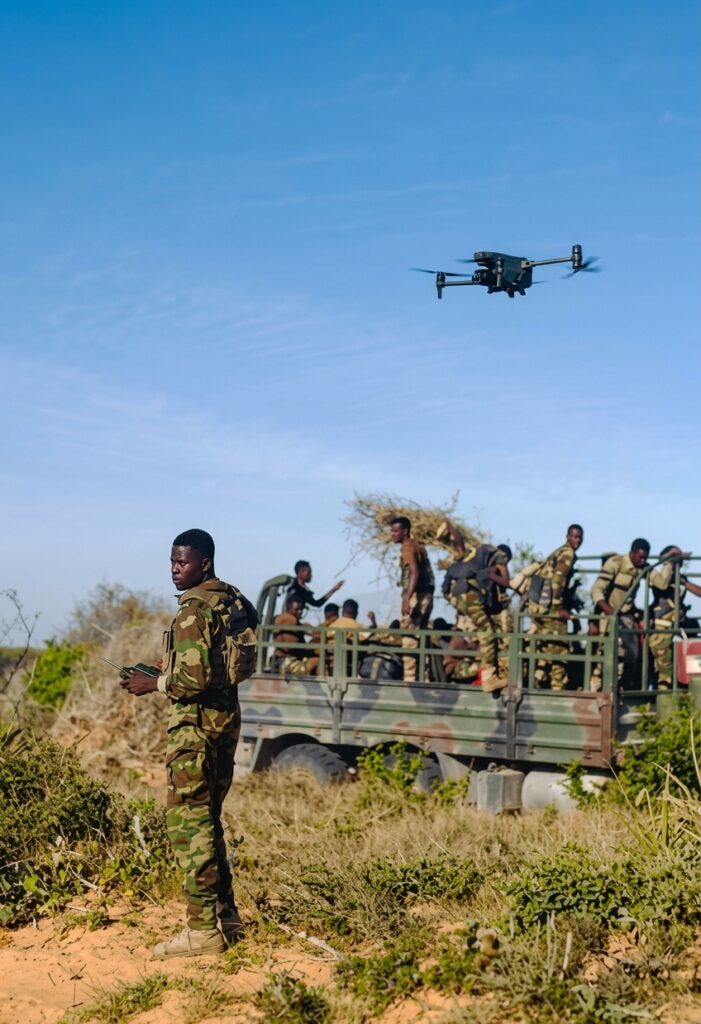


The battle in the Jameeco area generated intense debate after detailed accounts were released regarding the government forces involved, their tactical movement, the ambushes faced, and the reported casualties.
The published data also raised critical questions concerning military intelligence, drone operations, and overall mission execution.
The engagement at Jameeco was described as one of the fiercest battles fought between Somali government forces and Al-Shabaab, with both sides employing ground assaults, unmanned aerial vehicles , and vehicle-borne improvised explosive devices.
Battlefield details indicate that multiple units from the Somali National Army, participated in the operation, comprising Danab, Gorgor, the 12th April Brigade, heavy artillery units, and special forces from Xero-Gordan.
Government forces engaged in the mission comprised various elite contingents of the national army.
Named units included the 165th Danab Battalion, quick-reaction forces from the 161st and 164th Battalions, and the DMU armored platoon attached to Danab.
Also participating were two Gorgor battalions: the 4th Battalion and 2nd Battalion.
Other units listed were the 12th Battalion of the 1st Regiment (12th April Brigade), the heavy artillery battery known as ‘Jugta Culus’, and a special forces battalion from Xero-Gordan.
Reports named operational commanders including Colonel Ahmed Gaashaan, Mohamed Mahad, and an officer identified as Halac.
Operational details state that forces advanced in two parallel tactical columns flanking the road, preceded by route clearance units sweeping for IEDs and armored vehicles traversing cleared routes.
According to this data, the lead element consisted of the 165th Danab Battalion, the 2nd Gorgor Battalion, and the Special Forces unit from Xero-Gordan (identified as the 131st Battalion).
The center element was led by overall convoy commander Colonel Ahmed Gaashaan, accompanied by the 4th Gorgor Battalion and the heavy artillery unit (‘Jugta Culus’) led by an officer named Abdirizak.
The rear guard was commanded by Halac from the 12th April Brigade.
This force posture illustrates a multi-unit operation assigned distinct responsibilities including convoy defense, route reconnaissance, quick reaction, and direct combat.
It was reported that lead elements from Danab, the 2nd Gorgor Battalion, the 131st Special Forces, and overall commander Ahmed Gaashaan were conferring on establishing a defensive bivouac after an extended march.
As commanders evaluated the terrain to set up positions, the column came under a heavy ambush utilizing armed drones.
Reports suggest the initial drone strike attempted to target senior field commanders to disrupt command and control.
A Turkish-manufactured armored vehicle was credited with protecting key officers and personnel during the strike.
Following the initial strike on the lead element, combat expanded across the entire convoy. Intense fighting ensued between government forces and Al-Shabaab, involving armed drones, suicide VBIEDs, and direct ground assaults.
The 4th Gorgor Battalion, heavy artillery units, and Colonel Ahmed Gaashaan counter-attacked to reinforce lead elements withdrawing from compromised positions.
Rear elements under Halac also engaged in heavy combat, with reports indicating Halac was wounded. The engagement spread across multiple sectors of the column.
A heavily discussed aspect of the Jameeco engagement was the role of the Xero-Gordan Special Forces (identified as the 131st Special Forces).
Under the leadership of Mohamed Mahad, this unit engaged in heavy combat for nearly 24 hours while other elements faced sustained attack, before re-engaging at the battle site.
Initial operational reports state the Somali National Army suffered 36 fatalities alongside numerous wounded.
Conversely, reports claim Al-Shabaab lost over 80 fighters, with insurgent forces targeted by heavy bombardment over the two days following the initial battle.
Strikes targeted insurgent staging areas, transport vehicles, and a reported senior Al-Shabaab leadership meeting at a location identified as Akinji.
However, figures regarding enemy casualties, destroyed vehicles, and eliminated commanders remain without independent verification.
The Battle of Jameeco has sparked widespread commentary regarding reported casualties, operational management, and the tactical rationale for deploying heavy government forces into high-risk engagements.
External interference allegations also emerged, accusing two African nations and an Arab state of assisting insurgent dynamics, while alleging South West State President Abdiaziz Hassan Mohamed ‘Laftagareen’ was involved in the political context surrounding the battle.
These heavy allegations require verified evidence and clear distinction between belligerent claims and independent data.
Ultimately, the Battle of Jameeco has reopened debate over government force capacity, politico-military relations, and the execution of major counter-insurgency operations against Al-Shabaab, alongside the role of the Somali public in navigating the national security landscape.