


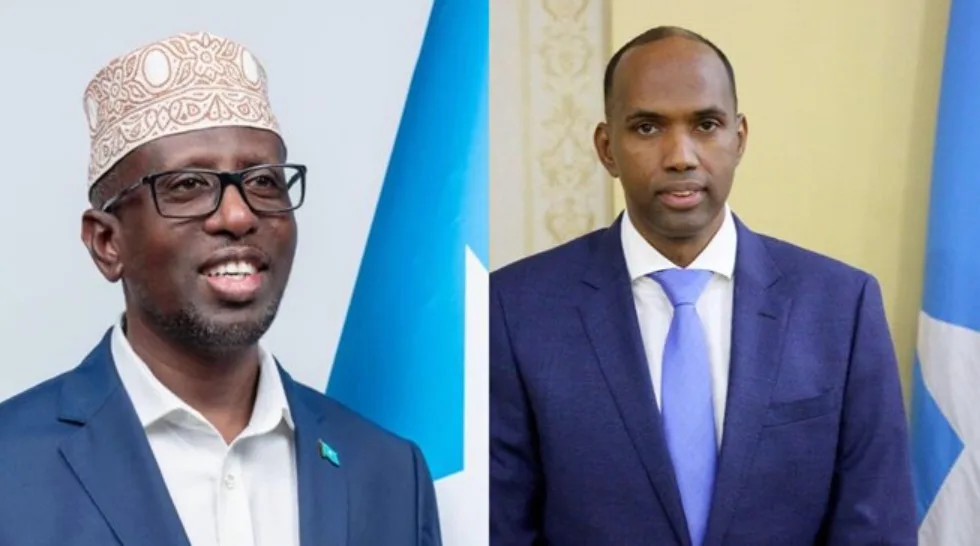


Political tensions in Mogadishu continue to escalate alongside mounting allegations surrounding the friction between the Federal Government of Somalia and opposition leaders—most notably former President Sheikh Sharif Sheikh Ahmed and former Prime Minister Hassan Ali Khaire.
Reports emerging in recent days indicate that Sheikh Sharif expressed deep concern over what he characterized as a government scheme under President Hassan Sheikh Mohamud designed to target opposition leadership.
These allegations coincide with a broader political impasse rooted in electoral disputes, constitutional amendments, and the future governance framework of Somalia.
Speaking on security and political developments on October 7, 2026, Sheikh Sharif accused the administration of utilizing his recent travel to the United Arab Emirates as a pretext to target opposition figures.
He further declared that there is no justification for sanctioning violence against political opponents who are advocating for constitutional compliance and a consensus-based electoral framework.
Reports circulating across social media platforms and select news outlets suggest that the Federal Government is preparing security measures interpreted by some observers as targeting Sheikh Sharif and Hassan Ali Khaire.
Unverified reports highlight growing apprehensions that the political deadlock could escalate into armed confrontation, particularly if all factions maintain rigid postures while avenues for dialogue contract.
Sheikh Sharif Sheikh Ahmed and Hassan Ali Khaire remain central figures within Somalia’s opposition coalition.
Both continue to exert significant influence over national debates regarding electoral architecture and the resolution of the country’s political crises.
Circulated reports indicate that the two politicians held a private consultative meeting to discuss the current security situation and emerging intelligence regarding alleged impending attacks.
If confirmed, this dialogue among opposition figures represents a strategic measure to assess security risks and determine an appropriate response to actions perceived as threats to their personal safety and political operational freedom.
Conversely, maintaining political stability in Somalia requires all factions to avoid actions that could exacerbate mistrust, particularly given unverified reports concerning planned military maneuvers.
Reports further note that security measures have been intensified around the residences of Sheikh Sharif and Hassan Ali Khaire, with heightened screening protocols applied to individuals entering and exiting their compounds.
Mogadishu has previously navigated severe crises where political standoffs escalated into armed maneuvers and urban clashes, as seen during the confrontations in June 2026.
The ongoing rift between the federal administration and opposition factions remains deeply rooted in disputes over electoral frameworks, constitutional revisions, and the mechanisms governing executive power transfers.
Opposition figures continue to raise serious concerns over unilateral government actions regarding electoral laws and constitutional amendments.
In his recent public statements, Sheikh Sharif reaffirmed the imperative of upholding constitutional frameworks and achieving broad political consensus on the structure and execution of the electoral process.
This stance underlines that the political impasse extends beyond immediate security concerns, touching directly upon political trust in the integrity of the electoral process.
Should the parties fail to reach a political consensus, concerns are likely to intensify that the impasse may be resolved through coercion and military force rather than mediated dialogue and constitutional frameworks.
Reports regarding the potential for renewed clashes risk sparking widespread public anxiety regarding civilian security, commercial activity, and municipal transit—particularly if armed troop presence escalates or localized clashes erupt across urban neighborhoods.
Mogadishu remains a densely populated metropolis where everyday livelihoods rely heavily on commerce, transport, public services, and unrestricted urban mobility.
Consequently, any political dispute that degenerates into armed confrontation threatens civilian safety and risks disrupting daily socio-economic activity.