

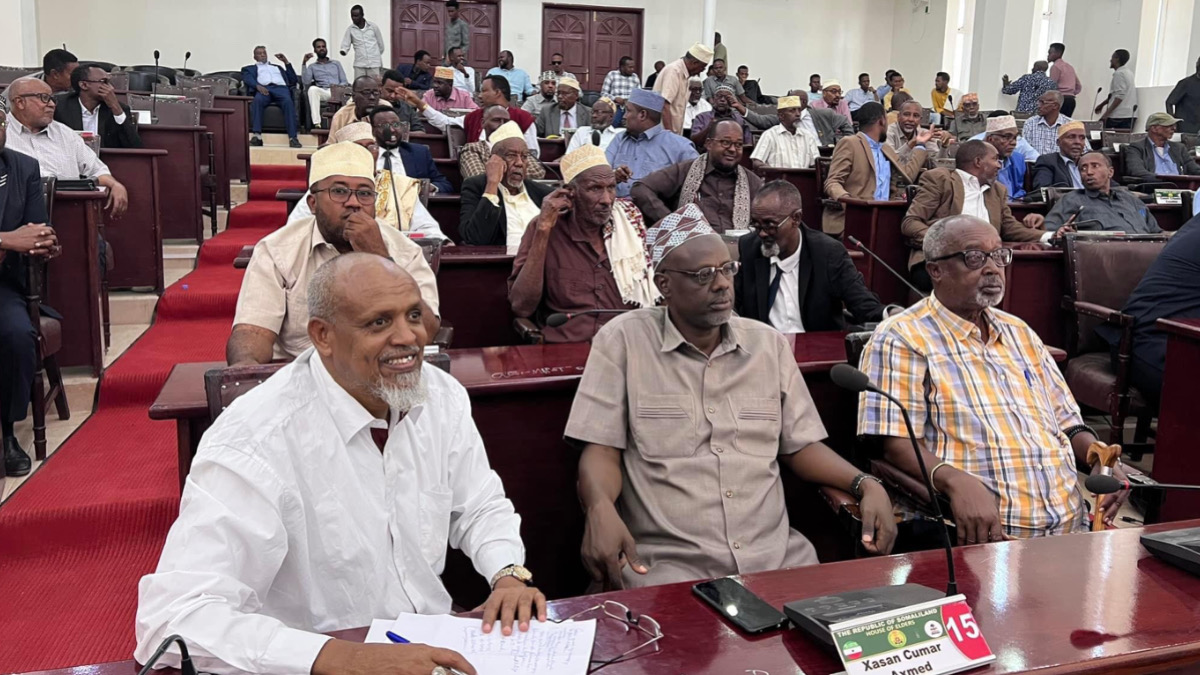

HARGEISA (Kaab TV) – The Somaliland House of Elders on Tuesday, April 28, 2026, approved a 27-month term extension—equivalent to two years and three months—for the Somaliland House of Representatives and local councils, effectively postponing elections that had been scheduled for the end of May 2026.
The decision comes amid growing public debate in recent days over the likelihood of election delays, after the government announced the appointment of a technical committee to advise on the electoral timetable for parliamentary and local council polls.
The Somaliland National Electoral Commission had earlier, in February, stated that it would not be possible to hold the elections on May 31, 2026.
The commission cited security concerns, technical challenges, and the impact of drought as key reasons for the delay, and requested a 10-month extension.
However, the Guurti went beyond the commission’s recommendation, approving a significantly longer extension of 27 months.
The move has reignited debate over the recurring use of term extensions and their implications for Somaliland’s democratic process.
The Guurti, which is composed of 82 traditional elders, is not an elected body but wields considerable influence over political decisions in Somaliland, particularly on electoral matters.
Concerns have already emerged that the decision could also affect Somaliland’s presidential elections, which have previously faced repeated delays.
President Abdirahman Mohamed Abdullahi Irro addressed the issue in his annual speech, acknowledging that election delays can have negative consequences for democracy, political stability, and Somaliland’s international reputation.
He said his administration had worked to ensure elections are held on time, but noted that technical aspects of organizing and implementing elections fall under the responsibility of electoral institutions, particularly the National Electoral Commission.
He added that the commission’s technical recommendations should be taken seriously, as it is the legally mandated body responsible for managing elections.
The latest extension has also revived long-standing debate over the role of the Guurti.
A key question being raised again is whether the body continues to serve as an institution safeguarding stability, tradition, and conflict resolution, or whether it has evolved into one that legitimizes prolonged mandates for elected institutions.
The KAAH Party, an opposition group that has been a close ally of the ruling Waddani Party, has expressed concern over the extensions, describing the move as “detrimental to the national electoral process and not in the best interest of the country.”
“The position of the KAAH Party is that the most appropriate path toward free and fair elections is the implementation of a new and comprehensive voter registration process,” the party said in a statement.
Under Somaliland’s Constitution, the Guurti serves as the upper house of parliament, with responsibilities related to religion, tradition, peacebuilding, and maintaining social stability.
The constitution also provides that its members should be selected through a legally defined process and serve six-year terms.
However, since its establishment, members of the Guurti have not been directly elected by the public—an issue that continues to fuel debate over its legitimacy and its role in Somaliland’s political system.