


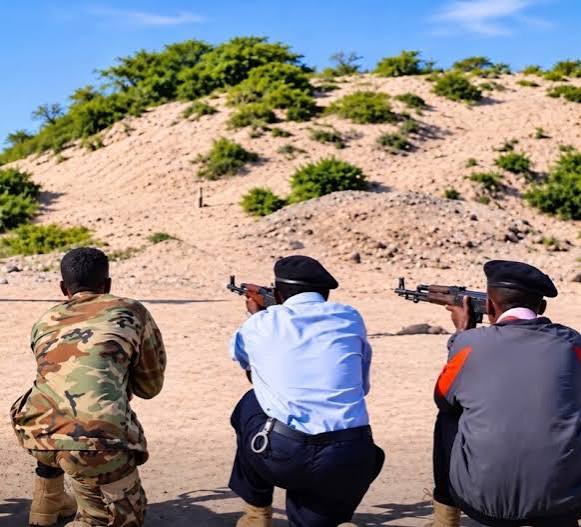


On Wednesday, 11 November 2026, Somaliland authorities announced that they had carried out the executions of nine individuals held at Mandera Prison following their convictions for murder.
Somaliland National Television reported: “The Government of the Republic of Somaliland carried out the execution of nine individuals who had previously been convicted of murder, following the imposition of sentences in accordance with Islamic Sharia law. The Qisas (retributive justice) sentences were carried out as prescribed by Allah, with the aim of upholding justice and protecting human life.”
The executions were reportedly carried out by firing squad in a public area near Mandera Prison, outside Hargeisa. A local resident, who requested anonymity, said he witnessed the execution of the nine prisoners. He later recorded a video showing bloodstained shoes and wooden stakes erected at the site, some of which appeared to bear bullet impacts.
“All nine were shot dead. They died,” the resident said.
Officials in Hargeisa said the executions were conducted in accordance with Islamic Sharia law, stating that all nine individuals had previously been charged with and convicted of murder in separate cases.
The majority of those executed were reportedly members of Somaliland’s police and military forces, while several were young men.
The executions mark the first reported public execution involving such a large number of prisoners convicted of murder since President Abdirahman Mohamed Abdullahi (Irro) took office following his election victory in November 2024.
According to the Somaliland Police’s annual crime statistics, 82 murder cases were recorded in 2025, with 78 suspects successfully arrested.
Local media reported that the nine executions were carried out following presidential authorisation.
However, questions remain over whether all available appeals had been exhausted before the sentences were implemented. Publicly available reports have not provided detailed information about the individual cases or the final stages of their judicial proceedings.
Somaliland’s Death Penalty and Constitutional Framework
The executions have also raised questions about the legal and constitutional basis of capital punishment in Somaliland.
Contrary to some interpretations, Somaliland’s Constitution does explicitly permit the death penalty, although its application is subject to specific legal and judicial safeguards. The government relies on the Somali penal code (1962), including Article 434, which provides for capital punishment in cases of murder.
Article 24(1) of the Somaliland constitution recognises the right to life, describing human life “as a gift from God and beyond price”. However, it expressly provides an exception where a person is convicted by a court of an offence for which the law prescribes the death penalty.
The Constitution therefore recognises the sanctity of human life while allowing capital punishment under legally established circumstances. It also requires the state to respect judicial procedures before depriving anyone of life.
Articles 26 and 27 further establish protections relating to criminal liability, due process and the right of convicted persons to appeal to a higher court.
Most importantly, Article 21 of the Somaliland constitution requires fundamental rights and freedoms to be interpreted in a manner consistent with international human rights conventions and international law recognised by the Constitution.
This raises broader questions about how Somaliland balances its application of Islamic Sharia law, particularly Qisas, with constitutional guarantees, due process and its international human rights obligations.