

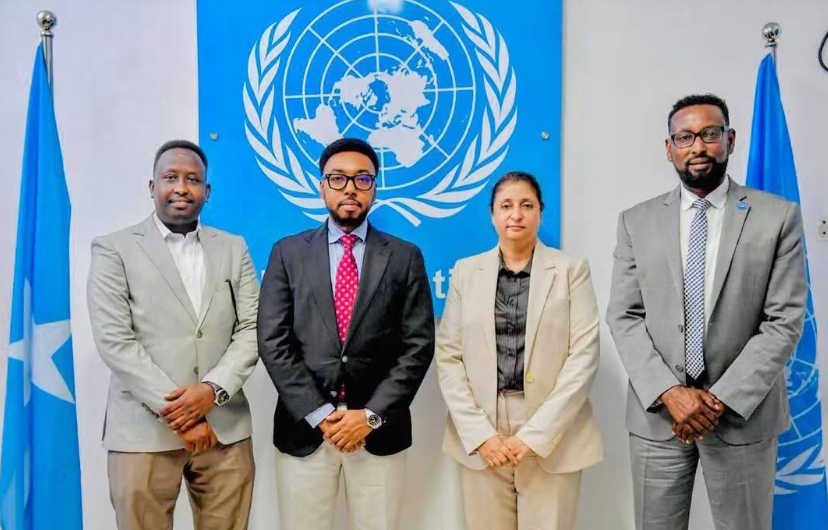

Somalia’s Director General of the Ministry of Transport and Civil Aviation, Omar Afrah, has held high-level talks with Aisa Kirabo Kacyira Sadozai, Acting Assistant Secretary-General of the United Nations and head of the United Nations Support Office in Somalia (UNSOS), focusing on strengthening cooperation in the country’s civil aviation sector and supporting Somalia’s transition toward greater institutional self-reliance.
The meeting brought together officials from the ministry and the United Nations to discuss ways of enhancing coordination on aviation-related matters, including technical assistance, institutional development, airport safety, and long-term capacity building for Somali aviation authorities.
According to officials, the discussions centered on how UNSOS and other international partners can continue supporting Somalia as it works to strengthen its aviation sector and assume greater responsibility for services and functions that have historically depended on international assistance.
A major topic of the meeting was the ongoing transition process in Somalia and the need for careful planning to ensure that national institutions are fully prepared to take over key aviation responsibilities, including technical operations, regulatory oversight, and airport support services.
The two sides also reviewed efforts to improve the safety and security of Somalia’s airports through investments in aviation systems, technical infrastructure, workforce development, and operational capabilities.
Officials emphasized that building a modern and resilient aviation sector is essential for Somalia’s economic growth, connectivity, and integration into regional and global transportation networks.
Speaking during the meeting, Omar Afrah expressed appreciation for the United Nations’ continued support to Somalia’s aviation sector and broader state-building efforts.
He underscored the importance of maintaining and expanding international cooperation during the transition period, particularly in areas requiring specialized technical expertise.
Afrah highlighted the need for additional assistance in strengthening Somali institutions, enhancing aviation safety standards, upgrading airport infrastructure, and developing a sustainable civil aviation system capable of meeting international regulatory requirements.
Somalia has made notable progress in rebuilding its aviation sector over the past decade after years of conflict severely damaged the country’s transport infrastructure and regulatory institutions.
The government has worked closely with international organizations and development partners to improve air navigation services, modernize airport facilities, and strengthen oversight of Somali airspace.
One of the most significant milestones came in recent years when Somalia regained full control of its airspace after decades of international management, a move widely viewed as a major step toward restoring national sovereignty and strengthening state institutions.
Airport security and aviation safety remain among the government’s top priorities as Somalia seeks to expand domestic and international air connections, facilitate trade and investment, and improve access to remote regions of the country.
Officials say a safe and efficient aviation sector is critical to supporting economic development, humanitarian operations, and national security.
UNSOS has played an important role in supporting Somalia’s institutions through technical assistance, logistical support, infrastructure development, and capacity-building programs.
The agency has been a key partner in helping Somali authorities strengthen critical sectors while preparing for a gradual transition toward greater national ownership.
The discussions also come at a time when Somalia is undertaking broader efforts to assume more responsibility for national functions as international support missions evolve and the government seeks to reduce long-term dependence on external assistance.
Officials say the successful transition of aviation responsibilities will require continued investment in infrastructure, advanced technical training, modern equipment, and stronger regulatory institutions capable of meeting international aviation standards set by organizations such as the International Civil Aviation Organization (ICAO).
Both sides reaffirmed their commitment to continued cooperation, emphasizing that a strong, secure, and internationally compliant aviation sector will be essential to Somalia’s long-term development, connectivity, and economic growth.