




The relationship between Somalia and Türkiye has undergone a dramatic transformation since 2011, when Ankara emerged as one of the most prominent international supporters of Somalia during a devastating famine and security crisis.
What began as a humanitarian partnership has gradually evolved into a broad strategic alliance encompassing defense, security, economic cooperation, infrastructure development, and regional geopolitics.
In 2011, then-Turkish Prime Minister Recep Tayyip Erdoğan made a landmark visit to Mogadishu at a time when Somalia was facing one of the worst humanitarian emergencies in its history.
The visit was widely viewed as a turning point in bilateral relations and marked the beginning of Türkiye’s expanded engagement in Somalia.
Following Erdoğan’s visit, Türkiye launched major humanitarian and development projects across Somalia, investing in healthcare, education, infrastructure, and emergency relief.
For many Somalis, Türkiye became associated with assistance, reconstruction, and solidarity during one of the country’s most difficult periods.
Over the years, however, the relationship expanded far beyond humanitarian aid. Türkiye emerged as one of Somalia’s most important international partners, playing an increasingly significant role in economic development, state-building, and security sector reform.
A major milestone came in 2017 with the opening of the TURKSOM military training facility in Mogadishu, one of Türkiye’s largest overseas military bases.
Thousands of Somali soldiers have since received training there, while Ankara has provided equipment, military assistance, and support aimed at rebuilding Somalia’s national armed forces.
The partnership deepened further in 2024 when Somalia and Türkiye signed a series of defense, economic, and maritime security agreements.
The deals granted Türkiye a prominent role in supporting Somalia’s efforts to strengthen its military capabilities, develop its maritime security sector, and protect its coastline.
As a result, Türkiye today occupies a position in Somalia that differs significantly from the role it played fifteen years ago. Ankara is no longer viewed solely as a humanitarian partner but as a major actor in Somalia’s security, defense, economic, and political landscape.
This growing influence has also sparked debate within Somali society.
While many Somalis continue to view Türkiye as a trusted ally that stood by Somalia during a period of crisis, others have raised questions about the extent of Ankara’s involvement in the country’s internal affairs, particularly regarding security and political issues.
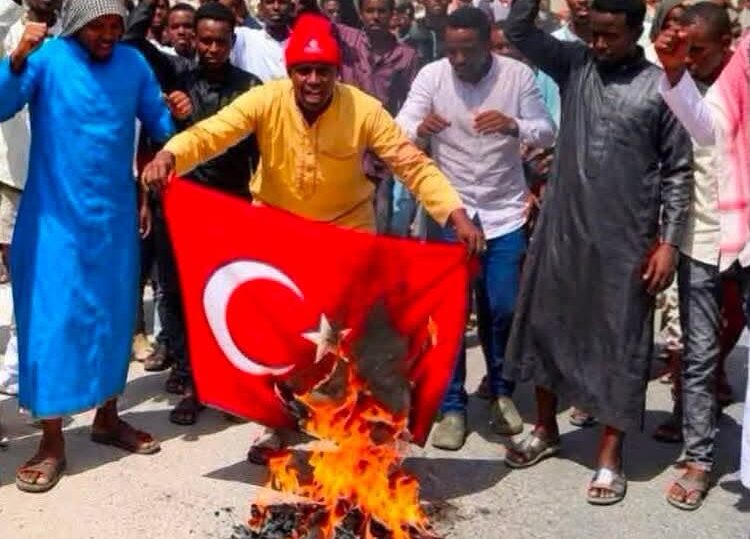
The shift in public sentiment has become increasingly visible in recent years, with some protests and public demonstrations expressing criticism of Türkiye’s expanding role.
Such reactions contrast sharply with the overwhelmingly positive perception that characterized Somali views of Türkiye during the early years of engagement.
Analysts note that this reflects a common dynamic in international relations: government-to-government partnerships do not always align with public opinion, especially when foreign involvement expands into sensitive areas such as security and domestic politics.
At the same time, reports have emerged regarding possible Turkish plans to establish additional facilities in the coastal town of Barawe in Lower Shabelle.
Some security sources suggest the proposed site could include communications infrastructure and support systems linked to unmanned aerial vehicles (UAVs), although such reports remain unconfirmed.
Because Barawe occupies a strategically important position in southern Somalia, any potential military or security-related development there is likely to attract significant attention.
If confirmed, such facilities could influence the broader security balance in southern Somalia, where multiple local, national, and international actors maintain competing interests.
The issue is particularly sensitive given the strategic importance of Jubaland and its capital, Kismayo, which remains a key political, commercial, and security hub in southern Somalia.
Meanwhile, neighboring Kenya continues to maintain close security cooperation with Jubaland.
Kenyan forces remain part of the African Union Support and Stabilization Mission in Somalia (AUSSOM) and have long been involved in operations near the Somalia-Kenya border.
Nairobi views stability in Jubaland as closely linked to its own national security and counterterrorism objectives.
Despite speculation about competing interests in southern Somalia, Türkiye and Kenya maintain generally positive diplomatic relations and cooperate on various regional and international issues, including security and defense matters.
Southern Somalia has increasingly become a focal point where domestic political dynamics intersect with regional and international strategic interests.
The Federal Government seeks to strengthen central authority and national security institutions, while international partners, including Türkiye, the United States, and others, remain heavily invested in counterterrorism efforts and state-building initiatives.
Looking back at the period between 2011 and 2026, Somalia–Türkiye relations can be broadly divided into four major phases:
2011: Türkiye emerged as a leading humanitarian partner during Somalia’s famine and humanitarian crisis.
2017: Military cooperation became a central pillar of the relationship with the opening of the TURKSOM training facility.
2024: Defense, economic, and maritime agreements elevated the partnership to a strategic level.
2026: Türkiye has become one of the most influential foreign partners in Somalia across security, defense, economic, and political sectors.
The evolution of the relationship has generated both support and concern within Somalia.
While many continue to see Türkiye as a reliable ally that contributed significantly to Somalia’s recovery and development, others worry that Ankara’s growing influence could affect domestic political dynamics and relations between the Federal Government and regional administrations.
Fifteen years after Erdoğan’s historic visit to Mogadishu, the Somalia–Türkiye partnership stands as one of the most significant bilateral relationships in the Horn of Africa—one that continues to shape Somalia’s security, development, and geopolitical future.