

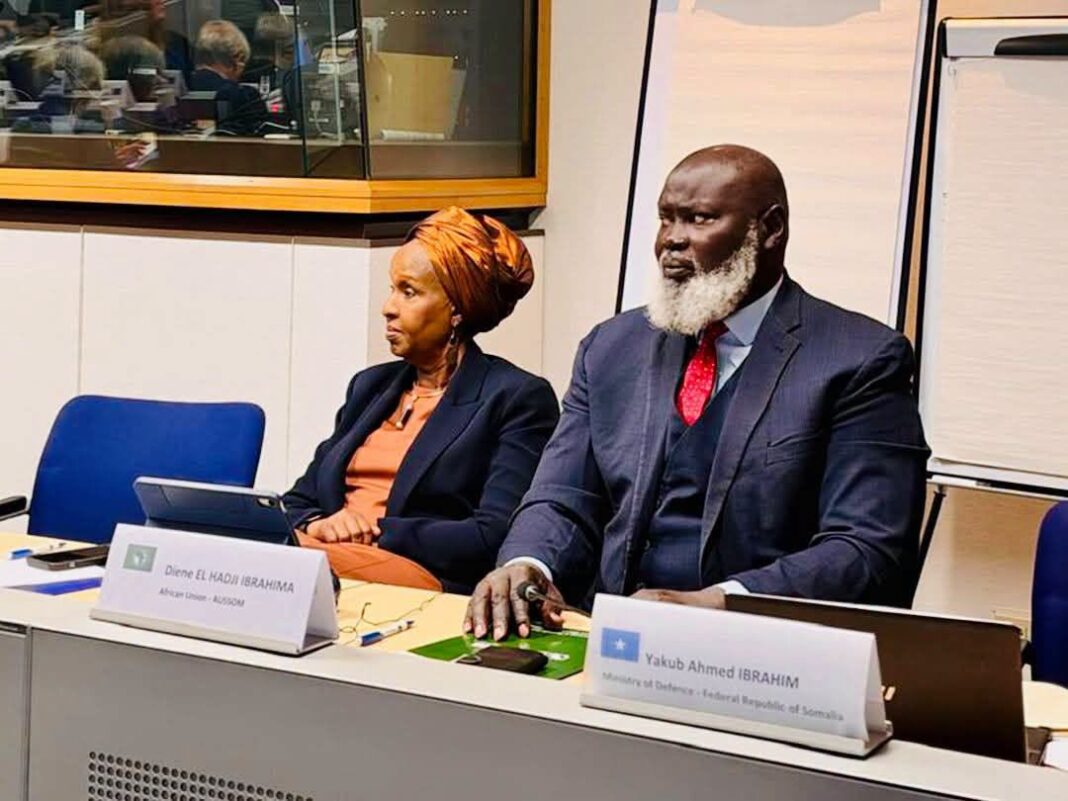

The Federal Government of Somalia held a high-level meeting in Brussels, Belgium, with the European Union and international partners to discuss the future of Somalia’s security, the security responsibility transition plan, and the African Union Support and Stabilization Mission in Somalia (AUSSOM).
The meeting, which took place on November 19, 2026, focused on how Somalia would gradually assume full responsibility for the country’s security, taking into account the prevailing security situation and the need for international support during the transition phase.
The conference was also crucial in preparing for the mandate renewal of the AUSSOM mission, which the United Nations Security Council is expected to deliberate on in December 2026.
Somalia’s delegation included Minister of Defense Ahmed Moallim Fiqi and Director of the Office of the President Abdirahman Mohamed Yusuf [Note: text reads Cabdulxakiin Maxamed Yuusuf / Abdulhakim Mohamed Yusuf], while the European Union side was led by senior officials from the European External Action Service (EEAS).
Also participating were representatives from the United Nations, the African Union, AUSSOM Troop-Contributing Countries (TCCs), EU member states, the United States, Britain, Turkey, Egypt, Saudi Arabia, Qatar, Kuwait, and other countries supporting Somalia.
One of the primary agenda items discussed at the meeting was the Somali government’s plan for assuming national security responsibility.
The Federal Government shared its vision with international partners on how to approach the security transition, aiming for Somali security forces and institutions to possess full capability to safeguard the country’s security.
This issue is vital for Somalia’s future, given that for over two decades, African Union troops and international partners have played a major role in supporting government forces and the fight against Al-Shabaab.
However, assuming security responsibility is not merely a matter of foreign troops withdrawing from the country; rather, it requires a Somali military that is trained, equipped, receives regular salaries, and possesses the capacity to secure urban centers and areas liberated from armed groups.
Another key topic was the future of the AUSSOM mission, as the UN Security Council will deliberate on renewing the mission’s mandate in December 2026.
AUSSOM plays a critical role in supporting Somali government forces, particularly in the fight against Al-Shabaab and securing key strategic locations.
The Brussels discussions came amid questions surrounding the mission’s duration, its financing, and the management of the African Union troop drawdown.
Consequently, the Security Council’s decision in December will significantly impact the direction of the mission and the support provided to Somali forces.
The meeting also analyzed how to harmonize and align the support provided to Somalia by various countries and international organizations.
Particular emphasis was placed on aligning support in training, equipping, logistics, and security institution-building under a unified framework, in order to avoid fragmented or uncoordinated efforts.
Somalia still requires multifaceted assistance, particularly in funding troop stipends, operational logistics, military hardware, and the development of security institutions.
Participants agreed to continue political and technical consultations to reach a consensus on the optimal approach to Somalia’s future security architecture.
These consultations are expected to continue in the lead-up to the UN Security Council’s decision.
For its part, the European Union reaffirmed its commitment to continuing support for Somalia, particularly for a Somali-owned and Somali-led security transition plan.
Another point highlighted at the meeting was the importance of an inclusive political agreement, which can serve as the foundation for a sustainable security framework.
International partners noted that lasting security cannot be built solely on military strength, but also requires political consensus, cooperation, and trust among the country’s various stakeholders.
This point is particularly critical for Somalia, as political disputes and differences among state institutions can adversely affect security plans and coordination across federal institutions.
Although the Brussels meeting demonstrated international backing for Somalia’s plan, major challenges remain that must be addressed.
These include the capacity of Somali forces, sustaining salaries and logistics, securing adequate funding, countering Al-Shabaab, and coordinating security institutions at both the federal and Federal Member State levels.
Furthermore, it is essential that the security transition is executed systematically so as not to create a security vacuum in the country, particularly in areas where AUSSOM forces maintain key bases.
The Brussels conference served as a platform for the Somali government to present its security roadmap, giving international partners an opportunity to discuss required support and how to navigate the upcoming phase.
However, the meeting did not constitute a final decision to terminate the AUSSOM mission or confirm the withdrawal of African Union troops. Major decisions regarding the mission’s mandate and United Nations support will depend on ongoing consultations and the Security Council’s resolution in December.
Ultimately, the future of Somalia’s security will depend on the government’s ability to build self-sufficient national forces, secure consistent financial backing, and achieve a political settlement that enables state institutions to work together toward security and stability.