

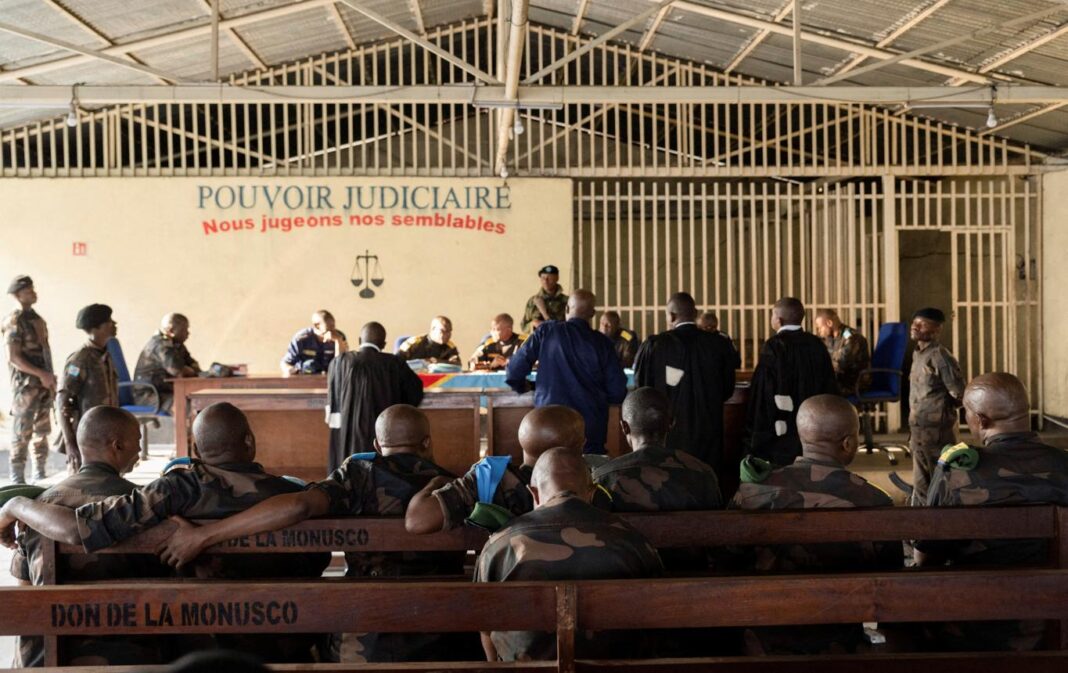

A decision by a military court in the Democratic Republic of the Congo sentencing 66 soldiers to death by firing squad, after finding them guilty of crimes related to desertion from the battlefront, insubordination, and mutiny, has reignited the debate on how governments hold military personnel accountable when they fail in their wartime duties.
This ruling comes at a time when Somalia is also facing tough questions regarding military discipline, officers abandoning combat zones, soldiers leaving the ranks of the armed forces, and the responsibility of military leadership when operational failures and heavy casualties occur.
The debate is particularly significant for Somalia, which has long been engaged in a war against Al-Shabaab and has been striving to build a national army governed by a system of command, accountability, and unified leadership.
As reported by international media outlets DW and Africanews on November 10, 2026, charges were brought against more than 70 soldiers belonging to the Congolese armed forces.
Reports indicate that 66 were sentenced to death, four were acquitted, and one soldier was sentenced to 10 years in imprisonment.
These soldiers were reportedly detained in the Walikale area of North Kivu province, following incidents related to battles that occurred on October 20, 2026.
The accusations leveled against them included abandoning assigned defensive positions and fleeing battles against rebels operating in the eastern part of the country.
Congolese military officials stated that such legal proceedings are part of ongoing efforts to restore discipline and order within the armed forces.
It is worth noting that a military court in the Congo recently sentenced another 27 soldiers to death on charges of abandoning the frontlines.
However, the announced death sentences do not necessarily mean those soldiers have been executed; they are judicial verdicts, and it remains important to monitor the appeals process and whether the sentences will ultimately be carried out.
How Does Somalia’s Situation Differ from the Congo?
In recent times, Somalia has faced incidents involving soldiers leaving their combat positions, returning to their local communities, or departing the government’s ranks due to political, security, and internal disputes.
One of the most recent incidents involved soldiers from the Hawadle clan returning to the city of Beledweyne, following an appeal issued by Ugaas Yuusuf Ugaas Xasan Ugaas Khaliif.
A report published by Somali Guardian on November 10 stated that soldiers belonging to the Somali National Army left their assigned positions in response to the Ugaas’s call to assemble in Beledweyne.
That report also highlighted concerns that soldiers leaving frontlines across various regions could impact ongoing military operations against Al-Shabaab.
However, the exact number of departed soldiers, their precise locations of origin, and the status of all abandoned defensive positions have not been independently verified. Consequently, this information should be treated as a report requiring further verification.
Deserters and Departing Officers: Who Should Be Held Accountable?
The central question prevailing in Somalia is why soldiers or officers occasionally abandon assigned posts without the public being presented with clear outcomes regarding investigations and the subsequent measures taken.
There are distinct scenarios that must not be conflated.
A soldier who deserts the frontlines without official leave faces military prosecution, subject to applicable laws and the circumstances surrounding the departure. An officer who fails to execute a lawful order likewise bears individual responsibility.
Conversely, if military units depart a combat zone due to ammunition shortages, logistical failures, injuries, contradictory orders, or a flawed operational plan, conducting a thorough investigation into those circumstances is essential before placing all responsibility solely on frontline troops.
Furthermore, accountability extends to the officers responsible for planning operations, those issuing commands, and the senior military leadership.
Therefore, accountability must encompass all echelons of the command structure rather than being restricted solely to lower-ranking enlisted personnel.
Has Somalia Previously Taken Action Against Frontline Deserters?
Somalia is not a nation devoid of measures against military personnel accused of dereliction of duty.
In October 2024, Garowe Online reported that four soldiers and a police commander were formally charged with abandoning their duties amid active operations against Al-Shabaab. The case was referred to a military court.
That report demonstrated that Somali jurisprudence contains mechanisms for pursuing legal action against soldiers and officers accused of breaching military duties.
Similarly, an assessment conducted by the European Union Agency for Asylum (EUAA) concerning conditions in Somalia noted that desertion represents a persistent challenge facing the Somali National Army, alongside disparities in how ordinary soldiers and officers are held accountable.
Nevertheless, the pressing issue at present is presenting the public with clear, transparent data regarding investigated cases, trials referred to the judiciary, and disciplinary actions taken against officers and soldiers found guilty.
The Jameeco Battle and Questions Raised Regarding Military Leadership
The debate concerning accountability within Somalia’s armed forces intensified following the battle of Jameeco in Bay region, which occurred on October 26, 2026.
That engagement resulted in heavy casualties among government forces, with reports cited by Reuters and the Associated Press from military sources indicating that numerous soldiers perished in the assault.
The Somali Ministry of Defense stated that government forces neutralized approximately 75 Al-Shabaab militants and wounded 56 others. The Ministry also confirmed that explosive devices targeted a military convoy, though it did not disclose government troop casualty figures.
Casualty figures claimed by Al-Shabaab regarding fallen soldiers have not been independently verified.
Following that incident, former President Sharif Sheikh Ahmed and former Prime Minister Hassan Ali Khaire called for accountability and formal investigations into military planning and operational command.
Questions raised included who planned the operation, what intelligence data was utilized, the state of troop preparedness, and the ultimate responsibility of the commanding officers.
What Is Expected of the Somali Government?
It is vital for the Federal Government of Somalia to establish a clear framework for investigating soldiers and officers who abandon combat zones, while applying the rule of law impartially.
If a soldier intentionally deserts the frontlines without legal justification, accountability must be enforced. If an officer issues flawed orders or fails to adequately lead troops, an investigation must likewise be initiated.
Additionally, a distinction must be drawn between soldiers departing frontlines due to political disputes, those fleeing active combat, personnel forced to retreat due to injuries or lack of supplies, and those granted lawful leave.
The government must clarify the following to the public:
The number of soldiers and officers accused of abandoning frontlines.
Personnel dismissed from service or facing formal legal charges.
Individuals convicted by military tribunals.
Officers currently under investigation for failed operational planning.
Measures implemented to protect the rights of soldiers and military families.
Furthermore, troops must be provided with regular salaries, adequate equipment, medical care, logistical supplies, and sufficient welfare support. Military discipline is not achieved through punitive measures alone; it relies on effective leadership, rigorous training, troop welfare, and the confidence soldiers repose in their command structure.
Should Somalia Adopt the Congolese Model?
The DRC case illustrates how a government can utilize military tribunals to address crimes committed within armed forces during wartime. However, capital punishment does not represent the sole metric for building a disciplined military.
Somalia requires a just legal framework, independent investigations, and accountability that extends beyond junior enlisted personnel.
The Somali National Army is actively waging war against an insurgent organization still capable of launching severe attacks across various regions of the country. Consequently, military discipline and public trust directly impact national security.
If soldiers depart frontlines without investigating the underlying causes, military cohesion risks erosion. Conversely, if officers accused of grave operational failures evade accountability, both military morale and public trust will suffer.