

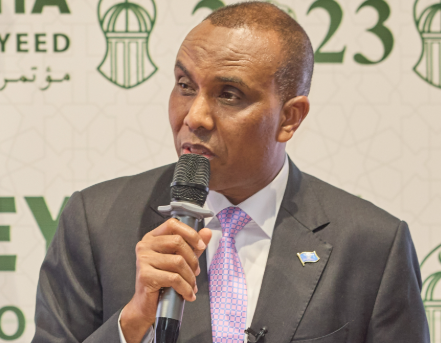

Somali Prime Minister Hamza Abdi Barre has announced a sweeping overhaul of the country’s Islamic education system, introducing mandatory standards for Quranic schools and teachers as part of a nationwide reform aimed at integrating religious education into Somalia’s formal education framework.
Speaking during the graduation ceremony of the first master’s cohort in Da’wah and Judiciary at the Higher Institute for Da’wah Affairs and Islamic Studies of Somali National University, Barre said the reforms are intended to improve the quality, oversight, and credibility of Islamic education while strengthening national education standards.
Under the new policy, Quranic schools (Dugsi Qur’aan) will be formally recognized as part of Somalia’s national education system and placed under the supervision of the Ministry of Education, ending the previous arrangement under which they were overseen by the Ministry of Endowments and Islamic Affairs.


The schools will be required to adopt a unified national curriculum, obtain official accreditation, issue recognized certificates, and operate under regular government inspection.
As part of the reforms, Prime Minister Barre announced that all Quranic school teachers will be required to undergo standardized professional training and obtain government-recognized certification in order to continue teaching.
The requirement forms part of a nationwide registration and reform campaign covering all Quranic schools, Islamic institutes, and educational institutions, which the federal government says is designed to improve teaching standards, strengthen accountability, and ensure consistent educational quality across the country.
The government also plans to establish a Supreme Council of Somali Scholars, a national body that will be responsible for issuing unified Islamic rulings (fatwas), replacing the fragmented system in which individual clerics issue separate religious opinions.
Legislation establishing the council has already been approved by the Council of Ministers and is awaiting parliamentary approval.
In addition, Barre announced the introduction of a digital registration system that will record Quranic schools, Islamic institutes, and universities nationwide.
The system will verify students’ academic records and certificates, improve transparency, and modernize the administration of Somalia’s education sector.
The Prime Minister also urged Somali universities to produce graduates with expertise in fields critical to the country’s future development, including maritime law, petroleum and natural resource disputes, financial crime investigations, auditing, and Islamic jurisprudence, saying Somalia requires specialists capable of addressing emerging legal, economic, and governance challenges.
The reforms represent one of the most significant restructurings of Somalia’s Islamic education system in recent decades.
Officials say the initiative is intended to strengthen institutional oversight, standardize religious education, improve teacher qualifications, and align Quranic education with the country’s broader education system as part of wider state-building and education modernization efforts.