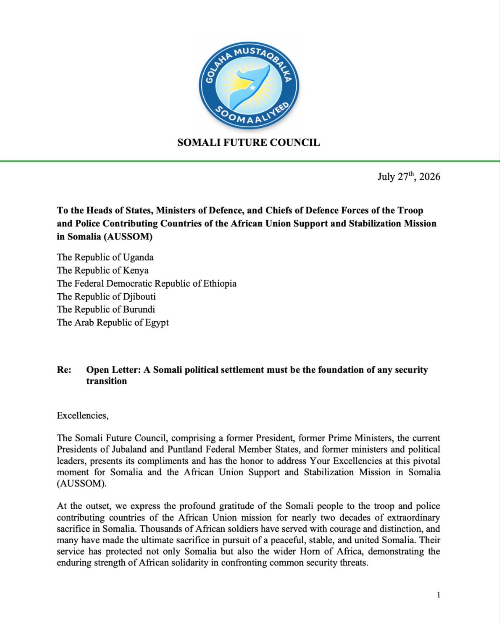

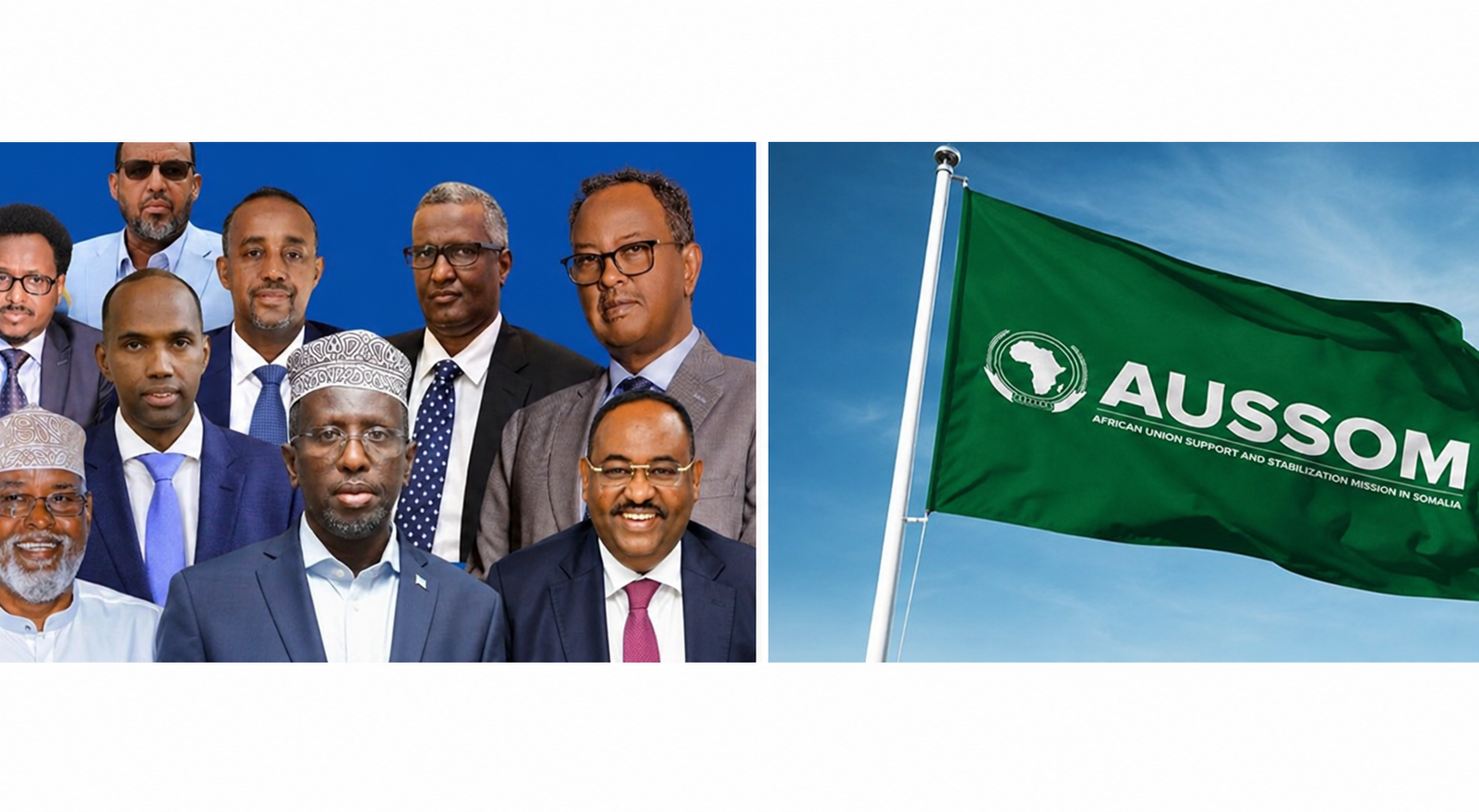

Somalia’s opposition coalition, the Somali Future Council, has formally called on African Union troop-contributing countries and key international partners to ensure that Somalia’s political crisis is placed at the center of discussions during the upcoming African Union Support and Stabilization Mission in Somalia (AUSSOM) summit scheduled for July 31 in Kampala, Uganda.
In an open letter dated July 27, 2026, the Council addressed the Heads of State, Ministers of Defence, and Chiefs of Defence Forces of the countries contributing troops and police to AUSSOM—including Uganda, Kenya, Ethiopia, Djibouti, Burundi, and Egypt.
Copies of the letter were also sent to the Chairperson of the African Union Commission, the African Union Peace and Security Council, IGAD, the United Nations, the United States Mission to Somalia, the United Kingdom Mission, the European Union Delegation, Türkiye’s Mission to Somalia, and the UN Transition Mission in Somalia (UNTMIS).
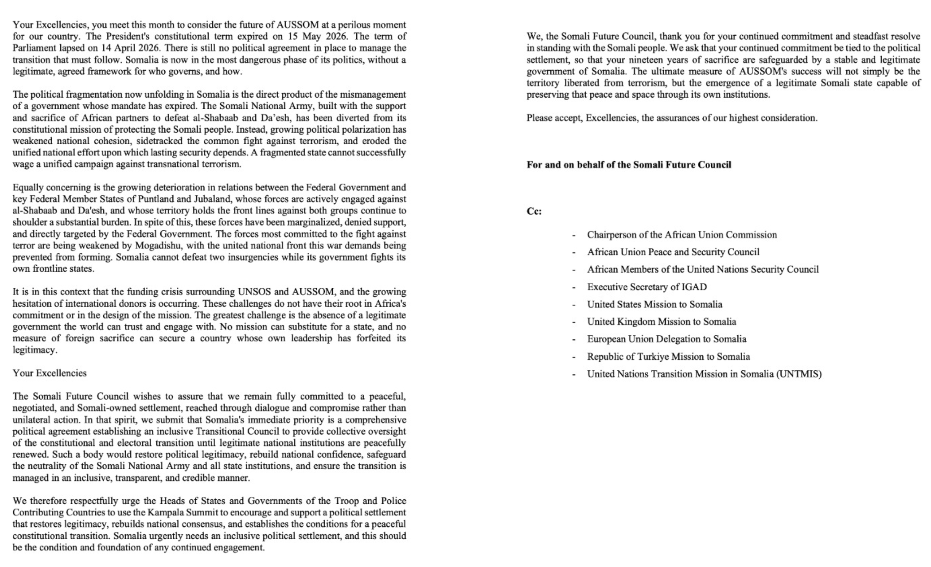
The opposition argued that Somalia’s worsening security situation and the financial uncertainty surrounding AUSSOM cannot be separated from what it described as the country’s unresolved political crisis.
According to the Council, the absence of an agreed electoral framework and the lack of a broad political consensus have undermined national institutions, weakened cooperation among security actors, and complicated efforts to combat al-Shabaab and ISIS.
The letter states that President Hassan Sheikh Mohamud’s constitutional term expired on May 15, 2026, arguing that Somalia currently lacks an agreed constitutional framework governing who should lead the country and how a political transition should be managed.
The Council warned that the resulting political fragmentation has weakened the legitimacy of state institutions, reduced public confidence, and disrupted the unified national front required to confront extremist groups.
According to the Somali Future Council, the political divisions have also strained relations between the Federal Government and several Federal Member States, particularly Puntland and Jubaland, whose security forces continue to fight al-Shabaab while, according to the opposition, facing political marginalization from Mogadishu.
The letter argues that Somalia cannot effectively fight multiple internal political disputes while simultaneously confronting terrorist organizations.
The opposition further linked Somalia’s political instability to the growing funding crisis facing AUSSOM. It warned that uncertainty surrounding donor financing reflects broader concerns among international partners about the country’s political direction.
The Council argued that no international peace support mission can substitute for a legitimate political settlement, stressing that foreign military assistance alone cannot secure a country whose political institutions remain deeply contested.
The funding crisis has become one of the most pressing challenges facing AUSSOM since the mission replaced ATMIS.
International partners have struggled to secure sustainable financing for troop allowances, logistics, and operational costs, raising concerns that the mission’s effectiveness could decline at a time when al-Shabaab has intensified attacks and regained territory in several regions..
Analysts have repeatedly warned that prolonged funding shortages could affect operational readiness and slow stabilization efforts across Somalia.
In its letter, the Somali Future Council proposed what it described as an immediate political roadmap to restore national legitimacy.
The opposition called for the establishment of an inclusive Transitional National Council that would oversee the creation of legitimate national institutions through dialogue and consensus.
It said such a mechanism should rebuild public confidence, safeguard the neutrality of the Somali National Army and other state institutions, and ensure that any political transition is conducted transparently and credibly.
The Council also urged leaders attending the Kampala summit to make continued international engagement conditional upon meaningful political progress.
It argued that support for AUSSOM should be tied to a comprehensive political settlement capable of restoring constitutional legitimacy, rebuilding national consensus, and creating the conditions for a peaceful and inclusive transition.
The appeal comes amid one of Somalia’s deepest political crises in recent years. The Federal Government’s push toward a one-person, one-vote electoral model has been rejected by several opposition groups and some Federal Member States, which argue that the process lacks broad national consensus.
The political dispute has widened divisions between Mogadishu and regional administrations while raising concerns among international partners about the country’s stability.
The Kampala summit is expected to focus primarily on AUSSOM’s future mandate and financing.
However, the Somali Future Council has urged participating governments to treat Somalia’s political deadlock as the root cause of both the country’s security challenges and the mission’s funding difficulties, arguing that lasting stability will only be achieved through an inclusive political agreement supported by all major Somali stakeholders.