

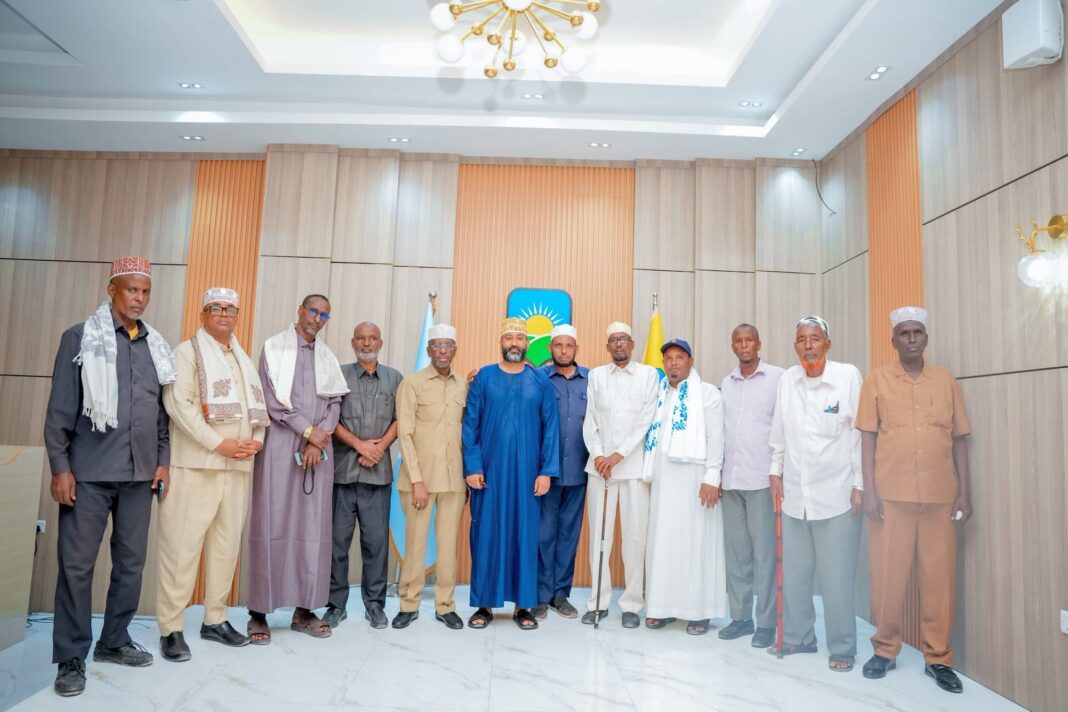

Former President of Somalia, Sheikh Sharif Sheikh Ahmed, hosted several traditional elders from the Xawaadle clan at his residence, where they discussed the status of peace, stability, conflict resolution, and the country’s political affairs.
This meeting comes amid an ongoing political dispute regarding Somalia’s electoral model, with Sheikh Sharif being among the prominent politicians opposed to the electoral plan of President Hassan Sheikh Mohamud’s administration.
Providing details about the meeting, Sheikh Sharif stated that the discussions focused on finding lasting solutions to conflicts occurring in areas inhabited by neighboring local communities, while strengthening peace building efforts and community cooperation.
He also noted that the meeting touched upon the importance of traditional elders in resolving disputes, preserving community cohesion, and their role in local governance political affairs.
The former president emphasized that community consultation and cooperation are the foundational pillars for building sustainable peace and stability that benefit all local residents.
The meeting between Sheikh Sharif and the Xawaadle traditional elders coincides with active disputes surrounding national elections and the Hirshabelle administration, particularly political grievances regarding the representation of the Hiiraan region and administrative power-sharing.
Some politicians and intellectuals from the Xawaadle clan previously expressed grievances concerning the management of Hirshabelle elections and Hiiraan region’s role within the administrative leadership.
These disputes have recently been evident among federal-level politicians and those within the Hirshabelle administration, with the parties holding diverging views on how to approach elections and resolve existing political complaints.
Sheikh Sharif has spoken out explicitly in recent weeks regarding Somalia’s electoral dispute, calling for an electoral framework reached through consensus political agreement.
The former president also criticized the electoral timeline announced by the disputed National Independent Electoral and Boundaries Commission, arguing that the framework requires an inclusive political agreement.
On October 17, 2026, Sheikh Sharif filed a lawsuit with the Supreme Court, requesting a review of the constitutional amendments and election-related decisions.
He called for resolving the dispute through dialogue and national consensus.
On the other hand, the Federal Government of Somalia and supporters of its electoral plan argue that the voting process should proceed according to established laws and the institutions tasked with managing elections.
The existing dispute continues to require political consultations among the government, the opposition, and Federal Member States.
Traditional elders play a vital role in resolving community conflicts, driving reconciliation, and bringing together factions holding opposing views.
In Hirshabelle areas, traditional elders are also part of consultations concerning political representation and governance issues.
Sheikh Sharif stated that his meeting with the Xawaadle elders is part of efforts to strengthen peace, cohesion, and community cooperation.
However, his public statement did not explicitly mention whether the meeting discussed a specific plan opposing Hassan Sheikh Mohamud’s election.
Furthermore, no official resolutions from the meeting or specific political actions agreed upon by the parties were announced.
The meeting illustrates the importance of political consultations and the role of traditional elders in resolving local disputes across the country’s regions.
Nevertheless, it remains uncertain whether this meeting will lead to a political consensus or shifts in the stances of parties holding opposing views on elections.
Somalia’s political situation continues to require dialogue, given differing perspectives on the electoral model, constitutional amendments, and the Federal Government’s relations with the opposition and Federal Member States.
The meeting between Sheikh Sharif and the Xawaadle traditional elders thus occurs at a time of ongoing political efforts seeking solutions to the country’s disputes, as next steps from political stakeholders are awaited.