

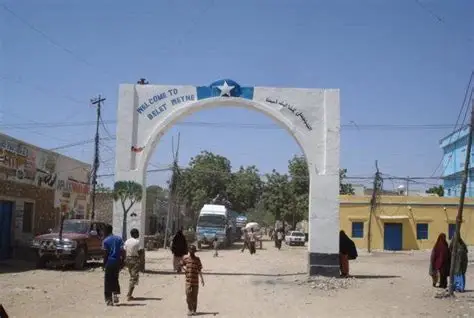

Beledweyne, the capital of the Hiiraan region and a city of significant commercial and social importance, has long struggled with challenges related to security, political disputes, flooding, and the need for advanced public services and infrastructure.
What is preventing the city from achieving tangible progress, and who is responsible for the current state of affairs? Conflicts between administrations, disputes over political representation, insecurity, and the problems arising from floods are all part of the obstacles hindering the city’s stability and development.
One of the major issues impacting the politics of Beledweyne is the ongoing conflict between Hiiraan region politicians and the Hirshabelle administration, particularly the dispute over regional representation and who participates in key political decision-making.
Since the establishment of Hirshabelle in 2016, there have been political grievances regarding how power and official positions are distributed between the two regions of Hiiraan and Middle Shabelle.
Some Hiiraan politicians and elders contend that the region has not received satisfactory representation, while other factions support resolving administrative matters through existing institutions and procedures.
When this type of conflict persists, it becomes difficult for various leaders to maintain a unified plan regarding road construction, public service improvements, revenue management, and the execution of development projects.
The issue is not merely who holds office, but also how government institutions function, how decisions are made, and whether the local community is satisfied with the governance framework.
Community division and its impact on the city: Beledweyne is home to diverse communities with social, economic, and political interests.
Diversity itself is not an obstacle to progress, but it can turn into a problem when political disputes are grounded in clan competition, mistrust, or disagreements over who represents the city and region.
When community groups and politicians hold opposing views on governance, necessary cooperation can diminish, and public interest projects become contingent on political agreements that have yet to be reached.
However, it is inappropriate to blame the city’s underdevelopment on a specific clan without evidence demonstrating the responsibility of various parties.
It is essential to distinguish between the political conflicts of leaders, community grievances, and the role of government institutions.
Ununified administration and public services: A city’s development requires an administration with a clear plan, an agreed-upon budget, and consistently functioning institutions.
It is also essential to have accountability regarding revenue collection and how it is utilized for public services.
When power struggles exist within the administration, identifying an authority to take full responsibility for planning and executing projects becomes difficult.
Beledweyne requires a development plan that addresses basic needs such as roads, drainage systems, health centers, education, sanitation, and commercial markets.
It is also important to know the budget allocated to the city, completed projects, stalled initiatives, and the underlying reasons for delays.
Such data would enable a genuine assessment of the responsibility of the administration and other stakeholders.
Insecurity and commercial challenges: Security is a vital pillar for economic development. Businesspeople, transporters, and daily wage earners require an environment where they can operate without fear of robbery, illegal checkpoints, or violence.
When business owners encounter insecurity and uncertainty, willingness to make new investments diminishes, while transportation and commodity costs increase.
This places a burden on families and small businesses.
Therefore, resolving political disputes must go hand in hand with securing safety, controlling illegal arms, and ensuring security institutions operate in accordance with the law.
Flooding and lack of urban planning: Beledweyne’s problems are not limited to political disputes. Recurrent flooding from the Shabelle River inflicts severe damage on homes, businesses, agriculture, and local livelihoods.
An assessment released by the Somali Ministry of Planning in 2020 indicated that the city’s floods are exacerbated by factors including lack of riverbank maintenance, inadequate drainage, poor urban planning, and a lack of emergency preparedness.
These factors demonstrate that Beledweyne’s development requires more than a political agreement.
Investments are needed in river defenses, drainage systems, roads, and land-use planning to mitigate flood losses.
Unless such projects are implemented consistently, every flood risks wiping out previous progress and pushing many families back into economic hardship.
Who is responsible for Beledweyne’s underdevelopment? Answering this question requires examining the responsibilities of various stakeholders rather than assigning all blame to a single individual or clan:
• Hirshabelle Administration: Required to clarify its development plan, respond to Hiiraan’s grievances, and ensure government services reach the population equitably.
• Federal Government of Somalia: Has a role in facilitating political dialogue, supporting security institutions, and encouraging a lasting consensus involving relevant stakeholders.
• Politicians and Community Leaders: Expected to resolve disputes through dialogue and avoid actions that further divide the community or disrupt public services.
• District Administration and Service Agencies: Required to provide planning, transparency regarding revenues and expenditures, and prioritization of daily citizen needs.
• Business Community and Civil Society: Can contribute by supporting public interest projects, preserving community cohesion, and monitoring the fulfillment of development promises.
Disaggregating these responsibilities is essential to understanding where the problem lies without making unsubstantiated accusations.
What can serve as a solution? The primary solution is a political consensus that addresses representation and power-sharing grievances between Hiiraan and Middle Shabelle.
That agreement must be built on inclusive dialogue rather than a narrow arrangement reached by a few politicians.
Next is establishing a city-specific development plan with clear priorities, an understandable budget, and a timetable to evaluate progress.
Local residents should be able to know planned projects, associated costs, and implementation entities.
Furthermore, it is critical to establish a unified, law-abiding security framework while actively combating illegal arms and unauthorized checkpoints.
Finally, traditional elders, women, youth, business owners, and civil society organizations must be integrated into reconciliation efforts.
Sustainable development cannot materialize if segments of society feel excluded from decisions affecting their lives.